Pacific Islands Monthly
pp. 12-13 · Read in the full issue
Wellington Conference Means
New Era Of Pacific Alliances
From
W. D. Forsyth.
in Canberra*
The de-colonisation of the island region of the Pacific has so far brought forward to indepen dence Western Samoa in 1962, Nauru in 1968, Fiji in 1970; in 1970 also the Kingdom of Tonga made its “re-entry into the comity of nations”, resuming control of defence and foreign affairs; while the Cook Islands have been fully self-governing since 1965.
Five of the oceanic insular countries are thus in the position of speaking for themselves and control ling their own future, and more are coming along. The five are to meet in Wellington in August to discuss a proposal that they set up some arrangement for regular consultation on questions in which all are in terested but which are of a political character and thus not appropriate for discussion in the non-political, development-oriented South Pacific Conference, in which they retain membership and voting rights.
What events and considerations have led to the Wellington meeting?
What sort of questions might an Islands political forum find it useful to discuss? And what may be the implications for the South Pacific Commission and conference?
Islands’ leaders and delegates have always talked to one another about political matters when they have come together from all over the Pacific at the 10 meetings that have taken place of the South Pacific Con ference. The conference was first launched at Suva by the South Pacific Commission in 1950—it met triennially at first, but since 1967 annually. But these talks were private and informal and outside the agenda and the meeting rooms.
This corridor consultation is likely to continue, since the majority of the islands are not yet independent or fully self-governing, and get to gether only in the annual conference.
Attempts to bring political matters into the debates of the conference have been made from time to time.
For example at Pago Pago in 1962 when some delegates wanted to dis cuss the then hot topic of West Irian; • W. D. Forsyth was Secretary-General, South Pacific Commission, 1948-51, 1963-66.
they were ruled out of order. Last year at the 10th conference at Suva criticism of the French nuclear tests in the Pacific was pressed into dis cussion on the floor of the con ference: the French delegation walked out of the debate, though not out of the conference. However, this incident showed the risk of serious division within SPC if political matters were forced into its meetings, and France is not the only member of SPC concerned with touchy topics, as we shall see.
Yet leaders of independent states are not happily resigned to keeping their mouths shut on things they feel to be of serious concern to them.
At the Singapore meeting of the Commonwealth Prime Ministers in January this year the three new Commonwealth members from the Pacific, Western Samoa, Fiji and Tonga, supported one another in seeking Commonwealth support for their strong protest against the French nuclear tests; the slightly dusty answer they got (PIM, Feb., p. 28) almost certainly strengthened
their feeling that it might be time to think about some platform of their own, additional to the Common wealth and SPC.
On his return to Apia, Tamasese Lealofi, Prime Minister of Western Samoa, in his Press conference called for a meeting of Prime Ministers of island states. The Fiji Times re ported that he had the support of Prime Minister Ratu Sir Kamisese Mara, of Fiji, and President Deßoburt of Nauru.
The Islands leader probably most entitled to the credit of initiating publicly the idea of an Islands’ political forum is Premier Albert Henry, of the Cook Islands. Mr.
Henry has been making known for the past 18 months or so his view that the independent and fully self governing states of the South Pacific should set up their own regular political consultations outside SPC.
He has made it clear that he wants this because the leaders must express themselves publicly on matters of concern to their peoples and where these matters are of common island! concern it is advantageous to do so with mutual support.
But he has also made it clear that he is not thinking along the lines of getting out of the SPC; on the con trary, he believes that to continue trying to force political discussion jn SPC and conference meetings will be damaging to the SPC, out of which after all the Islanders get each year a million dollars worth of social and economic projects they want. Moreover, they themselves, with their new ascendency in the conference and the membership of four of the independent states in the commission proper, lay down what these projects (and investigations and technical meetings) will be—the commission pays most of the cost,
the Islands contributions to the SPC budget being as yet small.
To make the commission a “political battle-field”, Albert Henry believes, would run the risk of dis rupting it; we could be parted from “our Tahitian cousins”, he points out. Strains affecting other “senior” members besides France could also arise, jeopardising an SPC network which benefits the Islands and is now very largely under their control.
At the PIPA meeting (Pacific Island Producers’ Association) in Tonga in April the Prime Ministers of Tonga, Fiji and Western Samoa and Premier Henry were present and on the side agreed to meet officially to discuss a possible consultative organ. Mara of Fiji, it was agreed, should approach New Zealand to see whether it would provide a meeting place; this was done in May and the announcement by New Zealand’s Prime Minister Sir Keith Holyoake that New Zealand (which has been showing increased interest in the Islands in recent years) would gladly provide facilities was followed by a statement by Australia’s Foreign Minister, Leslie Bury, welcoming the move. This is the Wellington meeting, to take place from August 5-7.
Australian Minister for Territories, Mr. C. E. Barnes, will represent Aus tralia.
Some topics on which the Islanders feel keenly have been mentioned.
There are others. At the Singapore Commonwealth Conference the Islands’ delegates also wanted sup port for their opposition to the American decision to dump the nerve-gas bombs, rejected by Okinawa, at Johnston Island, “on the door-step” of the South Pacific.
Readers of PIM will know of the repeated occasions when Islands’ re sentment of Australia’s apparently racial exclusion of Pacific Islands’ immigrants has been ventilated— perhaps the forum if set up will go into possible arrangements by which Australia could make good use of at least some of the thousands of young Islanders coming forward each year for jobs it is difficult even with vigorous development programmes for the small Islands economies to provide in adequate number. Then there is the discontent with which several Islands’ governments and ad ministrations regard the poaching on their fishing grounds by Japanese and Korean deep sea and other fishing vessels—Western Samoa and Tonga for example.
Further, the Commonwealth meet ings have shown the usefulness of exchanging opinions and attitudes, without necessarily reaching de-
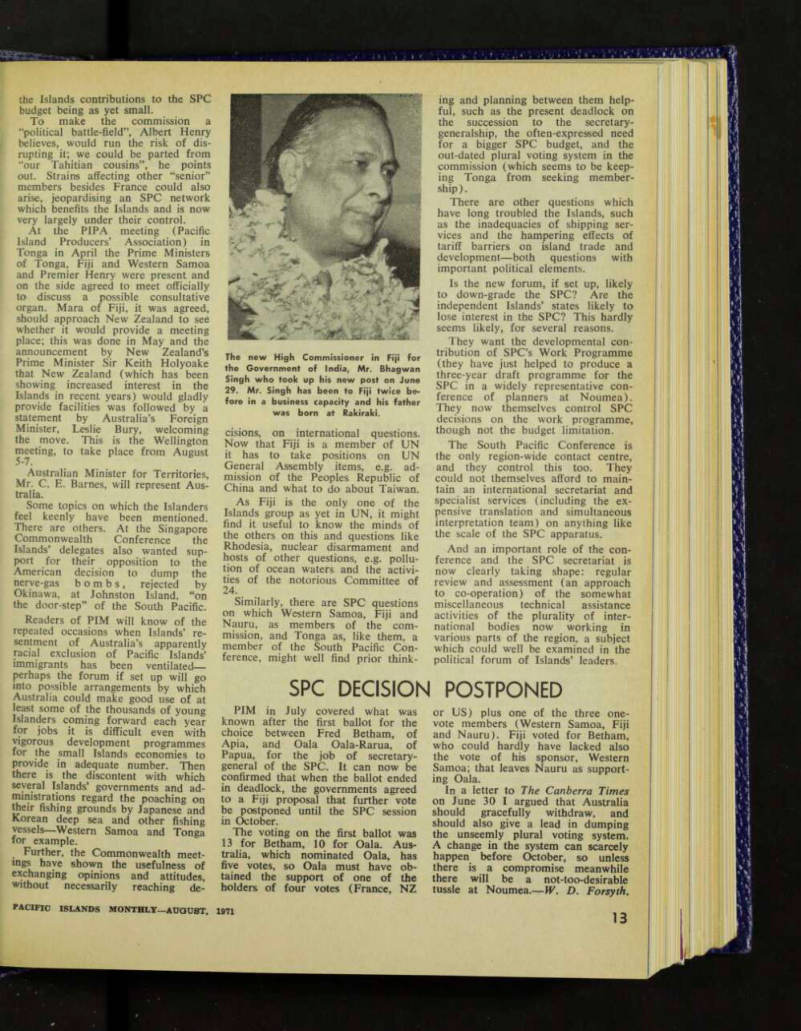
The new High Commissioner in Fiji for the Government of India, Mr. Bhagwan Singh who took up his new post on June 29. Mr. Singh has been to Fiji twice be fore in a business capacity and his father was born at Rakiraki.
cisions, on international questions.
Now that Fiji is a member of UN it has to take positions on UN General Assembly items, e.g. ad mission of the Peoples Republic of China and what to do about Taiwan.
As Fiji is the only one of the Islands group as yet in UN, it might find it useful to know the minds of the others on this and questions like Rhodesia, nuclear disarmament and hosts of other questions, e.g. pollu tion of ocean waters and the activi ties of the notorious Committee of 24.
Similarly, there are SPC questions on which Western Samoa, Fiji and Nauru, as members of the com mission, and Tonga as, like them, a member of the South Pacific Con ference, might well find prior think-
ing and planning between them help ful, such as the present deadlock on the succession to the secretary generalship, the often-expressed need for a bigger SPC budget, and the out-dated plural voting system in the commission (which seems to be keep ing Tonga from seeking member ship ).
There are other questions which have long troubled the Islands, such as the inadequacies of shipping ser vices and the hampering effects of tariff barriers on island trade and development—both questions with important political elements.
Is the new forum, if set up, likely to down-grade the SPC? Are the independent Islands’ states likely to lose interest in the SPC? This hardly seems likely, for several reasons.
They want the developmental con tribution of SPC’s Work Programme (they have just helped to produce a three-year draft programme for the SPC in a widely representative con ference of planners at Noumea).
They now themselves control SPC decisions on the work programme, though not the budget limitation.
The South Pacific Conference is the only region-wide contact centre, and they control this too. They could not themselves afford to main tain an international secretariat and specialist services (including the ex pensive translation and simultaneous interpretation team) on anything like the scale of the SPC apparatus.
And an important role of the con ference and the SPC secretariat is now clearly taking shape: regular review and assessment (an approach to co-operation) of the somewhat miscellaneous technical assistance activities of the plurality of inter national bodies now working in various parts of the region, a subject which could well be examined in the political forum of Islands’ leaders.