Republic
pp. 111-119 · Read in the full issue
Nauru revisited
An Island
Faces Up To
Its Problems
By Michael Batten
Re-visiting Nauru for the first time since independence one cannot fail to be impressed with what has been achieved in little more than three years.
The island has changed little, physically. It is still remarkable to me, even flying overhead, that Nauru is so little scarred by the phosphate extraction which has been going on for more than 60 years.
To the visitor from the big city, it still conjures up the tropical islands of storybooks, with its encircling reef, white sand and coconut palms. But once-sleepy Naum is very much on the move.
The first and most obvious change is in the getting there. When I first went to Naum, only three years ago, the only method was by chartered Qantas DC4—and a very long and tiring trip it was.
Now the Nauruans operate their own airline—Air Nauru—using a French Falcon 550 mph pure jet. It’s only an eight seater, but flies at 41,000 ft and gives as comfortable a ride as any jet I have been in. Fly ing time Melbourne-Nauru is about seven hours.
And “mini” though the plane is, the service and cuisine is of “maxi” standard.
Having its own airline has opened up communications for Nauru. The President, various ministers and those running the Nauru Phosphate Cor poration, are frequent commuters be tween Naum and the republic’s office in Melbourne.
Just as the airline has opened up communications, the republic has opened up trade with its Naum Paci fic Shipping Lines. The line now has three vessels, Eigamoiya, Rosie D (formerly Triaster ), and Enna G, which serve the island and operate variously to New Guinea ports, West ern Samoa and Guam. The Naumans
are pleased with the volume of cargo and passengers which the ships are carrying.
But no matter how important the shipping line may be in the future, it is still the phosphate industry which dominates Nauru’s thinking. The transfer of management from the BPC has been accomplished smoothly.
Many of the key BPC personnel have elected to remain with the new man agement.
The NPC has been actively explor ing new markets in addition to the traditional ones of Australia and New Zealand. Under the agreements made at the time of the handover of the industry, Australia and NZ under took to buy a guaranteed quantity of phosphate from Nauru only until the end of the 1971-72 fiscal year.
Thereafter, there are no guarantees.
Naum has already developed a worthwhile market in Japan, and in return has placed an order for a 31,000 ton bulk phosphate carrier with a Japanese shipyard.
Although the natural quality of Naum phosphate remains among the highest in the world (dig a shovel into the field and you will probably come up with 83 per cent, pure phos phate), even the best natural pro ducts have to be marketed correctly in this age of advanced technology. (over)
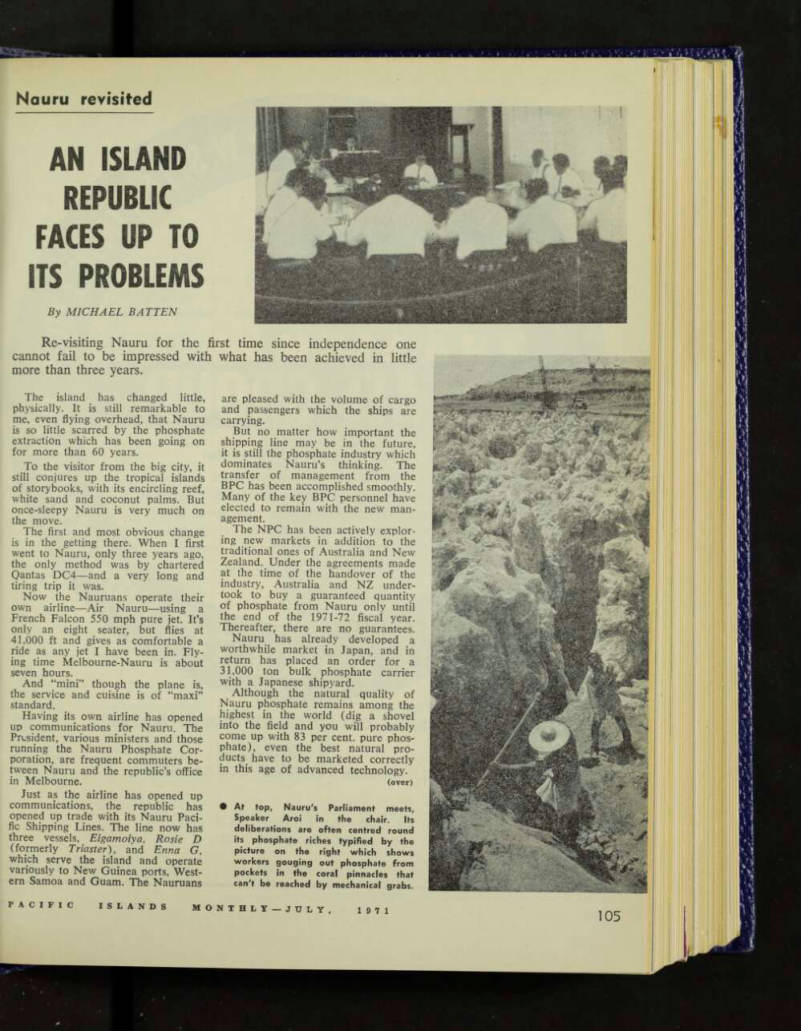
• At top, Nauru's Parliament meets, Speaker Aroi in the chair. Its deliberations are often centred round its phosphate riches typified by the picture on the right which shows workers gouging out phosphate from pockets in the coral pinnacles that can't be reached by mechanical grabs.
Fertiliser plants around the world are beginning to demand finer crush ing, and to meet this demand the NPC is planning to install a new plant which will crush to a size of minus i in. instead of the present minus 2 in.
Further upgrading is planned with the installation of a calcining plant (a process which removes moisture and reduces the content of impurities including limestone). Other new equipment to be installed will enable even the phosphate dust to be utilised, by being compounded into pellets.
Nauru is still dependent on expatri ate skills in both the running of the phosphate industry and in the govern ment itself. Yet NPC now employs 117 Nauruans compared with 140 ex patriates, and more than 70 per cent, of the posts in the Nauru Public Ser vice are held by Nauruan citizens.
Nauru suffers from a fairly high turnover of expatriate staff. Life in distant, small communities requires a special kind of people, and in the pro cess of finding these people, many others pass through the system.
Nauru is intent on educating its own people to take increasing respon sibility. There is a scholarship system at secondary school level, with 20 chil dren selected each year to study at a school of their choice (normally Aus tralia). There is also a cadetship scheme at tertiary level which assists intending university students and those undertaking other courses at tertiary level (such as schools of mines, etc.).
An apprenticeship scheme also ope rates.
The results of these education assist ance schemes are becoming apparent.
Nauruan graduates include a doctor of medicine, a dental surgeon, and a Bachelor of Arts in political science.
There are also five Fiji-trained Nauruan doctors (Diploma of Medi cine and Surgery) at the Nauruan General Hospital.
Currently, Nauruan cadets are pur suing studies as diverse as business administration, nursing, law, medi cine, engineering, dental mechanics and surveying in Australia, NZ, New Guinea and Hawaii.
Nauruans are also emerging as teachers. Some, including Lawrence Stephen, a member of parliament, have graduated with the Diploma of Teaching English as a Second Langu age from the University of Papua and New Guinea and returned home to teach own people.
Stephen is one of the young brigade who was elected to parliament in the first poll since the original elections which followed independence. Their
election highlighted another trend on Nauru —growing political awareness.
Question time in parliament is fre quently an opportunity for the young brigade to aim pinpricking questions at the cabinet ministers—albeit with good humour. With one of the team being a graduate in political science (Australian National University graduate Kinza Clodumar), the gov ernment could hardly expect anything else.
Despite the obvious signs of pro gress, Nauru’s President Hammer Deßoburt remains impatient. A tire less worker himself (he recently tele phoned a senior public servant at 3 a.m. to complain that the electricity had been cut off, interrupting his labours) he expects everyone else to be equally dedicated.
The President remains personally involved in all important decisions and still travels extensively, particu larly to Australia. He is highly re spected by both Nauruans and expat riates.
With the results of its phosphate revenues, Nauru has been able to re main a duty-free, income tax-free haven in the Pacific, and there is no indications that these policies will change.
It takes a visitor from Sydney a long time to adjust to prices such as 14c for 20 cigarettes, bottled-in-Scot land Scotch for $1.76, and French wine for $l.lO. At the NPC staff club, to which all expatriates auto matically belong, a beer costs seven cents, and any spirit 14c (with the “mixer” drink thrown in free).
Duty-free prices and absence of income tax have probably been the biggest lure to expatriates in the past, but with the deterioration in the qual ity of life in Australia’s big cities, Nauru’s other attributes—absence of pollution, traffic snarls and crime—
President DeRoburt
may well prove to be equal attractions in the future.
No one locks the door of his home or car. About the only offences are traffic violations—not surprising when you consider that there are about 900 cars and 1,100 motor cycles on the 8i square mile island for a total population of 6,600.
Mention of the law reminds me that Nauru’s progress is not confined to material things. For example, major revisions of the Criminal Code are be ing undertaken currently by Chief Justice Thompson and legal advisers.
The main revisions will be to in corporate many reforms recently in troduced in the UK and Fiji, and to rationalise relative sentences for offences. When the review is com pleted, Nauru’s Criminal Code will be among the most advanced in the world.
Other reforms are intended to suit purely local conditions. For example, because there are presently no bar risters or solicitors practising on Nauru (outside the Justice Depart-, ment) the courts will accept “pleaders”—unqualified people who have to pass an examination set by the court and who receive an annual practising certificate which is capable of being revoked.
However, it is likely that the gov ernment will invite a legal firm to establish a branch on the island.
The phosphate revenues enable the islanders to have an enviable standard of living and a wide range of social services, including pensions, free housing, free hospital, medical and dental treatment, free telephones, and free bus transport to work and school.
The government provides homes for all its citizens. The latest design is an attractive, modern, two-storey home with brick ground floor and timber/ asbestos cement upper storey. All homes are sewered.
Apart from its homebuilding pro gramme, the government is currently building a modern civic centre which will incorporate bank, post office, commercial offices, supermarket, and social centre. A new cinema, library and museum are also planned.
When I was on the island there had been no rain for many months (the drought has broken since), and there was a severe water shortage.
There is no natural catchment—and water was being brought in by tanker at a cost of as much as $4 per 1,000 gallons.
There is already a total of about 17m. gallons of water storage on the island, but with weekly consumption as high as 750,000 gallons, this will
not outlast prolonged drought condi tions.
The Nauruans are studying various alternatives—including a desalination plant. They have also had a study car ried out **v a civil engineer who re commended creating giant storage tanks in the worked-out fields and covering them with special rubber sheeting to retard evaporation. Be cause of the limestone pinnacles which remain after phosphate mining, even this would require massive excavation work.
Another possibility would be to create storage under the airfield—the only large open space on the island.
As extensions to the airport are cur rently planned to lengthen the runway to 5,800 ft and to strengthen the surface to take large-sized jets, it is possible that the water storage problem could be tackled at the same time.
Mothers attack
bride bartering
The Anglican Mothers’ Union in Papua New Guinea has come out strongly against the custom of paying for brides with goods or cash.
The Mothers’ Union has passed a resolution declaring that the bride custom was “quite wrong” in cases where it had become simply a pay ment for the bride. However, mem bers said the traditional “friendly ex change of gifts” between families of bride and groom was a perfectly acceptable custom.
As a result of the resolution, the union will ask its 4,000 members in the Territory to try to persuade their husbands to refuse to have anything to do with bride prices as a form of payment.
The PNG P resident of the union, Mrs. Ray Kendall, hopes it will soon be an accepted fact that families of Mothers’ Union members do not en gage in bride price payments. This would be influential in eliminating the bad aspects of the custom and en couraging the good.
O Nauru, per head of population, has probably done more for the vic tims of the disastrous floods in East Pakistan earlier this year than any other country. An appeal for flood relief raised $13,608.77. Expenses in curred in raising the money totalled a mere $117.70.