Pacific Shipping
pp. 81-84 · Read in the full issue
Mixed results on PNG, Fiji freight increases
Three major shipping companies servicing Papua New Guinea from Australian east coast ports refused to accede to a request from the Department of External Territories to delay applying a 9 per cent, freight increase. The increase is to come into effect on July 1.
But in NZ, the Union Steam Ship Co. gave in to protests against a temporary increased surcharge on some goods between NZ and Fiji but later announced an overall freight increase.
The companies concerned are Con pac (Burns Philp and Australia-West Pacific Line), New Guinea Australia Line and Karlander. A fourth com pany, Nauru Pacific Shipping Lines, was considering whether it would in crease its freight charges for the Aus tralia-PNG service.
The new freight rates come on top of a 15 per cent, increase which ap plied from March 1. According to a spokesman for Conpac, after going over figures it was found that the 15 per cent, increase was inadequate to cover losses occurring on the service.
In addition, since March 1, steve doring and port charges and other costs had risen.
An Australia-New Guinea Line spokesman said the 9 per cent, in crease had been discussed with the PNG Government. The rise was needed to cover increased labour costs in Australia.
A spokesman for Karlander gave similar reasons, and added that al though wages for labour had risen, there had been no increase in pro ductivity.
His firm had replied to the request to delay the increases by saying it “could not subsidise the territory”.
The department merely asked Naum Pacific Shipping Lines if it was going to put up its charges. This line operates on the same basis in relation to PNG as the other companies. The line is “examining the position”.
It was reported soon after the new freight rates were announced that Australian Government ministers would discuss ways to block it. The External Territories Minister, Mr.
Barnes, made a strong attack on the increase.
He described it as “quite a serious matter” and a hidden tariff for ex porters to PNG. The shipping lines
would be asked to justify the increase, to give greater consideration to ship pers, and make provision for cases of hardship.
In a later statement Mr. Barnes said the increase had not come about from any change in conditions in PNG, “where much had been done in recent years to encourage efficient shipping methods and to improve port facilities”. He gave details of new wharves under construction and he said it was hoped that World Bank assistance might be obtained for further port improvements.
Mr. Barnes had support from this year’s Visiting UN Mission to PNG, which, in its report to the UN in May criticised the 15 per cent, increase (it knew nothing about the extra 9 per cent.) as anomalous. The mission suggested that differential rates be worked out for the four better-equipped territory ports. It added that people, especially in New Ireland, had told the mission they wanted to see a New Guinea ship
ping company established. The report comments: “Although their petition ignores the cost of setting up and maintaining a fleet, it shows that pro ducers are not satisfied with the way in which the export of copra and cocoa is at present being handled by the private shipping companies”.
Bowing to pressure from the Fiji Government and to protests from Fiji business organisations, the Union Steam Ship Company has lifted the S 4 a ton surcharge which it had slap ped on to freight to Fiji.
The surcharge the company an nounced in May was to enable it to recoup its losses caused by the Fiji’s month-long dockworkers’ strike.
The Suva Chamber of Commerce, which represents the big Australian owned trading firms, and the Suva Indian Chamber of Commerce, rep resenting most of the Suva Indian merchants, took a dim view of the surcharge and hinted at moves to boy cott New Zealand goods and obtain supplies from elsewhere.
The Union Steam Ship Company had Fiji traders dizzy with its on again, off-again announcements of a S 4 a ton surcharge on goods to Fiji,
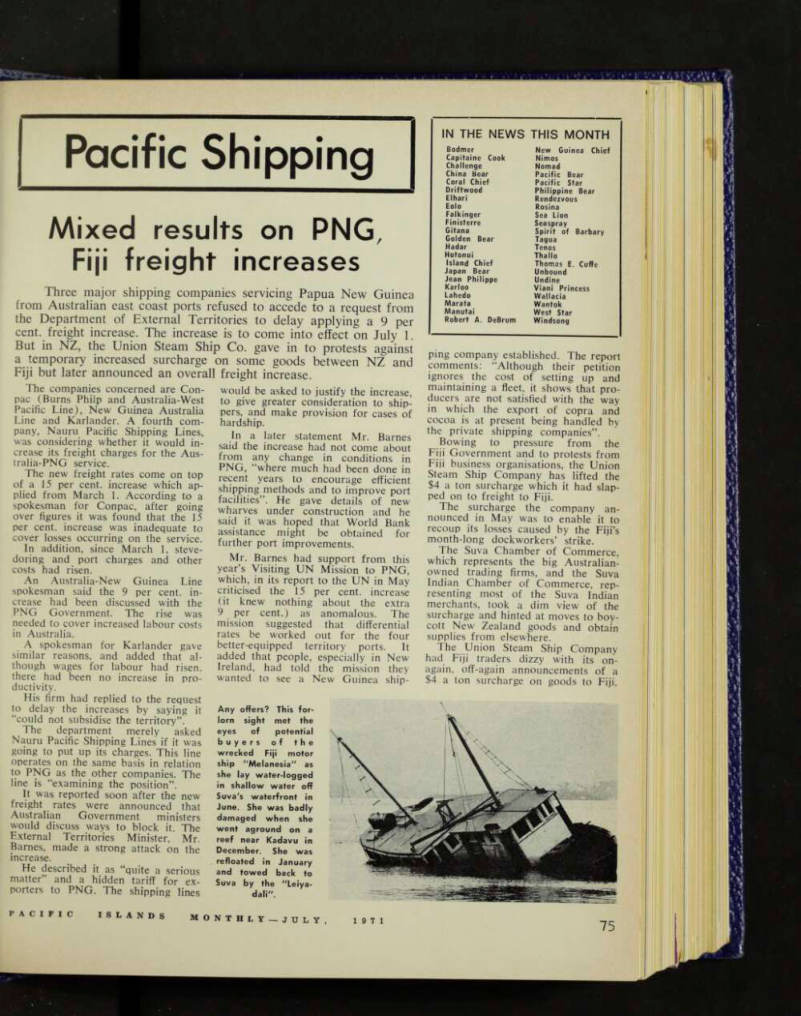
Any offers? This for lorn sight met the eyes of potential buyers of the wrecked Fiji motor ship "Melanesia" as she lay water-logged in shallow water off Suva's waterfront in June. She was badly damaged when she went aground on a reef near Kadavu in December. She was refloated in January and towed back to
Suva by the "Leiya
dali".
but after agreeing to limit the in crease to goods not under price con trol it shocked the dominion with an announcement that it would drop the surcharge after the Taveuni left Auckland on July 1 and would slap on a general Pacific freight increase.
This is expected to operate from about the middle of July.
Later, there was another shock— this time from London where ship ping lines including Port Line, Shaw Savill and New Zealand Shipping Co. announced that they will place a sur charge of SUSI.3O per 40 cu. ft/20 cwt on all freight from UK to Fiji ports from July 15. More companies, including some operating between NZ and Island ports, are expected to follow.
There were angry retorts from Fiji, Mr. Chimanlal R. Narsey, president of the Suva Indian Chamber of Com merce, accusing the London ship pers of using the Fiji dock strike “as a tool to increase their charges in stead of helping to build up the economy of Fiji”. He also prophesied more increases from companies operating out of Sydney, Hong Kong.
Singapore and Japan.
The Fiji National Federation Party leader, Mr. S. M. Koya, called the surcharges “malpractice of the highest order” and advocated the establish ment of a national shipping line.
Using Lash In
S. Pacific Trade
Pacific Far East Line executives are examining the possibility of using LASH (lighter aboard ship) vessels in the Australia-South Pacific trade.
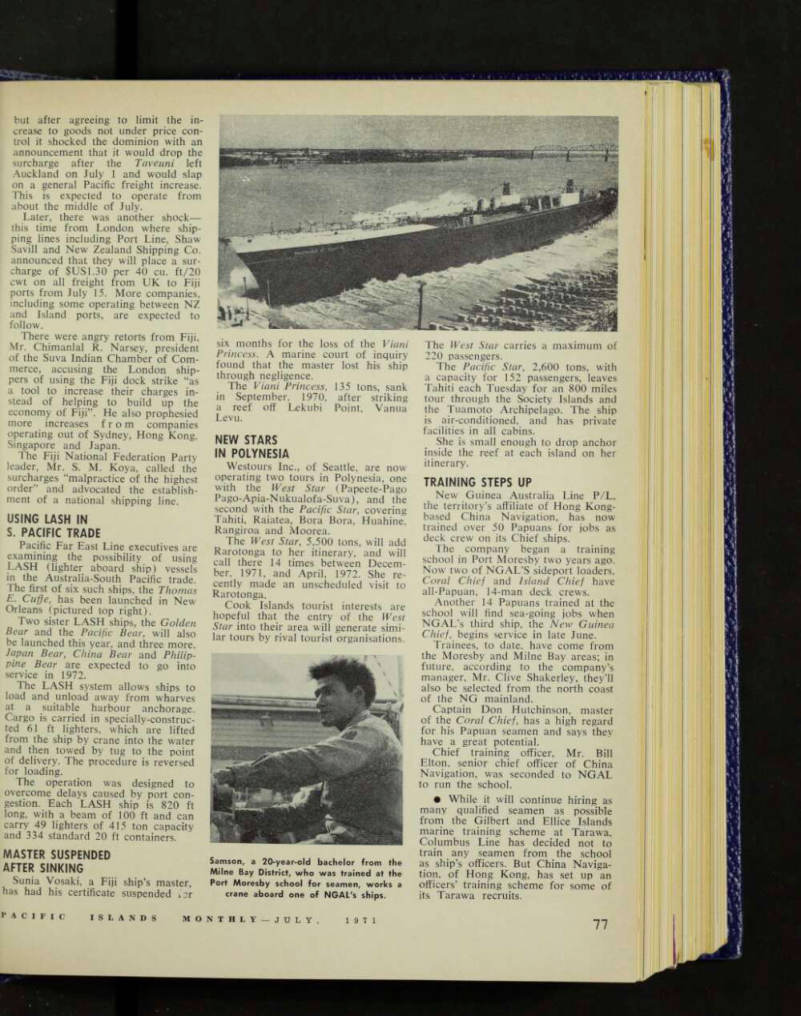
The first of six such ships, the Thomas E. Cuffe, has been launched in New Orleans (pictured top right).
Two sister LASH ships, the Golden Bear and the Pacific Bear, will also be launched this year, and three more, Japan Bear, China Bear and Philip pine Bear are expected to go into service in 1972.
The LASH system allows ships to load and unload away from wharves at a suitable harbour anchorage.
Cargo is carried in specially-construc ted 61 ft lighters, which are lifted from the ship by crane into the water and then towed by tug to the point of delivery. The procedure is reversed for loading.
The operation was designed to overcome delays caused by port con gestion. Each LASH ship is 820 ft long, with a beam of 100 ft and can carry 49 lighters of 415 ton capacity and 334 standard 20 ft containers.
Master Suspended
After Sinking
Sunia Vosaki, a Fiji ship’s master, has had his certificate suspended ijr
six months for the loss of the Viani Princess. A marine court of inquiry found that the master lost his ship through negligence.
The Viani Princess, 135 tons, sank in September. 1970, after striking a reef off Lekubi Point, Vanua Levu.
New Stars
In Polynesia
Westours Inc., of Seattle, are now operating two tours in Polynesia, one with the West Star (Papeete-Pago Pago-Apia-Nukualofa-Suva), and the second with the Pacific Star, covering Tahiti, Raiatea, Bora Bora, Huahine, Rangiroa and Moorea.
The West Star, 5,500 tons, will add Rarotonga to her itinerary, and will call there 14 times between Decem ber, 1971, and April, 1972. She re cently made an unscheduled visit to Rarotonga.
Cook Islands tourist interests are hopeful that the entry of the West Star into their area will generate simi lar tours by rival tourist organisations.
The West Star carries a maximum of 220 passengers.
The Pacific Star, 2,600 tons, with a capacity for 152 passengers, leaves Tahiti each Tuesday for an 800 miles tour through the Society Islands and the Tuamoto Archipelago. The ship is air-conditioned, and has private facilities in all cabins.
She is small enough to drop anchor inside the reef at each island on her itinerary.
Training Steps Up
New Guinea Australia Line P/L, the territory’s affiliate of Hong Kong based China Navigation, has now trained over 50 Papuans for jobs as deck crew on its Chief ships.
The company began a training school in Port Moresby two years ago.
Now two of NGAL’S sideport loaders, Coral Chief and Island Chief have all-Papuan, 14-man deck crews.
Another 14 Papuans trained at the school will find sea-going jobs when NGAL’s third ship, the New Guinea Chief, begins service in late June.
Trainees, to date, have come from the Moresby and Milne Bay areas; in future, according to the company’s manager, Mr. Clive Shakerley, they’ll also be selected from the north coast of the NG mainland.
Captain Don Hutchinson, master of the Coral Chief, has a high regard for his Papuan seamen and says they have a great potential.
Chief training officer, Mr. Bill Elton, senior chief officer of China Navigation, was seconded to NGAL to run the school. • While it will continue hiring as many qualified seamen as possible from the Gilbert and Ellice Islands marine training scheme at Tarawa, Columbus Line has decided not to train any seamen from the school as ship’s officers. But China Naviga tion, of Hong Kong, has set up an officers’ training scheme for some of its Tarawa recruits.
Samson, a 20-year-old bachelor from the Milne Bay District, who was trained at the Port Moresby school for seamen, works a crane aboard one of NGAL's ships.
Wewak's New
Wharf Open Soon
The $750,000 new overseas wharf at Wewak, New Guinea, is expected to be in use about the middle of Aug ust. The wharf is 240 ft long and has a causeway of 1,500 ft. One over seas ship only will be able to berth at a time.
At present ships are unloaded by a lighterage system, using small boats.
The "Robert A. Debrum"
A new addition to the US Trust Territory fleet was christened at Saipan in May, only about a month after the death of the man who has given his name to the ship—the MV Robert A. Deßrum.
Captain A. Robert Deßrum, com modore of Micronesia Interocean Line, Inc., died on April 16 at Saipan’s Dr. Torres Hospital.
His widow officially christened the MV Robert A. Deßrum in a dockside ceremony. An ex-US Navy vessel, the Robert A. Deßrum is 177 ft long and displaces 400 tons. She is commanded by Captain Tetrick J. Melander of Kusaie.
New Ship For
The Cooks
In Denmark in search of a replace ment for the Tagua, wrecked off Mangaia Island on December 15 (PIM, Jan., p. 90), Mr. Don Silk, of Silk and Boyd Ltd., of Rarotonga, has bought a IOJ-year-old Danish coaster.
Mik, which as the Manutai (Bird of the Sea) will be Cooks’ biggest ship.
Powered by a five cylinder diesel engine, the Manutai can reach 10 knots and has space for 400 tons of general cargo and 300 tons of copra.
She has a draught of only 9 ft, a single large hatch and two derricks, each of three tons capacity. According to Mr.
Silk, the Manutai is a little larger than current requirements warrant but the company is confident she will be paying her way in five years. They hope to develop more trade with Tahiti. Mr. F. Hendricks, the Bod mer’s engineer, who was to fly to Denmark to take charge of the Manutai, will load cargo in Copen hagen and other European ports before sailing to Rarotonga. • Construction of two large steel framed cargo sheds at Avatiu harbour.
Rarotonga, was well underway in June.