Bobby Gibbes-The Pilot's Pilot
p. 77 · Read in the full issue
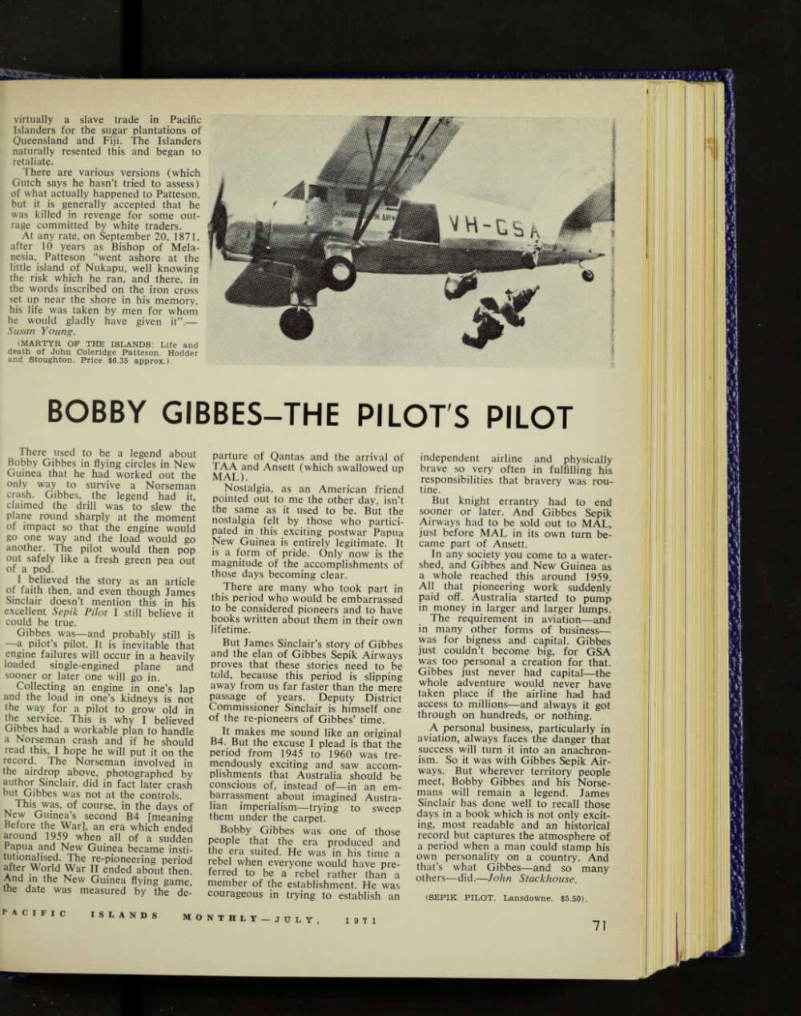
There used to be a legend about Bobby Gibbes in flying circles in New Guinea that he had worked out the only way to survive a Norseman crash. Gibbes, the legend had it, claimed the drill was to slew the plane round sharply at the moment of impact so that the engine would go one way and the load would go another. The pilot would then pop out safely like a fresh green pea out of a pod.
I believed the story as an article of faith then, and even though James Sinclair doesn’t mention this in his excellent Sepik Pilot I still believe it could be true.
Gibbes was—and probably still is —a pilot’s pilot. It is inevitable that engine failures will occur in a heavily loaded single-engined plane and sooner or later one will go in.
Collecting an engine in one’s lap and the load in one’s kidneys is not the way for a pilot to grow old in the service. This is why I believed Gibbes had a workable plan to handle a Norseman crash and if he should read this, I hope he will put it on the record. The Norseman involved in the airdrop above, photographed by author Sinclair, did in fact later crash but Gibbes was not at the controls.
This was, of course, in the days of
New Guinea’s second B 4 [meaning
Before the War], an era which ended around 1959 when all of a sudden Papua and New Guinea became insti tutionalised. The re-pioneering period after World War II ended about then.
And in the New Guinea flying game, the date was measured by the de
parture of Qantas and the arrival of TAA and Ansett (which swallowed up
Mal).
Nostalgia, as an American friend pointed out to me the other day, isn’t the same as it used to be. But the nostalgia felt by those who partici pated in this exciting postwar Papua New Guinea is entirely legitimate. It is a form of pride. Only now is the magnitude of the accomplishments of those days becoming clear.
There are many who took part in this period who would be embarrassed to be considered pioneers and to have books written about them in their own lifetime.
But James Sinclair’s story of Gibbes and the elan of Gibbes Sepik Airways proves that these stories need to be told, because this period is slipping away from us far faster than the mere passage of years. Deputy District Commissioner Sinclair is himself one of the re-pioneers of Gibbes’ time.
It makes me sound like an original 84. But the excuse I plead is that the period from 1945 to 1960 was tre mendously exciting and saw accom plishments that Australia should be conscious of, instead of—in an em barrassment about imagined Austra lian imperialism—trying to sweep them under the carpet.
Bobby Gibbes was one of those people that the era produced and the era suited. He was in his time a rebel when everyone would have pre ferred to be a rebel rather than a member of the establishment. He was courageous in trying to establish an
independent airline and physically brave so yery often in fulfilling his responsibilities that bravery was rou tine.
But knight errantry had to end sooner or later. And Gibbes Sepik Airways had to be sold out to MAT, just before MAL in its own turn be came part of Ansett.
In any society you come to a water shed, and Gibbes and New Guinea as a whole reached this around 1959.
All that pioneering work suddenly paid off. Australia started to pump in money in larger and larger lumps.
The requirement in aviation—and in many other forms of business— was for bigness and capital. Gibbes just couldn’t become big, for GSA was too personal a creation for that.
Gibbes just never had capital—the whole adventure would never have taken place if the airline had had access to millions—and always it got through on hundreds, or nothing.
A personal business, particularly in aviation, always faces the danger that success will turn it into an anachron ism. So it was with Gibbes Sepik Air ways. But wherever territory people meet, Bobby Gibbes and his Norse mans will remain a legend. James Sinclair has done well to recall those days in a book which is not only excit ing, most readable and an historical record but captures the atmosphere of a period when a man could stamp his own personality on a country. And that’s what Gibbes—and so many
others—did.
John Stackhouse.
(SEPIK PILOT. Lansdowne. $5.50).