Src Stakes
pp. 29-30 · Read in the full issue
Only Two
Starters In The
By a staff writer
The starters for the South Pacific Commission Stakes got down to two in June when they lined up at the barrier in Canberra. But the handi caps were too heavy for both, and it was a no-race.
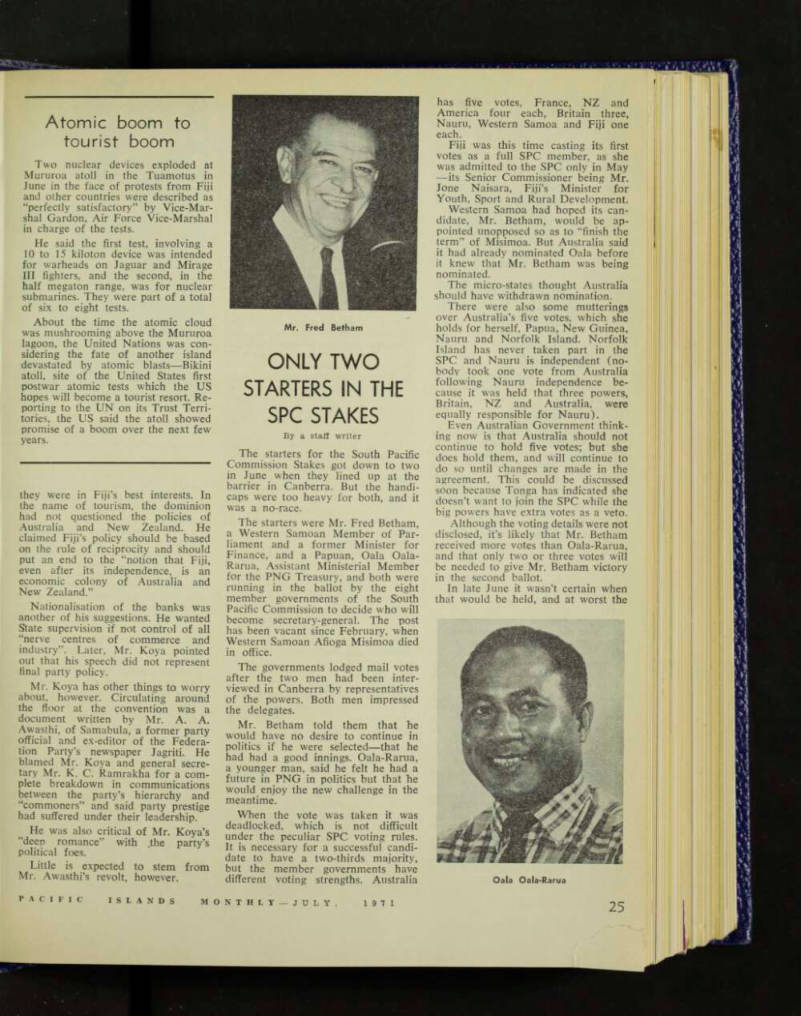
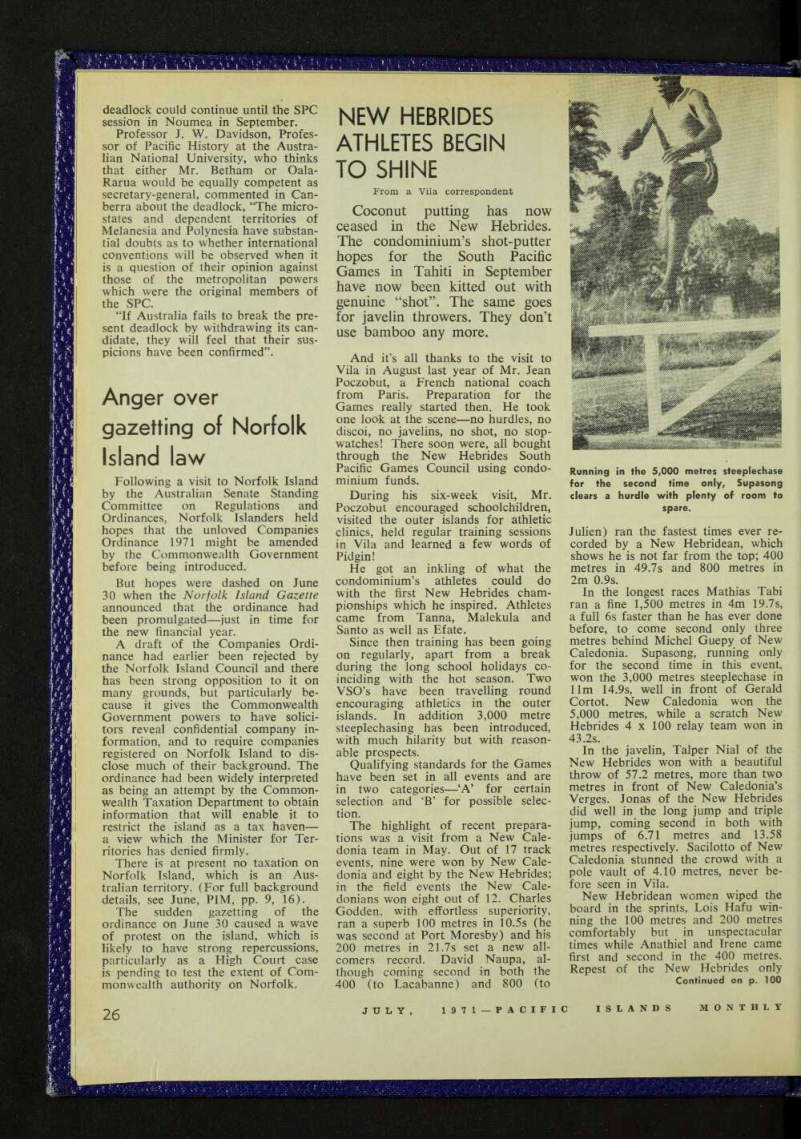
The starters were Mr. Fred Betham, a Western Samoan Member of Par liament and a former Minister for Finance, and a Papuan, Gala Oala- Rarua, Assistant Ministerial Member for the PNG Treasury, and both were running in the ballot by the eight member governments of the South Pacific Commission to decide who will become secretary-general. The post has been vacant since February, when Western Samoan Afioga Misimoa died in office.
The governments lodged mail votes after the two men had been inter viewed in Canberra by representatives of the powers. Both men impressed the delegates.
Mr. Betham told them that he would have no desire to continue in politics if he were selected—that he had had a good innings. Oala-Rarua, a younger man, said he felt he had a future in PNG in politics but that he would enjoy the new challenge in the meantime.
When the vote was taken it was deadlocked, which is not difficult under the peculiar SPC voting rules.
It is necessary for a successful candi date to have a two-thirds majority, but the member governments have different voting strengths. Australia
has five votes, France, NZ and America four each, Britain three, Nauru, Western Samoa and Fiji one each.
Fiji was this time casting its first votes as a full SPC member, as she was admitted to the SPC only in May —its Senior Commissioner being Mr.
Tone Naisara, Fiji’s Minister for Youth, Sport and Rural Development.
Western Samoa had hoped its can didate, Mr. Betham, would be ap pointed unopposed so as to “finish the term” of Misimoa. But Australia said it had already nominated Gala before it knew that Mr. Betham was being nominated.
The micro-states thought Australia should have withdrawn nomination.
There were also some mutterings over Australia’s five votes, which she holds for herself, Papua, New Guinea, Nauru and Norfolk Island. Norfolk Island has never taken part in the SPC and Nauru is independent (no body took one vote from Australia following Nauru independence be cause it was held that three powers, Britain, NZ and Australia, were equally responsible for Nauru).
Even Australian Government think ing now is that Australia should not continue to hold five votes; but she does hold them, and will continue to do so until changes are made in the agreement. This could be discussed soon because Tonga has indicated she doesn’t want to join the SPC while the big powers have extra votes as a veto.
Although the voting details were not disclosed, it’s likely that Mr. Betham received more votes than Oala-Rarua, and that only two or three votes will be needed to give Mr. Betham victory in the second ballot.
In late June it wasn’t certain when that would be held, and at worst the
Mr. Fred Betham
Oala Oala-Rarua
deadlock could continue until the SPC session in Noumea in September.
Professor J. W. Davidson, Profes sor of Pacific History at the Austra lian National University, who thinks that either Mr. Betham or Oala- Rarua would be equally competent as secretary-general, commented in Can berra about the deadlock, “The micro states and dependent territories of Melanesia and Polynesia have substan tial doubts as to whether international conventions will be observed when it is a question of their opinion against those of the metropolitan powers which were the original members of the SPC.
“If Australia fails to break the pre sent deadlock by withdrawing its can didate, they will feel that their sus picions have been confirmed”.