Pacific Islands Monthly
p. 25 · Read in the full issue
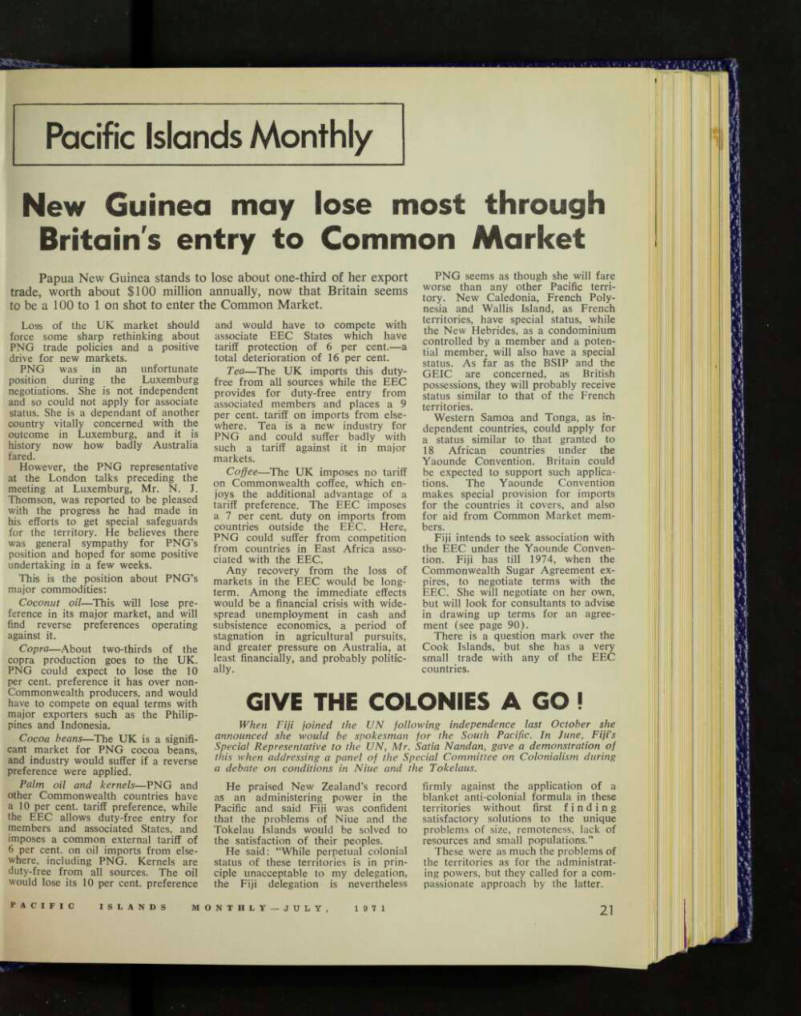
New Guinea may lose most through Britain's entry to Common Market
Papua New Guinea stands to lose about one-third of her export trade, worth about $lOO million annually, now that Britain seems to be a 100 to 1 on shot to enter the Common Market.
Loss of the UK market should force some sharp rethinking about PNG trade policies and a positive drive for new markets.
PNG was in an unfortunate position during the Luxemburg negotiations. She is not independent and so could not apply for associate status. She is a dependant of another country vitally concerned with the outcome in Luxemburg, and it is history now how badly Australia fared.
However, the PNG representative at the London talks preceding the meeting at Luxemburg, Mr. N. J.
Thomson, was reported to be pleased with the progress he had made in his efforts to get special safeguards for the territory. He believes there was general sympathy for PNG’s position and hoped for some positive undertaking in a few weeks.
This is the position about PNG’s major commodities: Coconut oil —This will lose pre ference in its major market, and will find reverse preferences operating against it.
Copra —About two-thirds of the copra production goes to the UK.
PNG could expect to lose the 10 per cent, preference it has over non- Commonwealth producers, and would have to compete on equal terms with major exporters such as the Philip pines and Indonesia.
Cocoa beans —The UK is a signifi cant market for PNG cocoa beans, and industry would suffer if a reverse preference were applied.
Palm oil and kernels —PNG and other Commonwealth countries have a 10 per cent, tariff preference, while the EEC allows duty-free entry for members and associated States, and imposes a common external tariff of 6 per cent, on oil imports from else where, including PNG. Kernels are duty-free from all sources. The oil would lose its 10 per cent, preference
and would have to compete with associate EEC States which have tariff protection of 6 per cent. —a total deterioration of 16 per cent.
Tea —The UK imports this duty free from all sources while the EEC provides for duty-free entry from associated members and places a 9 per cent, tariff on imports from else where. Tea is a new industry for PNG and could suffer badly with such a tariff against it in major markets.
Coffee —The UK imposes no tariff on Commonwealth coffee, which en joys the additional advantage of a tariff preference. The EEC imposes a 7 per cent, duty on imports from countries outside the EEC. Here, PNG could suffer from competition from countries in East Africa asso ciated with the EEC.
Any recovery from the loss of markets in the EEC would be long term. Among the immediate effects would be a financial crisis with wide spread unemployment in cash and subsistence economics, a period of stagnation in agricultural pursuits, and greater pressure on Australia, at least financially, and probably politic ally.
PNG seems as though she will fare worse than any other Pacific terri tory. New Caledonia, French Poly nesia and Wallis Island, as French territories, have special status, while the New Hebrides, as a condominium controlled by a member and a poten tial member, will also have a special status. As far as the BSIP and the GEIC are concerned, as British possessions, they will probably receive status similar to that of the French territories.
Western Samoa and Tonga, as in dependent countries, could apply for a status similar to that granted to 18 African countries under the Yaounde Convention. Britain could be expected to support such applica tions. The Yaounde Convention makes special provision for imports for the countries it covers, and also for aid from Common Market mem bers.
Fiji intends to seek association with the EEC under the Yaounde Conven tion. Fiji has till 1974, when the Commonwealth Sugar Agreement ex pires, to negotiate terms with the EEC. She will negotiate on her own, but will look for consultants to advise in drawing up terms for an agree ment (see page 90).
There is a question mark over the Cook Islands, but she has a very small trade with any of the EEC countries.