Business and Development
pp. 115-117 · Read in the full issue
Forever
Upwards! The
Hotel Boom
Important new moves in Pacific hotel building were announced in May.
Operator of three Fiji hotels, Naviti Investments Ltd. is planning to form a company with the Western Samoa Government to build a 100-room hotel on the old Casino Hotel site in Apia, and will hold 25 per cent, of the shares.
Honiara is also in Naviti’s sights.
The company has agreed to take a half-interest in the 30-room Mendana Hotel, owned and operated by Gua dalcanal Plains Ltd., which announced in April (PIM, May, p. 28) plans for a $500,000 expansion programme giv ing the hotel 102 rooms. Work is ex pected to begin in August on the first stage of 36 new rooms.
Naviti has agreed to operate the hotel and is also planning another in Fiji —at Votualailai, near Korolevu.
Travelodge has encountered a hitch in its plans to build a hotel on Rarotonga, Cook Islands.
The land, which had been ear marked for the hotel, is not available but approaches may be made to Cook Islands Holdings Ltd., the Invercargill, NZ, company which plans to build a 200-bed hotel on white sand beach at Aroa, Arorangi.
The Cook Islands Premier, Mr.
Henry, has had talks with senior Travelodge executives in New Zea land, and was told that Travelodge and the Invercargill company planned discussions over the Aroa site.
Developments are imminent on the long-shelved Natadola resort com plex. The Fijian-Mocambo Hotel group will announce a hotel resort to be built on freehold land owned by one of the company’s directors, Mr.
Pete Slimmer.
Mr. Slimmer bought the land several years ago from Mr. David Ragg, of Fiji’s Northern Hotels.
Development of it has so far been inhibited by owners of adjacent holdings.
But with Qantas and BOAC air lines now having a minority interest in the Fijian-Mocambo group, finance is more readily available and the
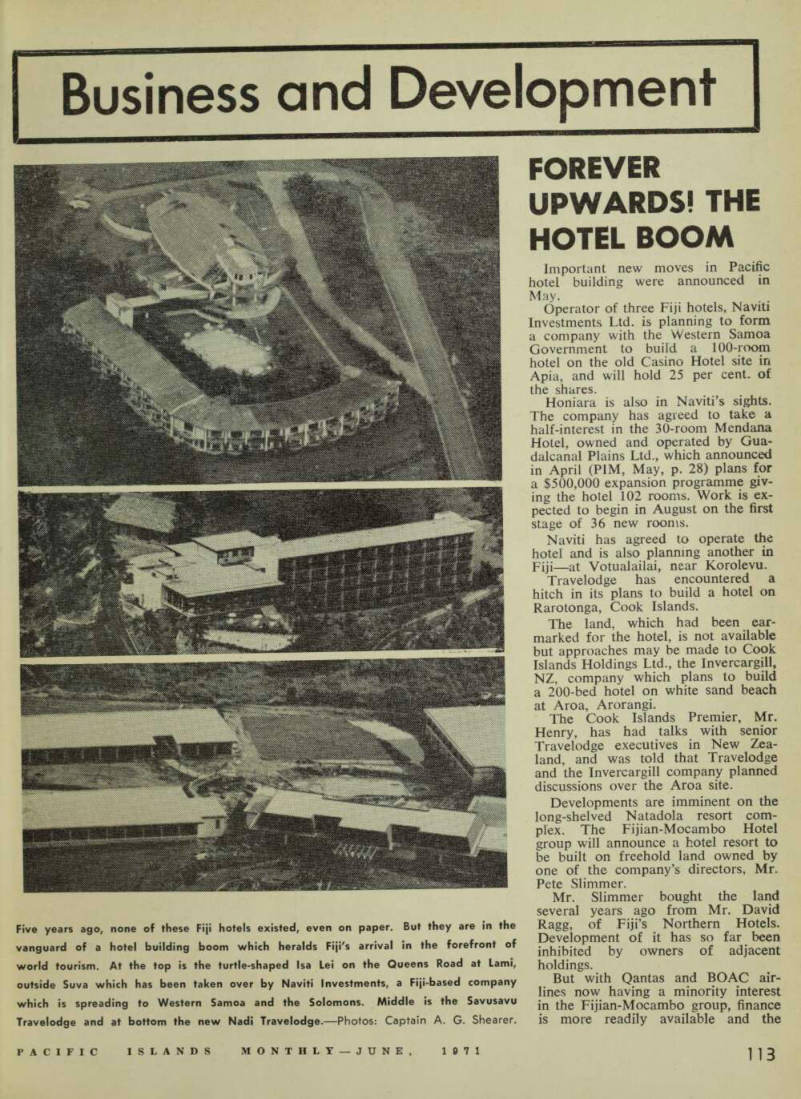
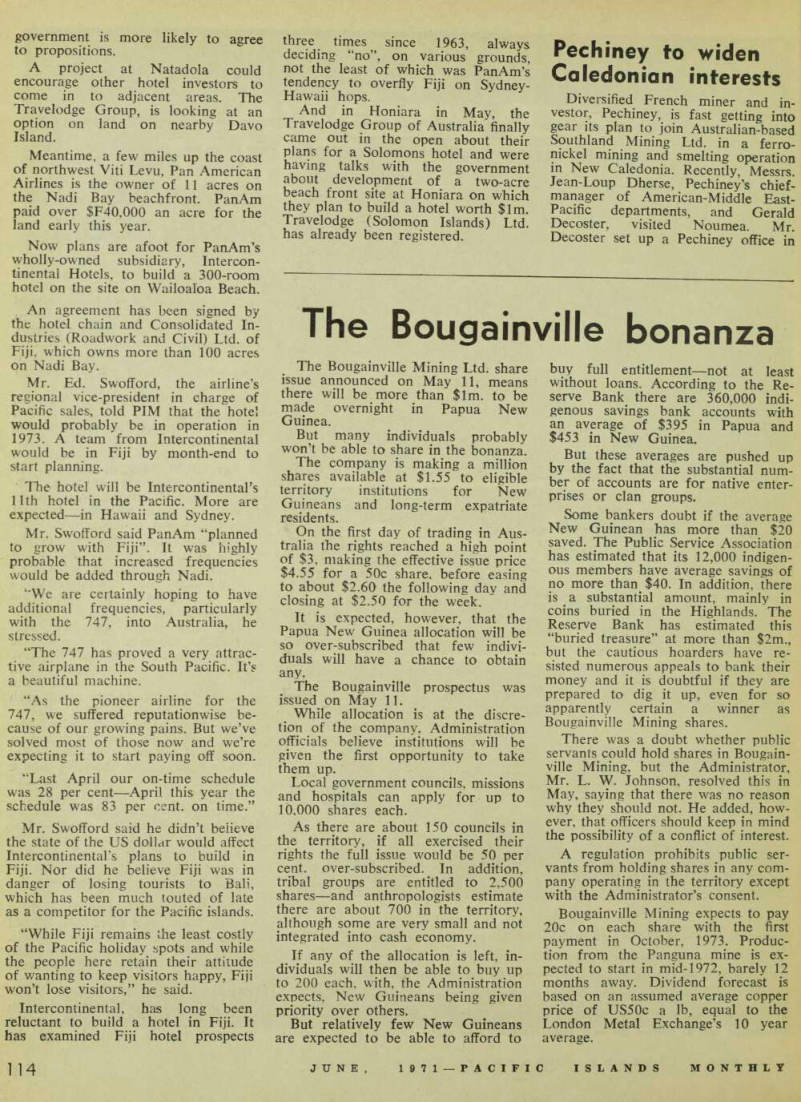
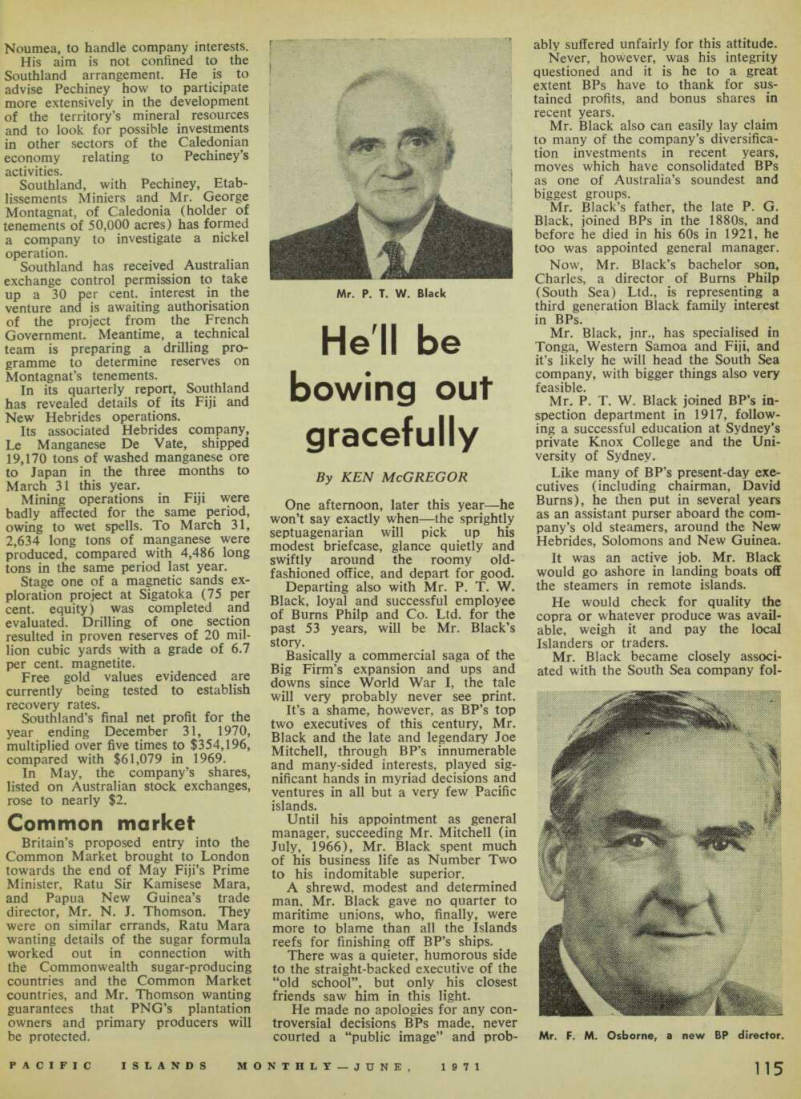
Five years ago, none of these Fiji hotels existed, even on paper. But they are in the vanguard of a hotel building boom which heralds Fiji's arrival in the forefront of world tourism. At the top is the turtle-shaped Isa Lei on the Queens Road at Lami, outside Suva which has been taken over by Naviti Investments, a Fiji-based company which is spreading to Western Samoa and the Solomons. Middle is the Savusavu Travelodge and at bottom the new Nadi Travelodge. Photos: Captain A. G. Shearer.
government is more likely to agree to propositions.
A project at Natadola could encourage other hotel investors to come in to adjacent areas. The Travelodge Group, is looking at an option on land on nearby Davo Island.
Meantime, a few miles up the coast of northwest Viti Levu, Pan American Airlines is the owner of 11 acres on the Nadi Bay beachfront. PanAm paid over $F40,000 an acre for the land early this year.
Now plans are afoot for Pan Am’s wholly-owned subsidiary, Intercon tinental Hotels, to build a 300-room hotel on the site on Wailoaloa Beach.
An agreement has been signed by the hotel chain and Consolidated In dustries (Roadwork and Civil) Ltd. of Fiji, which owns more than 100 acres on Nadi Bay.
Mr. Ed. Swofford, the airline’s regional vice-president in charge of Pacific sales, told PIM that the hotel would probably be in operation in 1973. A team from Intercontinental would be in Fiji by month-end to start planning.
The hotel will be Intercontinental’s 11th hotel in the Pacific. More are expected—in Hawaii and Sydney.
Mr, Swofford said PanAm “planned to grow with Fiji”. It was highly probable that increased frequencies would be added through Nadi.
“We are certainly hoping to have additional frequencies, particularly with the 747, into Australia, he stressed.
“The 747 has proved a very attrac tive airplane in the South Pacific. It’s a beautiful machine.
“As the pioneer airline for the 747, we suffered reputationwise be cause of our growing pains. But we’ve solved most of those now and we’re expecting it to start paying off soon.
“Last April our on-time schedule was 28 per cent—April this year the schedule was 83 per cent, on time.”
Mr. Swofford said he didn’t believe the state of the US dollar would affect Intercontinental’s plans to build in Fiji. Nor did he believe Fiji was in danger of losing tourists to Bali, which has been much touted of late as a competitor for the Pacific islands.
“While Fiji remains the least costly of the Pacific holiday spots and while the people here retain their attitude of wanting to keep visitors happy, Fiji won’t lose visitors,” he said.
Intercontinental, has long been reluctant to build a hotel in Fiji. It has examined Fiji hotel prospects
three times since 1963, always deciding “no”, on various grounds, not the least of which was Pan Am’s tendency to overfly Fiji on Sydney- Hawaii hops And m Honiara in May, the travelodge Group of Australia finally came out in the open about their plans for a Solomons hotel and were having talks with the government about development of a two-acre beach front site at Honiara on which they plan to build a hotel worth Sim.
Travelodge (Solomon Islands) Ltd. has already been registered.
Pechiney to widen
Caledonian interests
Diversified French miner and in vestor, Pechiney, is fast getting into gear its plan to join Australian-based Southland Mining Ltd. in a ferro nickel mining and smelting operation in New Caledonia. Recently, Messrs.
Jean-Loup Dherse, Pechiney’s chief manager of American-Middle East- Pacific departments, and Gerald Decoster, visited Noumea. Mr.
Decoster set up a Pechiney office in
Noumea, to handle company interests.
His aim is not confined to the Southland arrangement. He is to advise Pechiney how to participate more extensively in the development of the territory’s mineral resources and to look for possible investments in other sectors of the Caledonian economy relating to Pechiney’s activities.
Southland, with Pechiney, Etab lissements Miniers and Mr. George Montagnat, of Caledonia (holder of tenements of 50,000 acres) has formed a company to investigate a nickel operation.
Southland has received Australian exchange control permission to take up a 30 per cent, interest in the venture and is awaiting authorisation of the project from the French Government. Meantime, a technical team is preparing a drilling pro gramme to determine reserves on Montagnat’s tenements.
In its quarterly report, Southland has revealed details of its Fiji and New Hebrides operations.
Its associated Hebrides company, Le Manganese De Vate, shipped 19,170 tons of washed manganese ore to Japan in the three months to March 31 this year.
Mining operations in Fiji were badly affected for the same period, owing to wet spells. To March 31, 2,634 long tons of manganese were produced, compared with 4,486 long tons in the same period last year.
Stage one of a magnetic sands ex ploration project at Sigatoka (75 per cent, equity) was completed and evaluated. Drilling of one section resulted in proven reserves of 20 mil lion cubic yards with a grade of 6.7 per cent, magnetite.
Free gold values evidenced are currently being tested to establish recovery rates.
Southland’s final net profit for the year ending December 31, 1970, multiplied over five times to $354,196, compared with $61,079 in 1969.
In May, the company’s shares, listed on Australian stock exchanges, rose to nearly $2.
Common market
Britain’s proposed entry into the Common Market brought to London towards the end of May Fiji’s Prime Minister, Ratu Sir Kamisese Mara, and Papua New Guinea’s trade director, Mr. N. J. Thomson. They were on similar errands, Ratu Mara wanting details of the sugar formula worked out in connection with the Commonwealth sugar-producing countries and the Common Market countries, and Mr. Thomson wanting guarantees that PNG’s plantation owners and primary producers will be protected.