People
pp. 88-90 · Read in the full issue

• The exploits of the late Errol Flynn in New Guinea, before he hit the big time on the silver screen, are currently the subject of research by Dr. John H. Moore, Senior Lec turer in History at Macquarie Univer sity, Sydney, who plans to do a long paper on Flynn in the Islands. Among old Territorians who have been able to pass on reminiscences of Flynn to Dr. Moore are Mrs, Alice Innes, now of Sydney, and Mrs. Lillian Barclay- Millar, now of Surfers Paradise, and Dr. Moore is looking for others who knew Flynn in New Guinea and who can help him. • The University of the South Pacific, at Suva, is planning to establish a series of university centres in various Islands groups to help regionalise the work of the university.
Attractive, alert Sydney girl Rose mary Cameron, B.Agr., M.Ed., in May was appointed to take charge in the Gilbert and Ellice Islands. She will be based in Tarawa with the post of Lecturer at the University Centre, GEIC. She will organise extension courses among other things. • Tongan athlete Peni Tuipulotu, winner of two golds for hurdling at the South Pacific Games at Port Moresby in 1969, has left Tonga for Utah, USA. He will spend the next six months on a training course at the Brigham Young University in Salt Lake City. Peni broke two Games records to win his golds. • A school teacher for 32 years, Mrs. Rangi Viliko, of Niue, has retired. She was given a grand sendoff by top government brass and all the teachers on Niue at a magnificent kai which ended with singing and dancing.
Born in Apia, Mrs. Viliko went to Niue at the age of 10 and became a student teacher in 1938. She was appointed Infant Organiser in 1951 and held that position until her retirement. In 1954 she became the first teacher from Niue to go to New Zealand, where she stayed for six months. During her career she has seen four schools built on Niue— Natalave, Liolau, Halavai and Lia langi. She has also shared in the writing of a series of Niuean readers for use in infant classes. Mrs. Viliko worked closely with her uncle, the late Malama Head MBE, and has also been a member of the Public Service Association executive.
• Mr. Norman McDonald, a vice president of the Amateur Swimming Association of Fiji, has been appointed manager of Fiji’s swimming team at the South Pacific Games in Tahiti in September. Mr. Bob Kennedy will be the coach. • The great, great-grandson of the Rev. Walter Lawry, first Wesleyan missionary to land in Tonga, Mr.
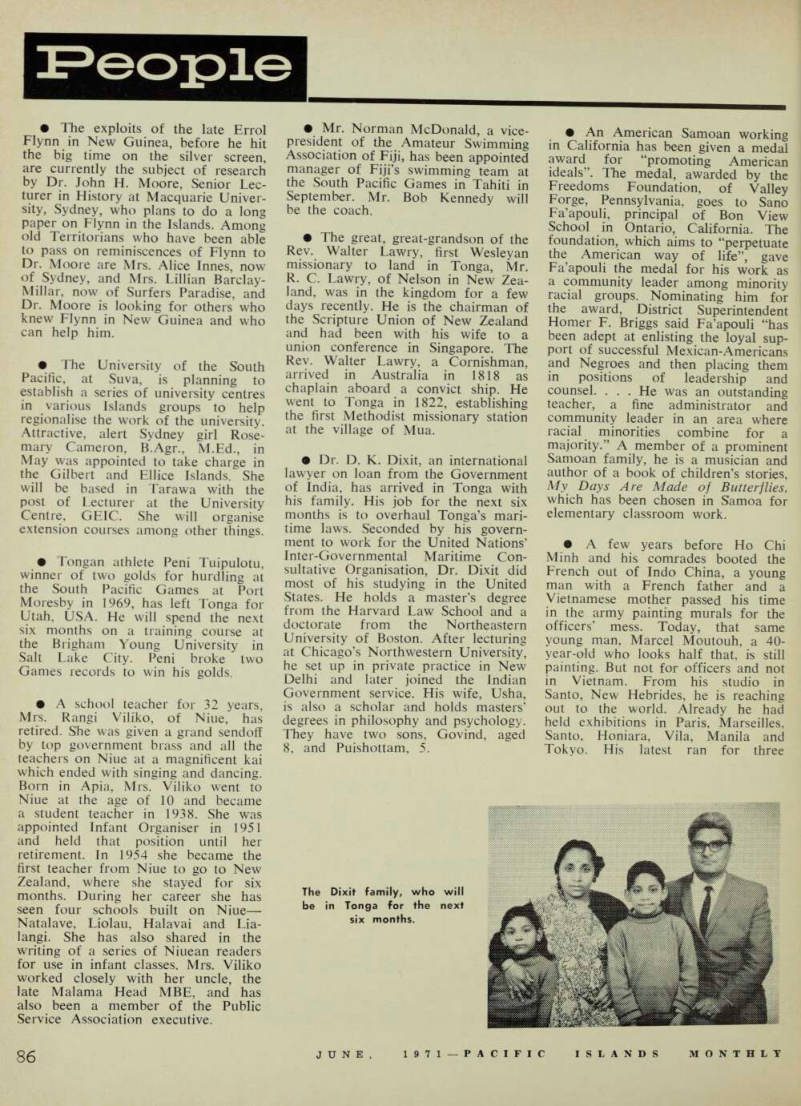
R. C. Lawry, of Nelson in New Zea land, was in the kingdom for a few days recently. He is the chairman of the Scripture Union of New Zealand and had been with his wife to a union conference in Singapore. The Rev. Walter Lawry, a Cornishman, arrived in Australia in 1818 as chaplain aboard a convict ship. He went to Tonga in 1822, establishing the first Methodist missionary station at the village of Mua. • Dr. D. K. Dixit, an international lawyer on loan from the Government of India, has arrived in Tonga with his family. His job for the next six months is to overhaul Tonga’s mari time laws. Seconded by his govern ment to work for the United Nations’
Inter-Governmental Maritime Con sultative Organisation, Dr. Dixit did most of his studying in the United States. He holds a master’s degree from the Harvard Law School and a doctorate from the Northeastern University of Boston. After lecturing at Chicago’s Northwestern University, he set up in private practice in New Delhi and later joined the Indian Government service. His wife, Usha, is also a scholar and holds masters’ degrees in philosophy and psychology.
They have two sons, Govind, aged 8, and Puishottam, 5.
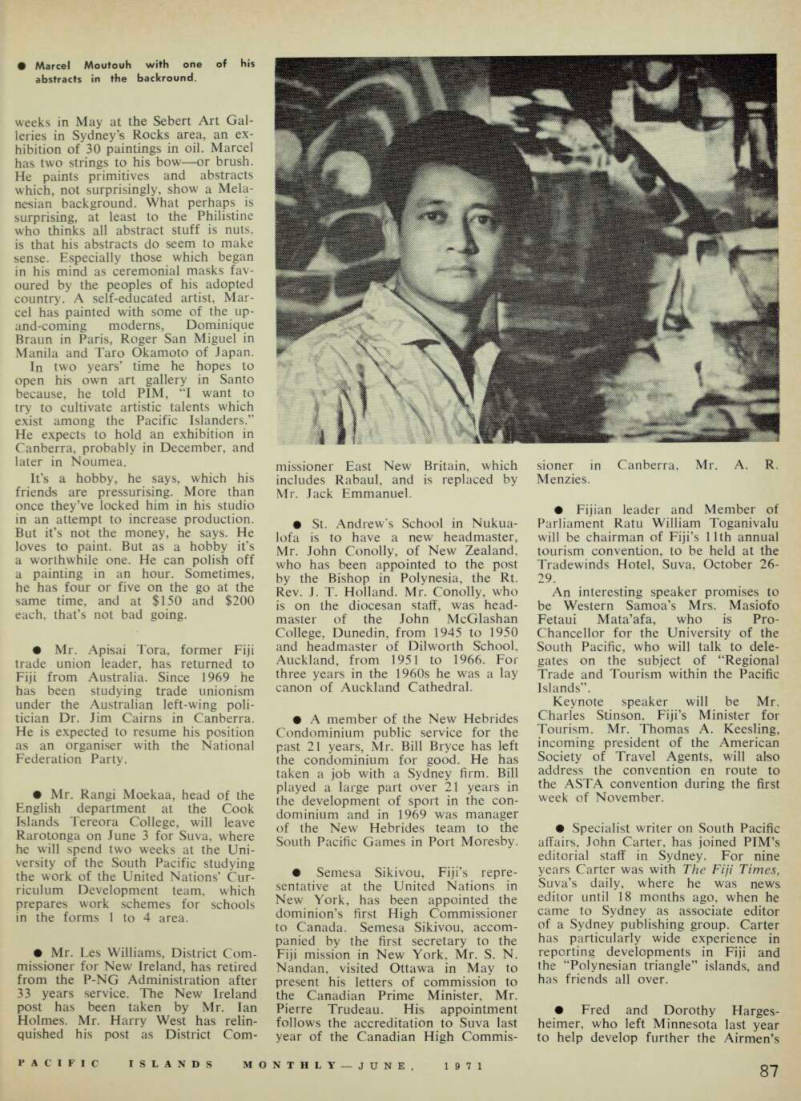
• An American Samoan working in California has been given a medal award for “promoting American ideals”. The medal, awarded by the Freedoms Foundation, of Valley Forge, Pennsylvania, goes to Sano Fa’apouli, principal of Bon View School in Ontario, California. The foundation, which aims to “perpetuate the American way of life”, gave Fa’apouli the medal for his work as a community leader among minority racial groups. Nominating him for the award, District Superintendent Homer F. Briggs said Fa’apouli “has been adept at enlisting the loyal sup port of successful Mexican-Americans and Negroes and then placing them in positions of leadership and counsel. . . . He was an outstanding teacher, a fine administrator and community leader in an area where racial minorities combine for a majority.” A member of a prominent Samoan family, he is a musician and author of a book of children’s stories, My Days Are Made of Butterflies, which has been chosen in Samoa for elementary classroom work. • A few years before Ho Chi Minh and his comrades booted the French out of Indo China, a young man with a French father and a Vietnamese mother passed his time in the army painting murals for the officers’ mess. Today, that same young man, Marcel Moutouh, a 40year-old who looks half that, is still painting. But not for officers and not in Vietnam. From his studio in Santo, New Hebrides, he is reaching out to the world. Already he had held exhibitions in Paris, Marseilles, Santo, Honiara, Vila, Manila and Tokyo. His latest ran for three
The Dixit family, who will be in Tonga for the next six months.
weeks in May at the Sebert Art Gal leries in Sydney’s Rocks area, an ex hibition of 30 paintings in oil. Marcel has two strings to his bow—or brush.
He paints primitives and abstracts which, not surprisingly, show a Mela nesian background. What perhaps is surprising, at least to the Philistine who thinks all abstract stuff is nuts, is that his abstracts do seem to make sense. Especially those which began in his mind as ceremonial masks fav oured by the peoples of his adopted country. A self-educated artist, Mar cel has painted with some of the up and-coming moderns, Dominique Braun in Paris, Roger San Miguel in Manila and Taro Okamoto of Japan.
In two years’ time he hopes to open his own art gallery in Santo because, he told PIM, “I want to try to cultivate artistic talents which exist among the Pacific Islanders.”
He expects to hold an exhibition in Canberra, probably in December, and later in Noumea, It’s a hobby, he says, which his friends are pressurising. More than once they’ve locked him in his studio in an attempt to increase production.
But it’s not the money, he says. He loves to paint. But as a hobby it’s a worthwhile one. He can polish off a painting in an hour. Sometimes, he has four or five on the go at the same time, and at $l5O and $2OO each, that’s not bad going. • Mr. Apisai Tora, former Fiji trade union leader, has returned to Fiji from Australia. Since 1969 he has been studying trade unionism under the Australian left-wing poli tician Dr, Jim Cairns in Canberra.
He is expected to resume his position as an organiser with the National Federation Party. • Mr. Rangi Moekaa, head of the English department at the Cook Islands Tereora College, will leave Rarotonga on June 3 for Suva, where he will spend two weeks at the Uni versity of the South Pacific studying the work of the United Nations’ Cur riculum Development team, which prepares work schemes for schools in the forms 1 to 4 area. • Mr. Les Williams, District Com missioner for New Ireland, has retired from the P-NG Administration after 33 years service. The New Ireland post has been taken by Mr. lan Holmes. Mr. Harry West has relin quished his post as District Com
missioner East New Britain, which includes Rabaul, and is replaced by Mr. Jack Emmanuel. • St. Andrew's School in Nukua lofa is to have a new headmaster, Mr. John Conolly, of New Zealand, who has been appointed to the post by the Bishop in Polynesia, the Rt.
Rev. J. T. Holland. Mr. Conolly, who is on the diocesan staff, was head master of the John McGlashan College, Dunedin, from 1945 to 1950 and headmaster of Dilworth School, Auckland, from 1951 to 1966. For three years in the 1960 s he was a lay canon of Auckland Cathedral. • A member of the New Hebrides Condominium public service for the past 21 years, Mr. Bill Bryce has left the condominium for good. He has taken a job with a Sydney firm. Bill played a large part over 21 years in the development of sport in the con dominium and in 1969 was manager of the New Hebrides team to the South Pacific Games in Port Moresby. • Semesa Sikivou, Fiji’s repre sentative at the United Nations in New York, has been appointed the dominion’s first High Commissioner to Canada. Semesa Sikivou, accom panied by the first secretary to the Fiji mission in New York, Mr. S. N.
Nandan, visited Ottawa in May to present his letters of commission to the Canadian Prime Minister, Mr.
Pierre Trudeau. His appointment follows the accreditation to Suva last year of the Canadian High Commis
sioner in Canberra, Mr. A. R.
Menzies. • Fijian leader and Member of Parliament Ratu William Toganivalu will be chairman of Fiji’s 11th annual tourism convention, to be held at the Tradewinds Hotel, Suva, October 26- 29.
An interesting speaker promises to be Western Samoa’s Mrs. Masiofo Fetaui Mata’afa, who is Pro- Chancellor for the University of the South Pacific, who will talk to dele gates on the subject of “Regional Trade and Tourism within the Pacific Islands”.
Keynote speaker will be Mr.
Charles Stinson, Fiji’s Minister for Tourism. Mr. Thomas A. Keesling, incoming president of the American Society of Travel Agents, will also address the convention en route to the ASTA convention during the first week of November. • Specialist writer on South Pacific affairs, John Carter, has joined PlM’s editorial staff in Sydney. For nine years Carter was with The Fiji Times, Suva’s daily, where he was news editor until 18 months ago, when he came to Sydney as associate editor of a Sydney publishing group. Carter has particularly wide experience in reporting developments in Fiji and the “Polynesian triangle” islands, and has friends all over. • Fred and Dorothy Harges heimer, who left Minnesota last year to help develop further the Airmen’s
Marcel Moutouh with one of his abstracts in the backround.
Memorial School and Hospital at Ewasse, New Britain—the complex which Fred got started as a practical gesture to the people who saved his life during World War ll—report that they are enjoying their work even more than they expected, despite the inevitable frustrations. It would be no surprise if they decided to ex tend their stay for another 12 months. • Port Moresby journalist and public relations man Denis Fisk is back in his home town, Sydney, after a second round of a love-hate re lationship with Papua-New Guinea.
He says he probably hasn’t turned his back on the territory permanently.
As a going-away present his wife, Suzanne, presented him with a son, Jason, who was born on the same day, March 31, as was their daughter three years previously. • Mr. David Eakins, after 20 years with the State Electricity Commission of Victoria has been appointed Commissioner of the Papua-New Guinea Electricity Commission. He succeeds Mr. J. A. Y. Rutter, who retires in June. • Dr. Darrell Tryon and his family returned to Australia from Vila in late April after having spent nine months in the group during which Dr. Tryon headed a research project into the 100 or so New Hebrides languages. He hopes that the work will enable him to map the paths of early migration and settlement in the New Hebrides. He will make a preliminary report by the end of the year, but final results won’t be avail able until next year. Dr. Tryon, a New Zealander, is a Research Fellow in Linguistics at the Research School of Pacific Studies at the ANU, Canberra, and has published gram mars and dictionaries of the languages of New Caledonia and the Loyalty Islands, and recently published an introduction to Tahitian, titled Con versation Tahitian. • Bishop Ravu Henao, of the United Churches of Papua-New Guinea, spent a fortnight on Raro tonga in April as guest of the Cook Islands Christian Church. During that time he visited all the island’s churches, gave talks, played cricket and went fishing with the locals. The Bishop is a keen fisherman and earned his living as a fisherman in his younger days. He was prompted to visit the Cooks because Cook Islands’ missionaries took the gospel to Papua over a century ago, and, he said in Rarotonga the Papuans regard the Cook Islands Christian Church as their parent church.