Whither Norfolk? A cloudy future
pp. 18-127 · Read in the full issue
for a profitable tax haven
By Stuart Inder
New companies legislation which is to be applied at any moment to Norfolk Island will, in the long term, close down the island as a tax haven, or “capital refuge”. When that happens the econo mic boom that the island has experienced in recent years will burst.
Are these statements true or false?
There are opposing views.
The answer seems to be that no body knows for sure what effect Nor folk’s new company legislation is go ing to have, and only one thing is certain: Norfolk will get the legisla tion whether it likes it or not.
The new legislation was approved by the Norfolk Island Council (an advisory body) in April, and in May at a special meeting the council re scinded approval on the ground that not all councillors had been present at the earlier meeting, and that the councillors needed further time, and expert advice, to make a decision. The recission motion was objected to by the council chairman, Norfolk’s Ad ministrator, Air Commodore R. N, Dalkin.
The council is currently getting the expert advice in Sydney, but it will probably come too late to do it any good.
The draft ordinance is a fat and technical document. Its main provi sions are based on the Australian Uniform Company Legislation, and it seeks among other things to have companies file returns showing direc tors, share allotments, etc.; it lays down requirements of a prospectus; gives the Norfolk registrar powers to strike a company off the register; lays down audit requirements for com panies and makes provision for the inspection of books if shareholders request an investigation; and it fixes an annual filing fee of $250 for every company on filing a return (which in cludes a balance sheet). Companies defined as “local” such as companies carrying on business as shopkeepers and tradesmen on the island, need pay only $5O filing fee, but must file profit and loss accounts to prove their bona fides.
The audit and require ments have caused alarm in some quarters on Norfolk, coming as they do upon recent request by the Aus tralian Taxation Department for some Norfolk companies to supply tax re turns. There is no income tax on Nor folk Island, which is an Australian territory 900 miles north-east of Syd ney, and the Australian High Court
currently has listed for hearing a case in which a Norfolk-registered com pany, Esquire Nominees, will argue that the Australian Government is not
entitled to tax the islanders (PIM, Apr., p. 97). In May this application was further put over until later in the year. Norfolk Islanders are frightened that the new Company Ordinance will be used as a weapon to introduce in come tax on Norfolk.
In late May the Australian Minis ter for External Territories, Mr. C. E.
Barnes, made a visit to Norfolk and had talks with councillors and local businessmen about the ordinance.
Before his departure Mr. Bames personally put the government’s point of view over the Norfolk Island radio, and at a news conference on the island.
In his broadcast Mr. Barnes said that in the eight years he had been Minister, no ordinance had been made affecting Norfolk Island contrary to the wishes of the council, and he was greatly concerned at the difference of opinion between the government and some councillors over the Norfolk Island Company Ordinance.
The government was not bound to accept the advice of the council, and he could not accept that the govern ment ought never to legislate against the wishes of the council, especially where an ordinance affected the island’s relationship with Australia and with other countries.
“I think the proposed ordinance comes into this class, he said. “It affects the island’s financial dependence upon the Commonwealth. It affects the Australian system of company regulation since companies can avoid some of the provisions of that legisla tion under the present Norfolk Island legislation.
“The proposed ordinance mainly affects companies that do not have any substantial trading connection with Norfolk. You all know that seven years ago only about 20 companies were registered in Norfolk Island; to day there are over 1,500 and it is acknowledged that a large proportion of these have Australian or overseas connections.
“Through this increase in company registrations the island is abandoning its traditional isolation and becoming
(Continued on p. 125)
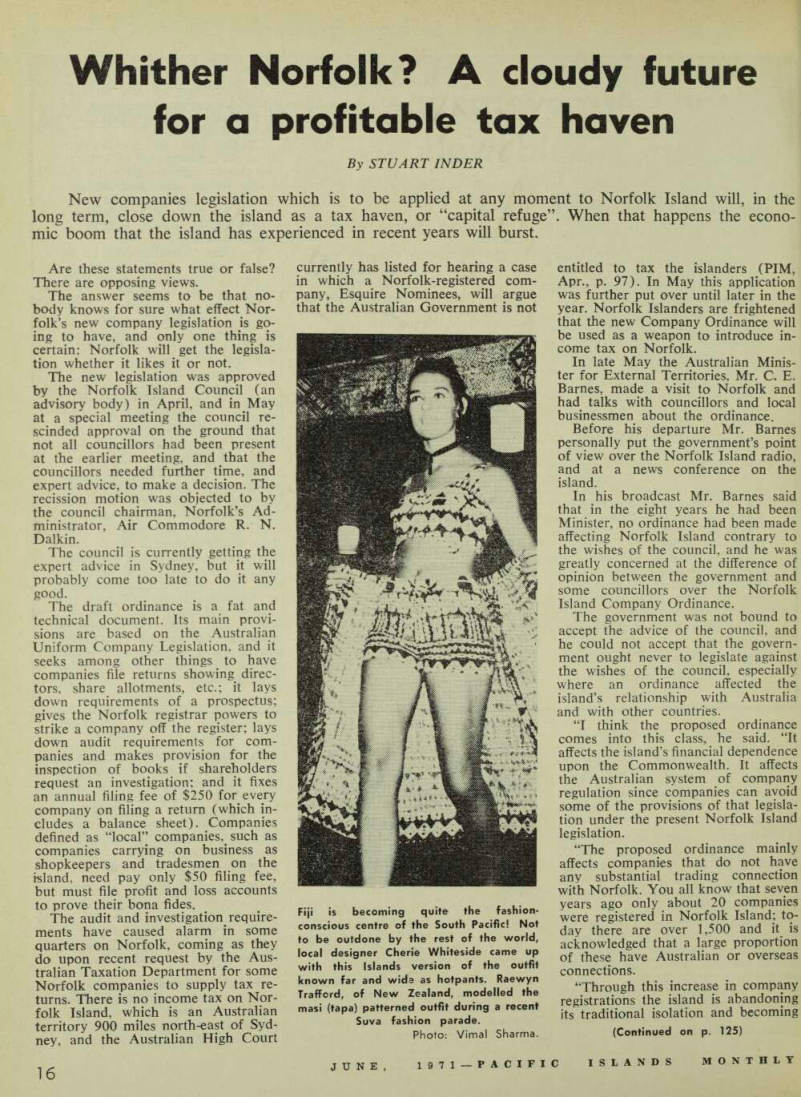
Fiji is becoming quite the fashion conscious centre of the South Pacific! Not to be outdone by the rest of the world, local designer Cherie Whiteside came up with this Islands version of the outfit known far and wide as hotpants. Raewyn Trafford, of New Zealand, modelled the masi (tapa) patterned outfit during a recent Suva fashion parade.
Photo: Vimal Sharma.
closely involved with the Australian financial structure. With the registra tion of these companies it must be expected that Australia must extend some control here”.
Mr. Barnes said that contrary to some views he had heard, the Com monwealth Taxation Department had had nothing to do with the prepara tion of the ordinance. It was not true that all companies would need to be audited, and he saw no reason why audit fees should be high. Genuine Norfolk Island companies would not have to pay the annual filing fee of $250.
The main purpose of this increase in fees (from $l3) was to get in creased revenue for the island. Under the present company operations on Norfolk only a few people benefited from company registration, and the government’s proposal was “aimed at benefiting the island as a whole”.
Norfolk urgently needed extra revenue, otherwise expenditure would have to be cut on various capital projects.
It had been said that the bigger fees would drive overseas companies away from Norfolk, but there had been no suggestion from the company representatives that the companies could not pay the increased fees, and one might ask oneself whether companies which had sought “the sub stantial financial advantages of incor poration on Norfolk would be driven away by a fee of $250”.
Mr. Barnes said there had been complaints that there had not been sufficient time to consider the ordin ance. But the council had first decided to adopt provisions based on the Uni form Company Legislation in March, 1968; the draft had been considered at three recent council meetings and it had been extensively discussed by company representatives with officers of his department. Every month that went by without the new fees saw a loss of revenue which the island sorely needed, Mr. Bames said, add ing: “I think that what I have said has made my opinions upon the pro posed ordinance fairly clear”.
Just in case there was any doubt about the clarity, Mr. Barnes gave more information at his news confer ence.
He said Australia was the “top in vestment country in the world today”, and Australia was going to attract in vestment capital “whether it comes via Norfolk Island or not”. Funds came in through Norfolk because this avenue was of financial benefit to the
people who provided the funds, and not to Australia.
A tax haven was something the islanders didn’t want, “and certainly something Australia doesn’t want”.
Should the proposed ordinance dis courage the present financial opera tions on Norfolk, Australia would benefit, to a minor degree.
Asked whether the ordinance “had been designed to deter companies from using Norfolk Island as a tax haven”, Mr. Barnes said that as the Minister it was a matter of concern to him that company registrations had grown on the island, yet the island people were not profiting to any degree. It was only reasonable that the companies should make a contri bution.
He was not aware of what the tax ation department thought about it, but any prudent person must realise that if things went to extremes the tax ation department must consider some sort of action.
While he did not anticipate that companies would remove themselves from the island as a result of the ordinance, the government had gone into the legislation deliberately, and was prepared for whatever conse quences there might be, Mr. Barnes added.
After all these statements by the Minister it is obvious that the Com monwealth Government won’t lose any sleep if Norfolk Island is closed down as a tax haven.
I don’t believe that the Department of Territories thinks that it will be closed down. I think it genuinely be lieves the ordinance will mean more money for the island, and improved legislation.
But the ordinance is such a mixture of legislation that it might operate in a way contrary to that intended. And there are some sections of it which have made some company experts query the expressed motives of its draughtsmen.
Referring to it as an “abomina tion”, one Sydney solicitor said the ordinance gave the government powers to have solicitors reveal con fidential company information. It also required companies to disclose whether they had granted options for others to take up shares in the future, and this was both a unique and dan gerous requirement. It would have been better, he said, if the Australian Uniform Company Legislation had been adopted in toto, rather “than the present mish-mash”.
There is clearly great confusion as
to the effects of some of the provi sions of the ordinance. The Norfolk Island Administration believes that of the 1,500 companies registered on Norfolk, only from 50 to 100 will require an audit under the regulations, and that most of the tax haven com panies will not be affected. The local professionals believe that most com panies will have to be audited.
The confusion about this and other provisions points to lack of real com munication between the government and the business community. Copies of the draft legislation, for instance, have been scarce as rubber coconuts.
As a whole, Norfolk Island resi dents do not understand the ordin ance. The present agitation centres around the councillors and local busi nessmen, particularly the professional people—solicitors and accountants — who are operating the machinery of company incorporation on the island.
For them, the island’s present tax-free status is extraordinarily lucrative.
Only a small proportion of the islanders benefit directly, through directors’ fees and other payments from the 1,500 companies registered there, most of them for the purpose of tax avoidance. Each company must have at least two local directors.
But undoubtedly the rise of the is land as a tax haven has improved the island economy generally. Business men arrive on every plane for com pany meetings or to inspect the situ ation, and hotels, shops and small local industries benefit from the new money. Present company fees bring the Administration something like $50,000 a year, and customs receipts are rising—currently they are worth almost $130,000 a year, not including profit on liquor—all of which is im ported and sold by the government.
This prosperity is the reason why the council as a body is not now in agreement with the ordinance it asked for three years ago. In the interval some of the members have personally come to appreciate the value of tax haven status. • See "Up Front with the Editor", p. 9.