Despite The French,
pp. 16-17 · Read in the full issue
Autonomists Romp In
From a Papeete correspondent Despite strenuous efforts by the French Administration of French Polynesia to achieve a contrary result, members of the territory’s two pro-self-govemment parties won all 27 seats in elec tions for the Papeete municipal council at the beginning of May.
The French made use of their resources of propaganda, directed the coalition of two anti-autonomist parties, and enrolled numerous French troops as voters in their efforts to defeat the autonomists. But the autonomists still romped in with 55 per cent, of the votes.
According to Mr. Jean Millaud, who has just retired as president of the Territorial Assembly, some of the French troops enrolled as voters had only just arrived in the territory by plane, and virtually none of the troops had, or was ever likely to have, any stake in the territory.
The autonomists hailed the election result as “a severe defeat” for the French Government’s “colonialist and centralist policy” towards French Polynesia, and called for a dialogue between the government and the ter ritory’s political leaders on the political future of the territory.
“To refuse this dialogue,” Mr.
Millaud said in an address to the Governor, Mr. Pierre Angeli, at the opening of the Territorial Assembly’s administrative session on May 13, “is a negative attitude which will not suppress the problem and will not lead to any solution.”
The Papeete elections were held at the same time as elections in French Polynesia’s three other com munes (municipalities)—Faaa and Pirae (Tahiti) and Uturoa (Raiatea).
They resulted in the return to office of all four outgoing mayors— Mr. Georges “Tetua” Pambrun (Papeete), Mr. Francis Sanford (Faaa), Mr. Gaston Flosse (Pirae) and Mr. Philippe Brotherson (Uturoa).
Three of the mayors, Messrs.
Pambrun, Sanford and Brotherson, are strong supporters of the move ment for internal self-government for the territory, an issue which generally overshadowed parish pump problems during the election cam paign.
Mr. Henri Bouvier, a spokesman for the autonomists, claimed during the campaign that the opponents of internal self-government were deliberately misrepresenting what the
autonomists aimed to achieve, and were thereby trying to panic electors into voting against them. (See panel).
After the election, Mr. Bouvier also claimed that the Governor’s office had been “transformed into an electoral office” since February and that “certain services of police” had been employed “in the lowest work of propaganda” to help the anti autonomist cause.
Twenty-seven council seats were contested in Papeete, Faaa and Pirae and 21 in Uturoa.
Four teams of candidates of varying political colours battled for the Papeete seats, three for Faaa, and two each for Pirae and Uturoa.
In Faaa, Pirae and Uturoa, all seats were decided in the first round of elections of May 1. But in Papeete a second round was needed to deter mine the composition of the full council.
Teams composed of members of the Here Ai’a and E’a Api, the two autonomist parties which form the majority coalition in the Territorial Assembly, were opposed to each other in Faaa and Uturoa.
Broadly speaking, the E’a Api (New Ways Party) draws its fol lowers from the part-Tahitian, part- European urban residents and “white collar” workers, while the strength of the Here Ai’a (Patriot’s Party) springs from the rural Polynesians, In urban Faaa, Mr. Sanford (E’a Api) led his team to an easy victory with 77 per cent, of the votes to 6 per cent, for the Here Ai’a team and 16 per cent, for a team led by Mr.
Francis Fuller. Mr. Sanford has been mayor of Faaa since it became a commune in 1965. He is also a lead ing member of the Territorial As sembly and deputy for French Polynesia in the French Parliament.
In the Uturoa election, the team led by Mr. Brotherson (Here Ai’a) gained 80 per cent, of the votes against the team of Mr. Roger Amiot (E’a Api).
Neither the Here Ai’a nor E’a Api fielded a team in Pirae, where many French troops are stationed, and Mr.
Flosse, an opponent of internal self-government, led his team to an easy victory with 85 per cent, of the votes.
In the four-sided Papeete election, only three candidates in the 27-man team headed by Mr. Pambrun gained the required 50 per cent, of votes in the first round of the election to win their seats. So a run-off poll had to be held the following week. Mr. Pam brun’s team included members ol both the Here Ai’a and E’a Api.
A feature of the first round was the dismal defeat of a team led by Senator Alfred Poroi, a former mayor, who was attempting to win back the mayoralty after a lapse ol five years.
Senator Poroi, a fervent supporter
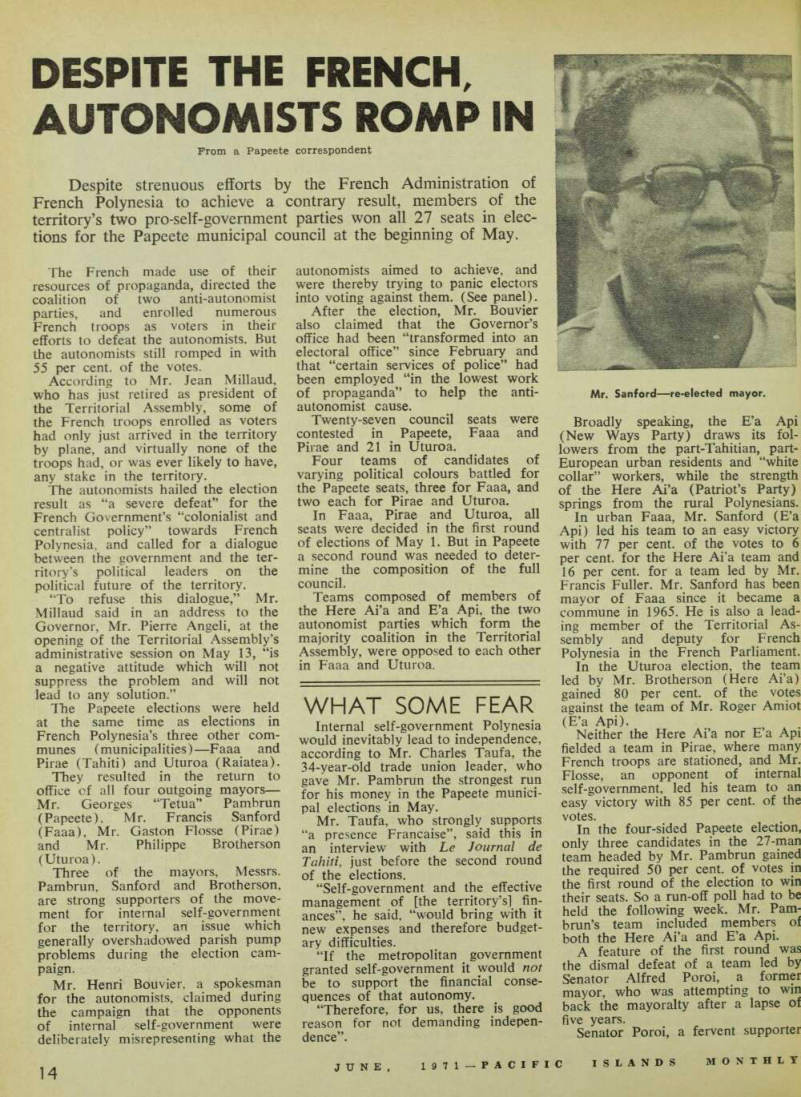
Mr. Sanford —re-elected mayor.
of “la presence Francaise” and a member of the UDR (the party of President Pompidou), was mayor of Papeete for 24 years until Mr.
Pambrun beat him at the last election in 1966 (PIM, Nov., 1966, p. 12).
Mr. Pambrun then had the support of Mr. Charles Taufa, a prominent, 34-year-old trade union leader. But this time Mr. Taufa, who also favours “la presence Francaise,” led one of the opposing teams.
The fourth team in the election was headed by Mr. J. B. Ceran- Jerusalemy, a veteran radical leader, whose political career has been on the skids in recent years.
Only 65 per cent, of the electorate registered votes in the first round, when the leaders of the four teams polled as follows:
Pambrun 3,520 Taufa 2,111 Poroi 1,411 Ceran-Jerusalemy 208 About 200 additional electors, bringing the total to 67.4 per cent, of the electorate, went to the polls for the second round. They included, ap parently, some newly-arrived French troops.
The remaining 24 members of Mr.
Pambrun’s team gained an average of about 4,050 votes each to about 3,050 for their opponents, and so won the 24 outstanding seats.
The outcome of the municipal elections will almost certainly cost Senator Poroi his seat in the French Senate.
Senator Poroi’s term in the Senate,
which began in 1962, is due to expire this month (June). It will then be the task of an electoral college, designated by the territory’s elected representatives municipal council lors, Territorial Assemblymen, and members of the Chambers of Com merce and Agriculture to choose a senator for a new term.
As the autonomists, through their successes in the municipal elections, control a majority of votes in the electoral college, there is little doubt that the new senator will be a man of their own political persuasion.
French Polynesia’s two represen tatives in the French Parliament would thus both be autonomists, a situation not likely to appeal to the French Government.