Song of the Solomons: Self
pp. 14-15 · Read in the full issue
Pacific Islands Monthly
Song of the Solomons: Self government costs more
Prom a Honiara correspondent The Solomons’ Governing Council members got down to some hard work in May, paving the way to prosperity. The job in hand was the long-awaited Sixth Development Plan which will cover the period 1971-4.
Though there were no fireworks, members demonstrated that they had no intention of being just rubber stamps, and at the end of the first week they were barely halfway through the committee stage.
In the main, however, they seemed to approve the plan which had con stituted their homework for several weeks before the meeting.
Financial Secretary John Smith, who is a comparative newcomer to the House, was warmly applauded for his introduction of the plan in a lengthy but concise speech in which he paraded his priorities—and his hopes.
Development meant balanced growth, he said, and that was what he was planning for. The goal was a better quality of life for everyone in the Solomons.
He explained that planning was largely concerned with deciding priorities which were dominated by the unusually high dependence of the Solomons on external aid.
The first priority was to encourage internal growth by developing agri culture, forestry and mining.
Here he mentioned the very favour able agreement signed with the Mitsui Mining Company in Japan recently over the bauxite deposits on Rennell.
He said that trial mining was to begin in the first half of next year.
The government team had also signed an agreement with the Taiyo Fishing Company in Japan, for an 18-month survey of fishing potential in the Solomons. The company, one of the biggest in the world, would report every two months to govern ment. (See stories, pp. 118, 127.) The second priority was to de velop manpower.
He warned members that only by keeping strictly to the plan could the Solomons be well on the way to complete economic viability by the end of the decade.
Overall public expenditure was estimated at about $16.5m and 510.25 m of this was for productive investment, with agriculture taking more than $2.5m.
He anticipated substantial private investment in timber, mining and agriculture.
In the development sector nearly ssm would provide for basic com munications and public utilities infrastructure. Half of this sum would be devoted to roads. Social services had been allocated $4.5m and administration $ 1.75 m.
Capital funds for the plan would come mostly from the UK, where the Overseas Development Adminis tration had already indicated en dorsement of the general emphasis of the plan, and aid would be sought from the UN Development Pro gramme.
He had hopes too, he said, of aid from the Asian Development Bank, as a result of their associate mem bership of ECAFE. He hoped associ-
ations with the Australian South Pacific Aid Programme and the vol unteer programmes of New Zealand and USA would also continue.
Capital expenditure would result in new commitments and increased recurrent expenditure, and he was determined to find those increased costs from Solomons’ revenue, and also progressively reduce during the decade the dependence of the coun try on budgetary aid.
The writing seems to be on the wall for increased taxation in the next budget, as he went on to tell the House that he wanted to ensure that all sectors of the community played their fair role in the raising of the revenue.
He then described what he called “the sting in the tail” of his speech —some adjustments to the customs tariff.
The increases, which he said rep resented an increase in the cost of leisure and not in the cost of living, were: • From 20 per cent, to 35 per cent, on passenger cars with engine capacity of more than 1,500 cc; • A 20 per cent, preferential duty on ships and boats not exceed ing 15 tons; • From 20 per cent, to 35 per per cent, preferential duty on cameras, projectors, photographic materials, gramophones and tape re corders; • From 20 per cent, to 30 per cent, on clocks and watches; • From 20 per cent, to 25 per cent, on gramophones and tapes, and, • From 25 per cent, to 50 per cent, on jewellery.
Stressing that the Solomons rice industry needed sufficient protection in the near future to make sure it did not fail, he announced an in crease of 2c a pound in the prefer
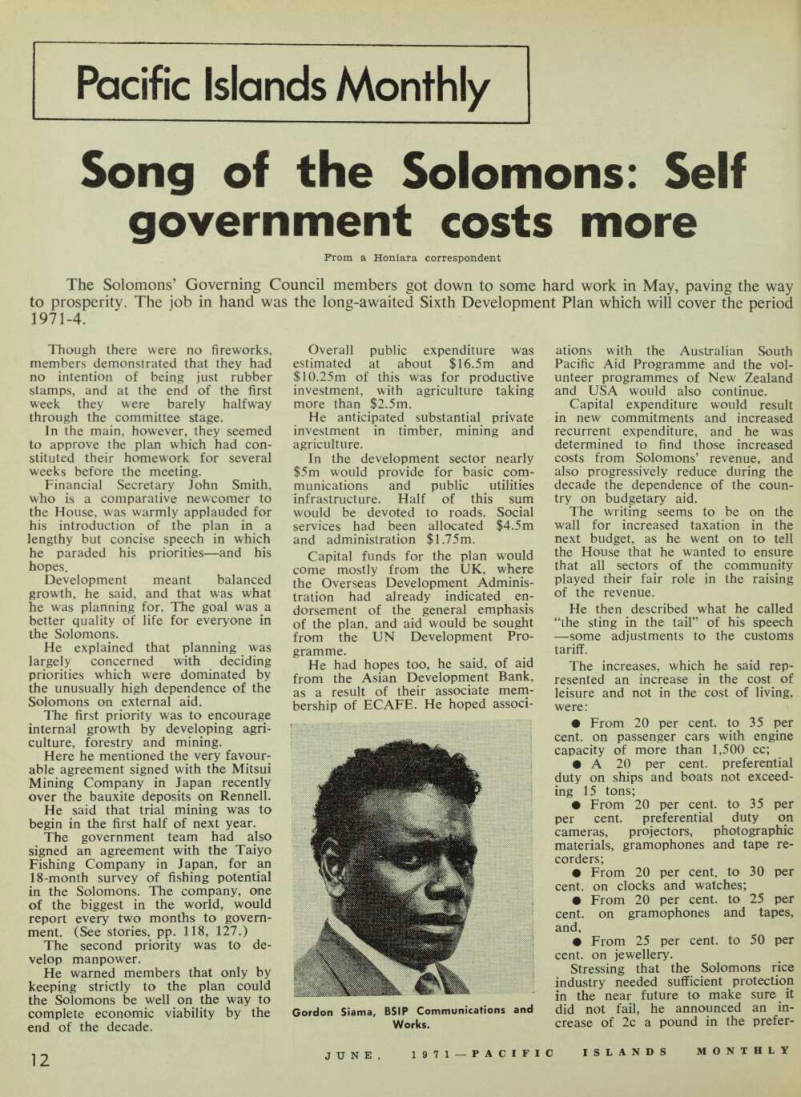
Gordon Siama, BSIP Communications and Works.
ential duty on rice, bringing it up to 3c.
When the country was required to stand on its own feet as far as a monetary system was concerned, said the Financial Secretary, it must be ensured that foodstuffs were not im ported unnecessarily. (Australian rice will now retail in Honiara at about $7 a sack, compared with the locally grown at about $4.50).
Although there was general ap proval in the debate which followed, members were worried about some schemes, and many deplored the omis sion of another government second ary school from the plan.
Several too were suspicious of the change of policy of giving grants to church secondary schools to make up for the omission.
There was also concern by many that the education system was geared too much to the mere production of manpower.
Peter Thompson, in particular, spoke eloquently about the dangers of exclusive education.
Alfred Maeke was supported by several of his colleagues when he called for the seven years primary schooling to be raised to 10 years for all children, whether bright or dull, poor or rich.
Agriculture came in for some knocks, and Joe Bryan, himself a plantation owner, described this sec tion as being written by “desk farm ers” who had clearly never had to earn their living on the land.
Chief Secretary Tom Russell aroused laughter later when, admitting to being one of the “desk farmers”, he said he ploughed the fields and scattered development plans and white papers on the land.
Money allocated for agriculture re search came under fire too, particu
larly the provision for a new experi mental farm on the Guadalcanal Plains.
Localisation was brought up seve ral times by Peter Salaka, who de scribed it as his favourite subject. He was concerned that there was no de tailed firm localisation programme in the plan, and nobody appointed to carry it out.
He had the support of many of the elected members in this, but the Chief Secretary warned that a Civil Service could not be run efficiently without a certain amount of continuity and ex perience.
Graduates fresh from university would not necessarily be as efficient for some years as the older and more experienced men they sought to re place, and a service with impaired efficiency could slow down the plan’s implementation.
The Financial Secretary said a localisation plan should be ready for submission to the House before the end of 1971.
To the observer, members on both sides of the House seemed to be more into the swing of the committee sys tem, and there were fewer issues be ing thrashed out on the floor which should have been brought up in com mittee.
The four Solomon Islander chair men are obviously learning by experi ence.
One could pick out, particularly, Gordon Siama of Communications and Works. He defended with courage and some spirit his committee’s deci sion to raise fares and freight charges on government vessels.
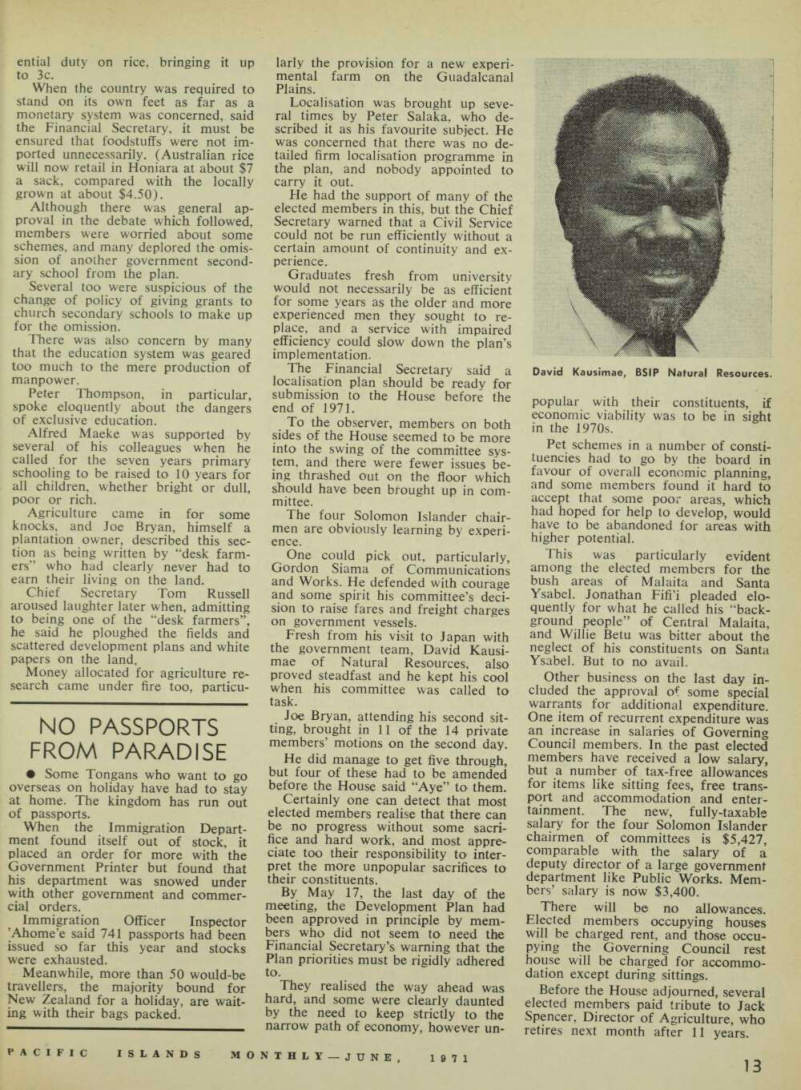
Fresh from his visit to Japan with the government team, David Kausi mae of Natural Resources, also proved steadfast and he kept his cool when his committee was called to task.
Joe Bryan, attending his second sit ting, brought in 11 of the 14 private members’ motions on the second day.
He did manage to get five through, but four of these had to be amended before the House said “Aye” to them.
Certainly one can detect that most elected members realise that there can be no progress without some sacri fice and hard work, and most appre ciate too their responsibility to inter pret the more unpopular sacrifices to their constituents.
By May 17, the last day of the meeting, the Development Plan had been approved in principle by mem bers who did not seem to need the Financial Secretary’s warning that the Plan priorities must be rigidly adhered to.
They realised the way ahead was hard, and some were clearly daunted by the need to keep strictly to the narrow path of economy, however un-
popular with their constituents, if economic viability was to be in sight in the 19705.
Pet schemes in a number of consti tuencies had to go by the board in favour of overall economic planning, and some members found it hard to accept that some poor areas, which had hoped for help to develop, would have to be abandoned for areas with higher potential.
This was particularly evident among the elected members for the bush areas of Malaita and Santa Ysabel. Jonathan Fifi’i pleaded elo quently for what he called his “back ground people” of Central Malaita, and Willie Betu was bitter about the neglect of his constituents on Santa Ysabel. But to no avail.
Other business on the last day in cluded the approval of some special warrants for additional expenditure.
One item of recurrent expenditure was an increase in salaries of Governing Council members. In the past elected members have received a low salary, but a number of tax-free allowances for items like sitting fees, free trans port and accommodation and enter tainment. The new, fully-taxable salary for the four Solomon Islander chairmen of committees is $5,427, comparable with the salary of a deputy director of a large government department like Public Works. Mem bers’ salary is now $3,400.
There will be no allowances.
Elected members occupying houses will be charged rent, and those occu pying the Governing Council rest house will be charged for accommo dation except during sittings.
Before the House adjourned, several elected members paid tribute to Jack Spencer, Director of Agriculture, who retires next month after 11 years.
David Kausimae, BSIP Natural Resources.