Book Reviews
p. 53 · Read in the full issue
An art at which the Nauruans excelled
Early this century, an American woman, Mrs. Caroline Furness Jayne, discovered to her surprise that the world’s most expert makers of string figures (commonly known as cat’s cradles) were the inhabitants of a small Pacific island that few people had then heard of—Nauru.
In a book on string figures which Mrs. Jayne published in New York in 1906, she included illustrations of 15 Nauruan string figure patterns which her brother, who had visited Micronesia, had sent her mounted on paper.
Mrs. Jayne thought the patterns so intricate that she could not imagine how they had been made. In fact, she doubted whether they had been formed on the hands at all, and sug gested that, to some extent, they may have been made “artificially”.
Twenty-five years after Mrs. Jayne’s book was published, Mrs. Honor Maude, wife of a British administra tive officer in the Gilbert Islands, read it and developed an urge to visit Nauru to see if string-figure making was still practised there.
This she did in 1937, and although it seemed at first- that changing ways brought about by the exploitation of the island’s phosphate over the previous 30 years, had vanquished the practitioners of the old art, it turned out that a small group of experts (mainly old men) could still be gathered together.
There and then, Mrs. Maude set about learning all she could about the Nauruans’ remarkable dexterity, a process that was facilitated by her knowledge of more than 100 Gilbertese string figures.
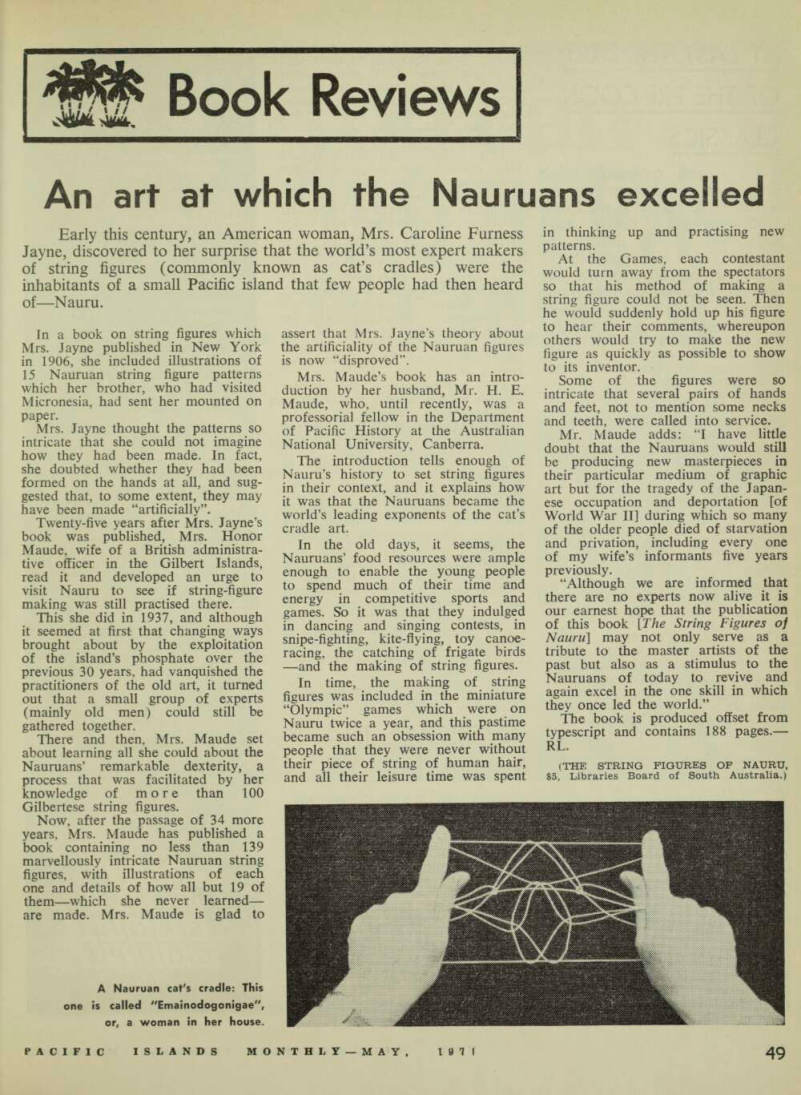
Now, after the passage of 34 more years, Mrs. Maude has published a book containing no less than 139 marvellously intricate Nauruan string figures, with illustrations of each one and details of how all but 19 of them—which she never learned — are made. Mrs. Maude is glad to
assert that Mrs. Jayne’s theory about the artificiality of the Nauruan figures is now “disproved”.
Mrs. Maude’s book has an intro duction by her husband, Mr. H. E.
Maude, who, until recently, was a professorial fellow in the Department of Pacific History at the Australian National University, Canberra.
The introduction tells enough of Nauru’s history to set string figures in their context, and it explains how it was that the Nauruans became the world’s leading exponents of the cat’s cradle art.
In the old days, it seems, the Nauruans’ food resources were ample enough to enable the young people to spend much of their time and energy in competitive sports and games. So it was that they indulged in dancing and singing contests, in snipe-fighting, kite-flying, toy canoe racing, the catching of frigate birds —and the making of string figures.
In time, the making of string figures was included in the miniature “Olympic” games which were on Nauru twice a year, and this pastime became such an obsession with many people that they were never without their piece of string of human hair, and all their leisure time was spent
in thinking up and practising new patterns.
At the Games, each contestant would turn away from the spectators so that his method of making a string figure could not be seen. Then he would suddenly hold up his figure to hear their comments, whereupon others would try to make the new figure as quickly as possible to show to its inventor.
Some of the figures were so intricate that several pairs of hands and feet, not to mention some necks and teeth, were called into service.
Mr. Maude adds; “I have little doubt that the Nauruans would still be producing new masterpieces in their particular medium of graphic art but for the tragedy of the Japan ese occupation and deportation [of World War ll] during which so many of the older people died of starvation and privation, including every one of my wife’s informants five years previously.
“Although we are informed that there are no experts now alive it is our earnest hope that the publication of this book [The String Figures of Nauru] may not only serve as a tribute to the master artists of the past but also as a stimulus to the Nauruans of today to revive and again excel in the one skill in which they once led the world.”
The book is produced offset from typescript and contains 188 pages.— RL.
(The String Figures Of Nauru,
$5, Libraries Board of South Australia.)
A Nauruan cat's cradle: This one is called "Emainodogonigae", or, a woman in her house.