Fiji's dock
p. 29 · Read in the full issue
strike —a test for Mara
The strike by Fiji stevedores in April provided the first real test for Ratu Sir Kamisese Mara s Alliance Government since maependence on October 10. The stevedores went on strike in Suva on April 8 demanding an increase in basic pay from 32c an hour to 62ic, and improved conditions. It soon spread to Fiji’s other major port, Lautoka.
A board of inquiry heard evidence from shipowners and the stevedores, and held its decision. But it did issue an interim report, just after the owners offered an across-the-board increase of 6c an hour. The board described the strikers’ demands as unrealistic and said that the shipowners offer of an 18.5 per cent. rise seemed to be the maximum they could expect.
Ratu Sir Kamisese Mara postponed an official visit to Australia, scheduled to start on April 26, becr.use of the strike, saying he felt he could not leave the country at such a time.
The strike was called by the Fiji Seamen’s and Dockworkers’ Union after earlier negotiations for an increase had broken down. Union secretary Taniela Veitata said the union would not negotiate with shipowners until the board released its findings.
Veitata said that living standards of his members were extremely low.
An economist told the inquiry that a big increase, of the amount sought, would have a fairly heavy impact on the Fiji economy as a whole and might increase the retail price of goods by one per cent.
Veitata said the dispute was with
the “big companies only”. But the big companies operate the major in ternal services in the dominion, and therefore food supplies for many of the outer islands were quickly cut.
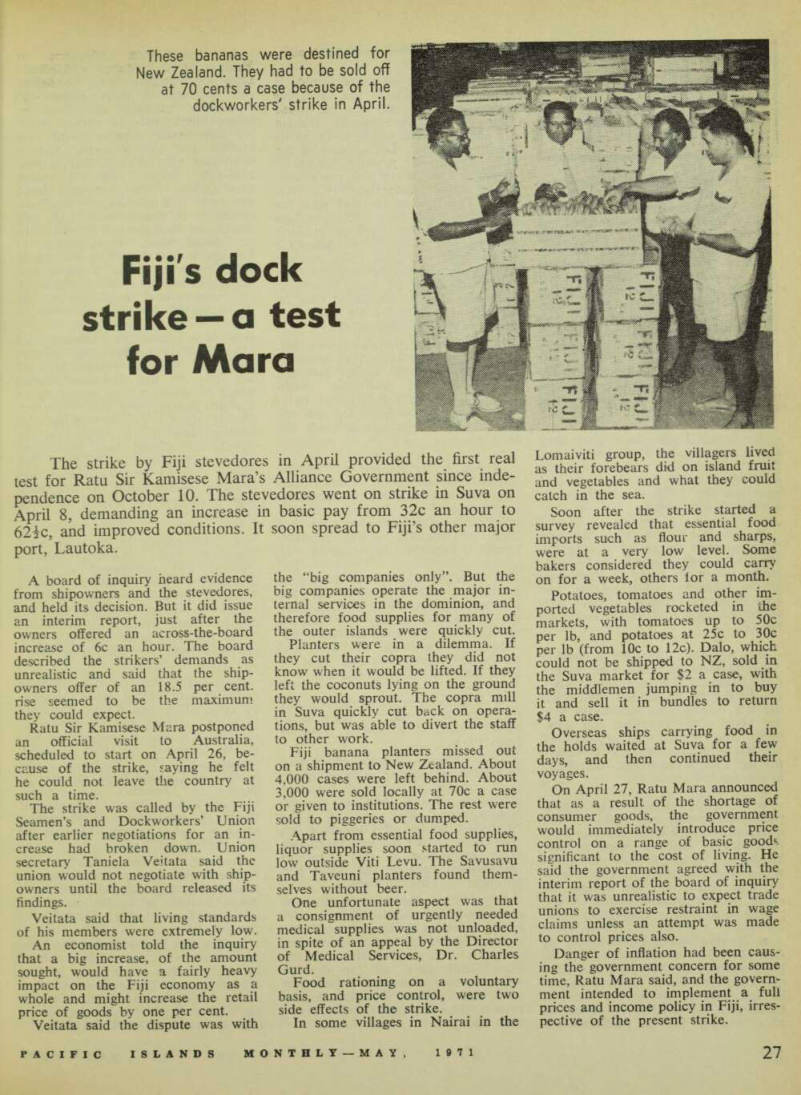
Planters were m a dilemma. If they cut their copra they did not know when it would be lifted. If they left the coconuts lying on the ground they would sprout. The copra mill in Suva quickly cut back on opera lions but was able to divert the staff to other work. . , Fiji banana planters missed out on a shipment to New Zealand. About 4,000 cases were left behind. About 3,000 were sold locally at 70c a case or given to institutions. The rest were sold to piggeries or dumped.
Apart from essential food supplies, liquor supplies soon started to run l ow outside Viti Levu. The Savusavu an d Taveuni planters found them selves without beer.
One unfortunate aspect was that a consignment of urgently needed medical supplies was not unloaded, in spite of an appeal by the Director of Medical Services, Dr. Charles Gurd.
Food rationing on a voluntary basis, and price control, were two side effects of the strike.
In some villages in Nairai in the
Jn tlaud fraft
and vegeta bi e s a nd what they could catc h in the sea. soon after the strike started a survey revealed $ were at a very low level. Some bakers considered they could carry on f or a week, others lor a month, Potatoes, tomatoes and other inl ported vegetables rocketed in the marke ts, with tomatoes up to 50c lb and potat oes at 25c to 30c * lb (from 10c to 12c). Dalo, which £ ould nQt be shippe <i to NZ, sold in the Suva market for $2 a case, with tbe middlemen jumping in to buy i( . and sell it in bundles to return $4 a case Qverseas ships carrying {ood in t u p bolds waited at Suva for a few tben con tinued their voyages.
On April 27, Ratu Mara announced that as a result of the shortage ot consumer goods the would immediately intro P c o nt Tpl on a F f ,• • ® H the cost of living. He . the government agree re P° r ‘ TS that>t was unrealistic to expect trade unions to e e ss a n made . , nrices also to control prices also, Danger of inflation had been caus ing the government concern for some time, Ratu Mara said, and the govern ment intended to implement a lull prices and income policy in Fiji, irres pective of the present strike.
These bananas were destined for New Zealand. They had to be sold off at 70 cents a case because of the dockworkers' strike in April.