A timetable for New Guinea
p. 28 · Read in the full issue
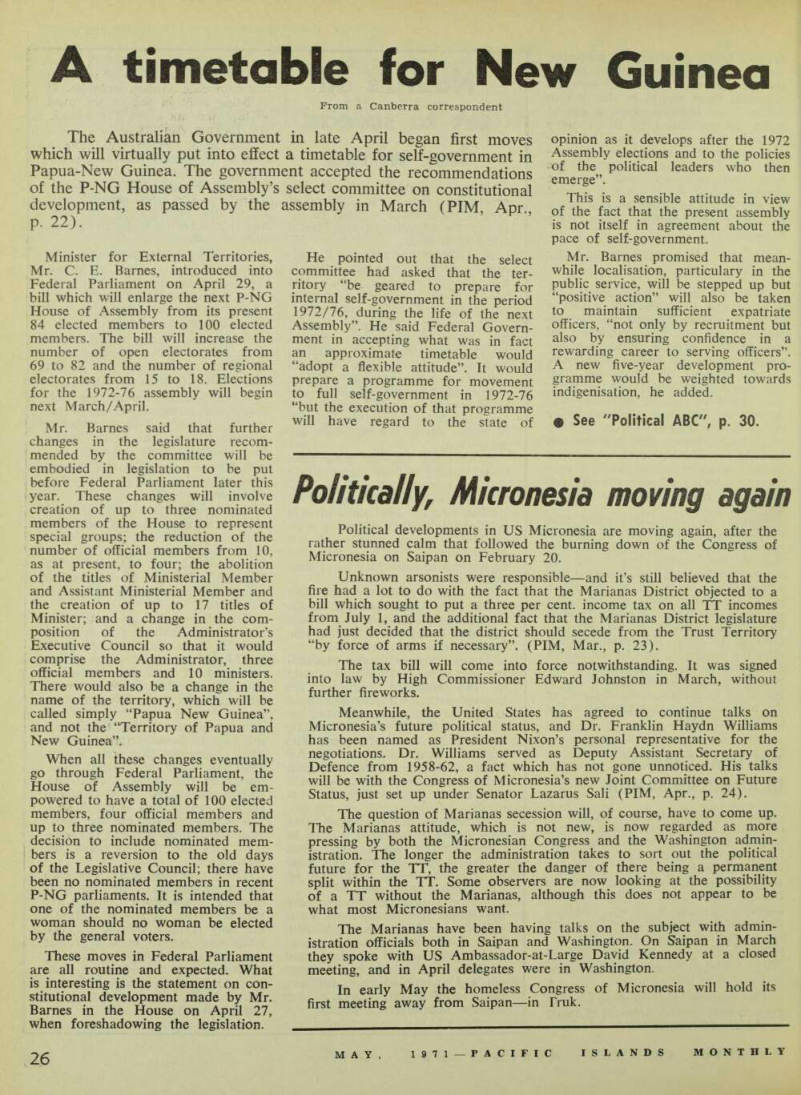
From a Canberra correspondent The Australian Government in late April began first moves which will virtually put into effect a timetable for self-government in Papua-New Guinea. The government accepted the recommendations of the P-NG House of Assembly’s select committee on constitutional development, as passed by the assembly in March (PIM Apr p. 22).
Minister for External Territories, Mr. C. E. Barnes, introduced into Federal Parliament on April 29, a bill which will enlarge the next P-NG House of Assembly from its present 84 elected members to 100 elected members. The bill will increase the number of open electorates from 69 to 82 and the number of regional electorates from 15 to 18. Elections for the 1972-76 assembly will begin next March/April.
Mr. Barnes said that further changes in the legislature recom mended by the committee will be embodied in legislation to be put before Federal Parliament later this year. These changes will involve creation of up to three nominated members of the House to represent special groups; the reduction of the number of official members from 10, as at present, to four; the abolition of the titles of Ministerial Member and Assistant Ministerial Member and the creation of up to 17 titles of Minister; and a change in the com position of the Administrator’s Executive Council so that it would comprise the Administrator, three official members and 10 ministers.
There would also be a change in the name of the territory, which will be called simply “Papua New Guinea”, and not the “Territory of Papua and New Guinea”.
When all these changes eventually go through Federal Parliament, the House of Assembly will be em powered to have a total of 100 elected members, four official members and up to three nominated members. The decision to include nominated mem bers is a reversion to the old days of the Legislative Council; there have been no nominated members in recent P-NG parliaments. It is intended that one of the nominated members be a woman should no woman be elected by the general voters.
These moves in Federal Parliament are all routine and expected. What is interesting is the statement on con stitutional development made by Mr.
Barnes in the House on April 27, when foreshadowing the legislation.
He pointed out that the select committee had asked that the territory “be geared to prepare for internal self-government in the period 1972/76, during the life of the next Assembly”. He said Federal Government in accepting what was in fact an approximate timetable would “adopt a flexible attitude”. It would prepare a programme for movement to full self-government in 1972-76 “but the execution of that programme will have regard to the state of
opinion as it develops after the 1972 Assembly elections and to the policies of the political leaders who then emerge”.
This is a sensible attitude in view of the fact that the present assembly is not itself in agreement about the pace of self-government.
Mr. Barnes promised that mean while localisation, particulary in the public service, will be stepped up but “positive action” will also be taken to maintain sufficient expatriate officers, “not only by recruitment but also by ensuring confidence in a rewarding career to serving officers”.
A new five-year development pro gramme would be weighted towards indigenisation, he added.
• See "Political ABC", p. 30.