Pacific Islands Monthly
pp. 24-25 · Read in the full issue
Pacific Leaders Make Nukualofa
A Get-Together To Remember
History may record that a meeting of Pacific Islands leaders held in Nukualofa in April was the most significant in the last decade. And yet the meeting took place under the auspices of nothing more exciting than the Pacific Islands Producers Association a dull-sounding organisation if ever there was. But don’t be misled by the title.
PIPA has grown from the needs of some of the major Pacific territories to compare notes on common prob lems and speak in one voice on trade matters that affect them, thus counter ing the pressures that can be brought to bear by those who trade with the Islands.
Its beginnings go back to 1964 when Fiji’s present Prime Minister, Ratu Sir Kamisese Mara, was negoti ating a sensitive banana contract with New Zealand and realised the neces sity of islands sticking together for a better deal.
The first official meeting of what was then called the Pacific Islands Producers Secretariat was held in Apia in 1965, with Fiji, Tonga and Western Samoa taking part. The Cooks and Niue joined later, PIPS was changed to PIPA, a full-time executive secretary was employed, with headquarters in Suva, and the organisation assumed a more dynamic role, with Ratu Mara its president.
The secret of its dynamism is that PIPA is an organisation conceived and operated by Islanders for Islanders—and thus it draws not a little of its strength from national istic pride. As Cooks Premier Albert Henry said in Nukualofa in April, “for 200 years the white man has been exploiting the resources of the Pacific, but now Polynesians are working together for Polynesians”.
Ratu Mara has from the start seen the organisation as being more effec tive than the South Pacific Commis sion, and has worked to give it an ever-widening base.
PIPA began as a commercial pres sure group. We can expect it to be come more and more involved with political questions, for the good reason that politics are closely in volved with international trade.
The April meeting, the sixth, was the largest yet held. More than 60 delegates and observers attended, in cluding a delegation from the Gilbert
and Ellice Islands. The GEIC was admitted to PIPA, as its sixth mem ber.
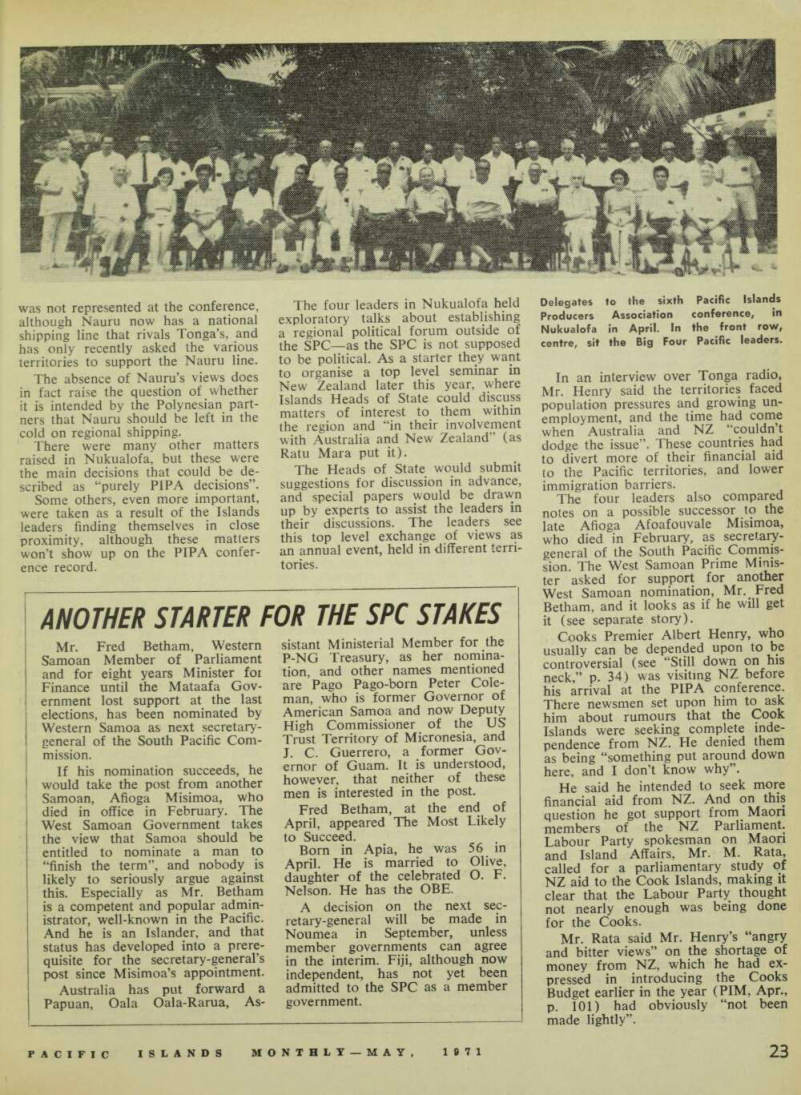
It was announced that the consti tution of PIPA had been registered with the UN, and it was decided to elect as president for the next two years, in succession to Ratu Mara, the Prime Minister of Western Samoa, Tamasese Lealofi. Tamasese was one of the big four Islands leaders who were present, the others being Ratu Mara, Albert Henry and Prince Tui’pelehake, Premier of Tonga, • After hearing a frightening re port on the state of the Islands banana market, the meeting resolved to improve production, quality, disease control, and packing of bananas so as to protect the trade.
The conference was told that a banana scarcity existed in the South Pacific.
Samoa was the leading producer in 1970 with 200,000 cases, while Fiji was the smallest, with 87,000.
Tonga and the Cook Islands each exported 130,000 cases.
All were exported to New Zea land, which had to supplement its requirements from Central America.
Heads of State from the rour territories joined in discussions on the banana situation and were ad vised of the extreme dangers facing the industry due to the prevalence of weakening diseases which the territories find difficult and expen sive to control.
Constant increases in shipping costs and rising production costs also assisted in making the industry un economic.
The managing director of New Zealand Fruit Importers Ltd., Ross Walker, told the conference that un less the disease problem could be solved and the quality of fruit con sistently improved, New Zealand consumers would find that Pacific
Islands bananas would be too ex pensive. • The meeting heard arguments for the Islands to speak as one voice on the copra trade (an early dream of Ratu Mara’s), and PIPA is to look into the possibility of establishing its own copra crushing mill, “with pro ducer participation”. PIPA is also to investigate regional membership of the Asian Coconut Community on behalf of those territories not want ing individual membership (Tonga and Western Samoa are applying for individual membership of ACC).
This decision was made as a result of one of the resolutions at a regional coconut conference held in Nukualofa the previous week, attended by delegates from the same territories plus the Trust Territory of Micro nesia. The coconut conference was concerned that tariffs would be im posed on coconut products if Britain joined the EEC, and decided to in vestigate alternative markets for copra in Asia and the Pacific Basin, parti cularly the US. • The meeting set up a working committee to investigate formation of a regional shipping line to serve the Islands and overseas ports. It was proposed that the shipping line utilise and develop the fleet of the Tonga Shipping Agency, already in operation. The conference heard argument on the difficulties of operat ing a regional service (see p. 71 for one recent view), but members, on the other hand, were unhappy at in creasing freight rates imposed by foreign-owned ships. The turning point came when Ratu Mara re minded delegates that Fiji Airways had started as a purely local venture and developed into a regionally owned airline.
Mr. Henry, who has his eyes on extending Cook Islands shipping, agreed with the proposal “in prin ciple”. But what Nauru thought of the proposal nobody knew, for Nauru
was not represented at the conference, although Nauru now has a national shipping line that rivals Tonga’s, and has only recently asked the various territories to support the Nauru line.
The absence of Nauru’s views does ¥here Tre many Pin o g iher matters raised in Nukualofa, but these were the main decisions that could be described as “purely PI PA decisions”.
Some others, even more important, were taken as a result of the Islands leaders finding themselves in close proximity, although these matters won’t show up on the PIPA conference record.
The four leaders in Nukualofa held exploratory talks about establishing a regional political forum outside of the SPC—as the SPC is not supposed to be political. As a starter they want to organise a top level —r with New Zealand ” (as Ratu Mara P ut 11 )• The Heads of State would submit suggestions for discussion m advance, and special papers would be drawn up by experts to assist the leaders in their discussions. The leaders see this top level exchange of views as an annual event, held m different tern tones.
In an interview over Tonga radio, Mr. Henry said the territories faced population pressures and growing un employment, and the time had come when Australia and NZ “couldn’t dodge the issue”. These countries had to divert more of their financial aid to the Pacific territories, and lower immigration barriers.
The four leaders also compared notes on a possible successor to the late Afioga Afoafouvale Misimoa, who died in February, as secretary general of the South Pacific Commis sion. The West Samoan Prime Minis ter asked for support for another West Samoan nomination, Mr. Fred Betham, and it looks as if he will get it (see separate story).
Cooks Premier Albert Henry, who usually can be depended upon to be controversial (see “Still down on his neck,” p. 34) was visiting NZ before his arrival at the PIPA conference.
There newsmen set upon him to ask him about rumours that the Cook Islands were seeking complete inde pendence from NZ. He denied them as being “something put around down here, and I don’t know why”.
He said he intended to seek more financial aid from NZ. And on this question he got support from Maon members of the NZ Parliament.
Labour Party spokesman on Maori and Island Affairs, Mr. M. Rata, called for a parliamentary study of NZ aid to the Cook Islands, making it clear that the Labour Party thought not nearly enough was being done for the Cooks.
Mr. Rata said Mr. Henry’s “angry and bitter views” on the shortage of money from NZ, which he had ex pressed in introducing the Cooks Budget earlier in the year (PIM, Apr., p. 101) had obviously “not been made lightly”.
Delegates to the sixth Pacific Islands Producers Association conference, in Nukualofa in April. In the front row, centre, sit the Big Four Pacific leaders.