Yesterday
p. 79 · Read in the full issue
April, 1951, was a month for castigating governments—a job PIM had plenty of practice at. PIM blasted the New Zealand Government for not modernising Nadi Airport amenities; the British Government came in for a barb for negotiating a sugar agreement with Cuba; the Australian Government had allowed Lae Hospital, New Guinea, to run down into “disgraceful” condition; the US Government had done world communism a favour by sacking General MacArthur. That was PlM’s Pacific 20 years ago this month.
One might have thought Britain would have bought its extra sugar from within the Empire, not without, PIM said, commenting on the news that Britain was negotiating a sugar agreement with Cuba to buy 500,000 tons for three years.
The New Zealand Government was both “indifferent and ignorant” about the miserable facilities afforded travellers at Nadi Airport, PIM said.
The airport was the responsibility of the NZ Government and since it had been upgraded to international status, it was about time travellers had better than a collection of hutments along side the strip to stay in. The hutments, dignified by the name Mocambo Hotel, were a rough place to stay in—and to make matters worse, the bar often shut just at the time weary travellers most needed it. Things have changed in 20 years. The new Mocambo is a different hotel, different site.
The pre-war buildings making up Lae Hospital, New Guinea, were hardly conducive to sanitation and segregation, PIM complained 20 years ago. Open drains were found a few feet from kitchens swarming with flies.
Thin paper walls separated wards, giving no privacy. A very senior administrative official had also com plained in the wards, that he had had to share his European nurses with Asian patients. The government had promised to do something about a new hospital, but nothing had hap pened so far, but the choosing of a site.
PIM next turned its attention to petty bureaucracy. The latest examples of their bungling were in New Guinea where native stevedores had been encouraged to cease work at noon on Saturdays, and in the Solomons, where a junior govern ment official had stopped the loading of a copra ship at Saturday noon because he thought "his precious weekend should not be interfered with".
However, there were other matters of wider interest in PIM of 20 years ago.
Captain (later Sir) P. G. Taylor took off from Australia in his Catalina and a crew of three, and arrived in
Chile 13 days later. He put down at Noumea, Suva, Satapuala Bay, Aitutaki, Papeete, Mangareva and Easter Island, before reaching Val paraiso, and there announced that although the survey flight of 8,000 miles had taken 13 days, it could eventually be covered in three days by a commercial plane. How right he was.
Talking of aviation, Trans Oceanic Airways’ Solent finally arrived for the company’s Sydney-Port Moresby flying-boat service. It was also an nounced that the Clan Shipping Line had acquired a major interest in TO A.
A Clan director on the delivery flight of the Solent, said his company was keen on the idea of getting some of the 50 million people who lived in Great Britain, shifted to other Empire countries. Looking back, it appears his ideas were followed. Britons are still pouring into Australia in their thousands every year. A new airways company also started operating in the territory that month; Amphibious Airways Ltd., based at Rabaul with two Walrus amphibians, was avail able for charter work in New Britain and New Ireland.
An Englishman espoused the use of garlic to prevent malaria. In a letter, Mr.
A. F. Newell of Radlett, Herts., said he gave his native workers in India a weak solution of garlic essence to fend off malaria and he wouldn't be a bit suprised if it also cured TB and early leprosy. At least if you try it, it won't hurt you, he added; not like quinine.
A marriage, a death and a murder.
Miss Jean Page, daughter of the late Harold Page, former Government Secretary to the pre-war New Guinea Administration, married Mr. John Adams, son of Mrs. Una and the late Mr. H. Adams of Patlangat Planta tion, New Ireland. Fathers of both bride and groom had been in the Montevideo Maru when that ship was torpedoed on its way to Japan during the war. The death was reported of Captain Dick Whitehouse,
former Senior Medical Assistant in Papua. He was famous for his part played in the American “capture” of Kiriwina. When the US landing force rushed the beach, he came out to meet it. He had been sent to take charge of the Trobriand Islands some months before, and Intelligence had apparently forgotten him. A 23-year old European was gaoled for 12 months in Port Moresby for the murder of a native. Derek Massey Layfield had been working for a seismic survey party and was in charge of a bomb scow with several natives on board. A native went over board and drowned and natives testified Layfield had pushed him over the side.
High Commissioner of Western Samoa, Mr. G. R. Powles, announced at the March opening of the Legislative Assembly that expert advice was now being received about the possibility of introducing a Samoan currency and an independent Samoan pound.
Semi paralysis of shipping in New Zealand ports, where wharf labourers were on strike, had a bad effect on Islands trade, particularly in Fiji and Western Samoa. Essential foodstuffs were running short in Samoa and there was no sign of the strike being called off. (Last month NZ water siders were again on strike for a pay rise).
PIM said Fiji had a wonderful tourist potential but this “goldmine” was being neglected because Govern ment officials didn’t understand what was needed. Fiji’s revenue from tourism was thus “almost negligible”.
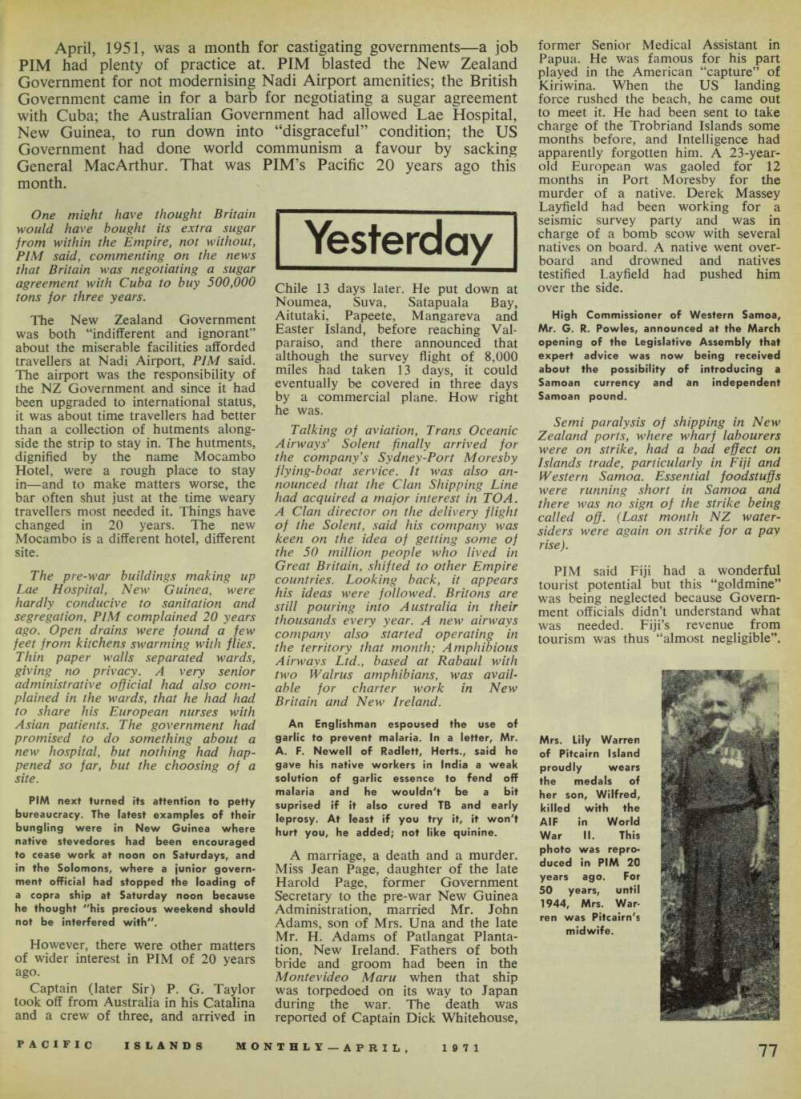
Mrs. Lily Warren of Pitcairn Island
proudly wears
the medals of her son, Wilfred, killed with the AIF in World War 11. This photo was repro duced in PIM 20 years ago. For 50 years, until 1944, Mrs. War ren was Pitcairn's midwife.