Magazine Section
pp. 73-125 · Read in the full issue

Missionaries Slaughtered In
Grim Advance On Moresby
By Tom Grahamslaw
The north-east coastal station of Buna, which was part of my area as Australian New Guinea Administrative Unit commander in the Northern District of Papua, was about to be invaded. We had expected it for some time.
There was such a feeling in the atmosphere in the weeks up to July, 1942, that when I got word from Port Moresby that a vessel was en route with a large supply of cargo which was to be unloaded at Buna and sent by carrier to Kokoda, I decided to hold the vessel in the small harbour at Oro Bay and unload her there instead of at the open road stead at Buna, where she would be conspicuous. And I also decided to transport all the vessel’s cargo to Kokoda in one move which meant 1,500 carrier loads.
McKenna at loma and Brewer at Kokoda were instructed to provide 800 carriers between them, while Champion and I obtained the re mainder.
We got them, and Jack McKenna, a former Assistant Resident Magistrate, was the first to arrive with his quota.
But he strode into my office at Awala with blood in his eye, demanding to know why I should have made such a savage demand on the already denuded manpower in his area. He calmed down when I explained my fears, and he gave invaluable help in organising the three-day carrier haul from Oro Bay to Kokoda.
I went ahead to Kokoda to meet Captain S. V. Templeton and his men of B Coy, 39th Battalion, who had marched over the Owen Stanleys to Kokoda en route to Buna. After we met, Templeton went on to Buna for a recce and then walked back to Awala, where I joined him on the afternoon of July 21. There we began to make plans to walk to Morobe a round journey of three weeks because we had no ships when we were interrupted by Jack Mason, who had been crouched over his beloved radio.
Corporal Hanna at Ambasi, was
on the air with the urgent news that enemy ships were shelling Buna. I took over the radio and instructed him to have a good look at the ships and what they were doing and to report back every hour, so long as it was safe to do so. I got some details from him after 10 minutes, which 1 sent immediately to Port Moresby, and after that silence.
Meanwhile Captain Templeton sig nalled his troops at Kokoda to set off for Buna and he himself left straight away to join them.
It was many months before I learned that Templeton (after whom Templeton’s Crossing, on the Kokoda Track, is named) was killed by the Japanese a few days later (there is evidence that natives were also in volved in his death), and that Cor poral Hanna and a group had had to flee ahead of the Japs. On the following day Corporal Hanna’s group caught up with a party com prising the Gona missionaries (Rev.
Benson, Miss May Hayman and Miss Mavis Parkinson), a detachment of the PIB commanded by Lieut. A. A.
Smith, and several American airmen whose aircraft had been shot down.
The party was endeavouring to make its way inland when it was attacked by Japanese troops who were being guided by Orakaiva natives.
But the party escaped with the excep tion of the Rev, Benson, who was elderly and made no attempt to avoid the Japanese. Presumably because of his age his life was spared and he was a POW in Rabaul for the rest of the war.
The remaining members of the party, under Lieut. Smith, met a worse fate. They reached a village in the Sangara area, where they got food and accommodation. The people professed friendship and even offered
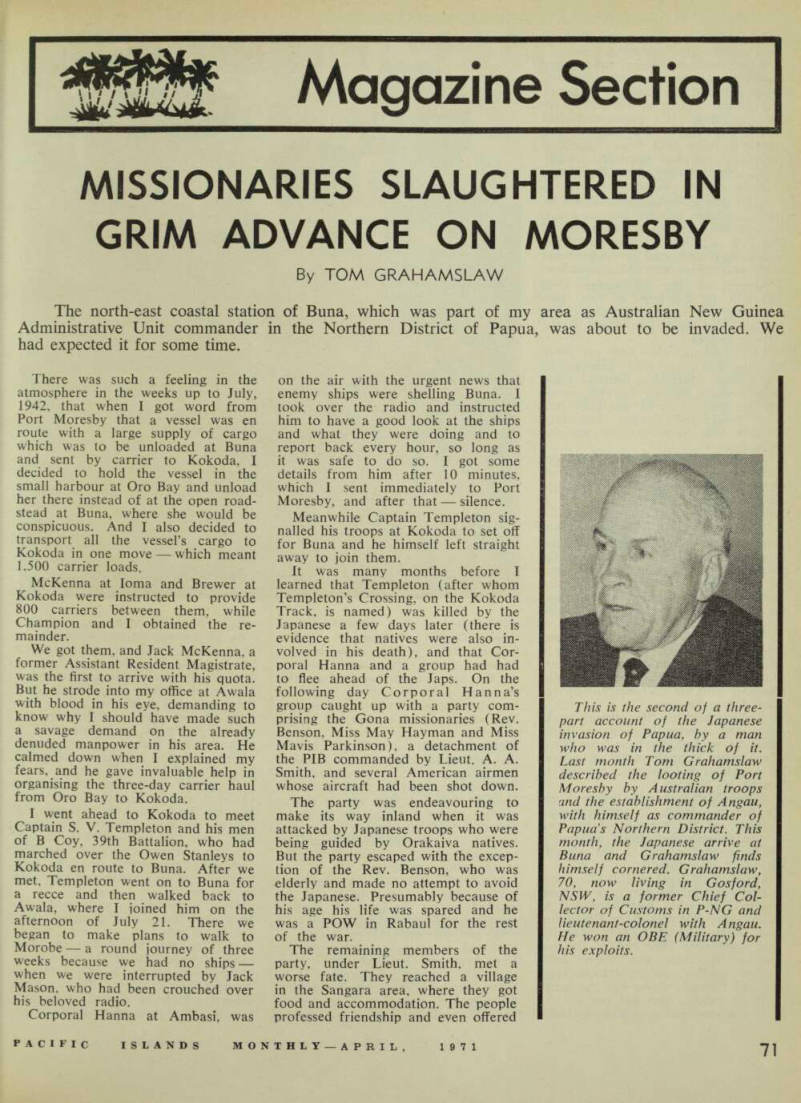
This is the second of a three part account of the Japanese invasion of Papua, by a man who was in the thick of it.
Last month Tom Grahamslaw described the looting of Port Moresby by Australian troops and the establishment of Angau, with himself as commander of Papua’s Northern District. This month, the Japanese arrive at Buna and Grahamslaw finds himself cornered. Grahamslaw, 70, now living in Gosford, NSW, is a former Chief Col lector of Customs in P-NG and lieutenant-colonel with Angau.
He won an OBE (Military) for his exploits.
to provide the party with carrriers on the following morning.
When morning came the village constable, whose name was Embogi, explained that the carriers had not arrived but would be available later that morning. His explanation did not satisfy the native members of the PIB, who told their European superiors that they suspected treach ery. Unfortunately, the Europeans did not believe them.
Later that morning Japanese troops, led by village people, appeared and opened fire. The native members of the PIB detachment, who had been expecting trouble and in consequence were prepared, were able to escape.
Several of the Europeans were killed in the first burst of fire. Two ran into the bush where they were pursued and speared to death by the village natives.
Lieut. Smith, who also got away into the bush, was made prisoner by the village constable. Embogi acted in a friendly manner towards Smith for the first day or so, providing him with food and shelter, but then handed him over to the Japs for execution.
Miss Hayman and Miss Parkinson were captured by the Japs, who took them to Popondetta. They were kept in one of the coffee buildings for at least a day, and then murdered.
Mavis Parkinson was an attractive young woman in her early twenties.
She was engaged to a lieutenant in the Australian Army who was stationed at Port Moresby. May Hayman, who was several years older, was engaged to an Anglican clergyman named Vivian Redlich.
They were high-spirited, intelligent young women and it was always a pleasure to call on them during my occasional visits to Gona for dis cussions with the missionary-in-charge Rev. James Benson.
Redlich lost his life several weeks after the enemy landing at Buna, when he walked overland from Kapa Kapa with a small party of natives in a gallant but abortive attempt to rescue his fiancee.
It was some months before I got the horrible details, in an unexpected manner, of the murder of the two women missionaries, but I will tell it in its proper place. I am already ahead of my story.
On the first light of July 22, I and a party left in the direction of Buna to find out what had happened to everybody. We met Alan Champion and a group, who told us that the first knowledge they had of the Jap landing at Buna was when shells began whistling over the station. They decided that discretion was the better part of valour, and got out.
I and my party, which included
McKenna, went on to Hagenahambo and later to the Arehe Creek crossing.
At Hagenahambo I instructed WO H. F. Bitmead, former Administration Medical Assistant who was in charge of the native hospital, to send his patients back to their villages and fall back to Wasida. I stressed that soon his services would be needed to tend the wounded.
However, Bitmead a dedicated man prevailed on me to let his assistant go to Wasida with medical supplies while he personally saw to it that his patients got to safety. I stationed a police constable on the track below the hospital with instruc tions for him to tell Bitmead if he saw signs of the enemy. Unfor tunately the constable later fled to his own village and the Japanese
caught Bitmead unawares, capturing him. That constable was an exception.
At Arehe Creek our party stopped for a meal. We needed it, because Our journey had been interrupted a number of times by Zeros flyingdo™ the track at a height of onlya.few hundred feet. Tea was made and we were relaxing m the shade, with a Police patrol fanned out-onguard, when we heard two shots, followed by a terrific burst of tong.
It turned out the leadmg elements of the Japanese were on bicycles and they were almost on
‘ A police co^do
The Ja'ps*^—bly thought they had run into an ambush and hundreds opened fire.
Our party , T n °Xre together then McKenna and I were together, t los t ea .S* l ot^ e r r ‘ T made a Shortly after “fijj cautiora of the some m ile s o “^^° R v this time Arehe Creek crossing. By tins time the mainibodj-of: enemy £oops had passed. They were being followed y
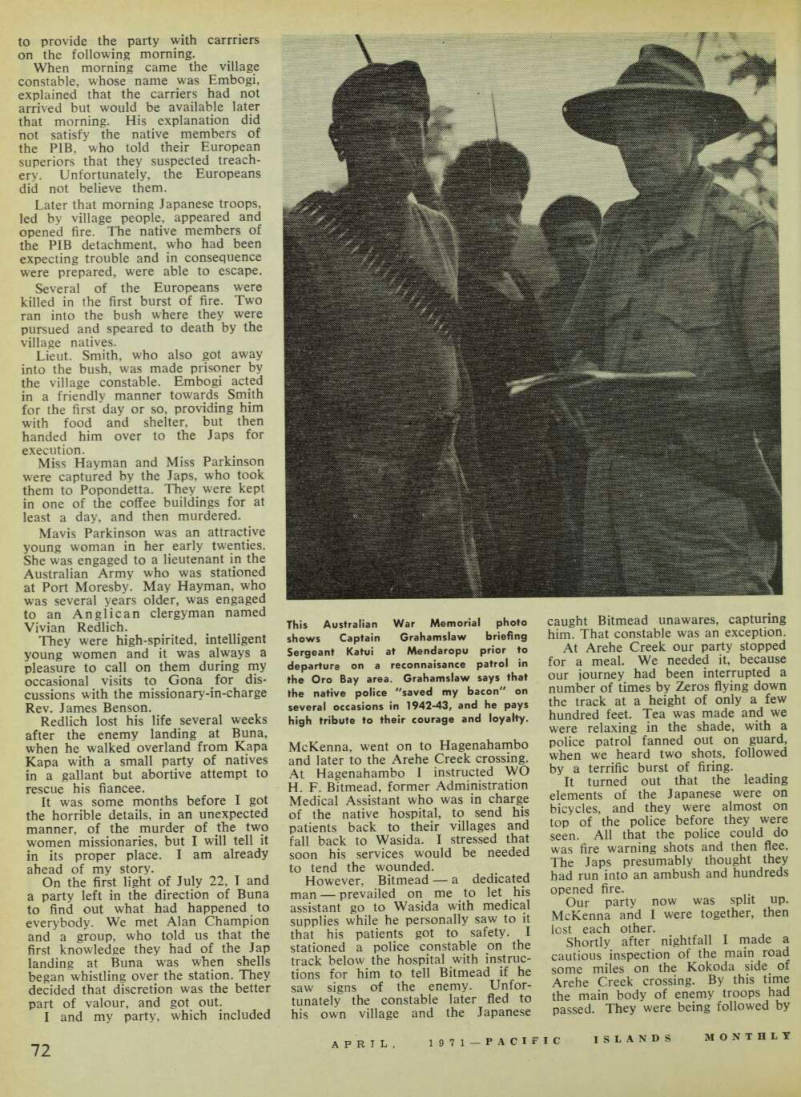
This Australian War Memorial photo shows Captain Grahamslaw briefing Sergeant Katui at Mendaropu prior to departure on a reconnaisance patrol in the Oro Bay area. Grahamslaw says that the native police "saved my bacon" on several occasions in 1942-43, and he pays high tribute to their courage and loyalty.
native carriers brought from Rabaul by the Japs. The carriers were in groups of what appeared to be between 20 and 30, with Jap guards at the front and rear of each group.
The natives were silent but I could distinctly hear the guards calling out to each other. Perhaps they were doing this to keep about the same distance between each group. It was quite an experience listening to voices gradually becoming louder and then just as gradually dying away.
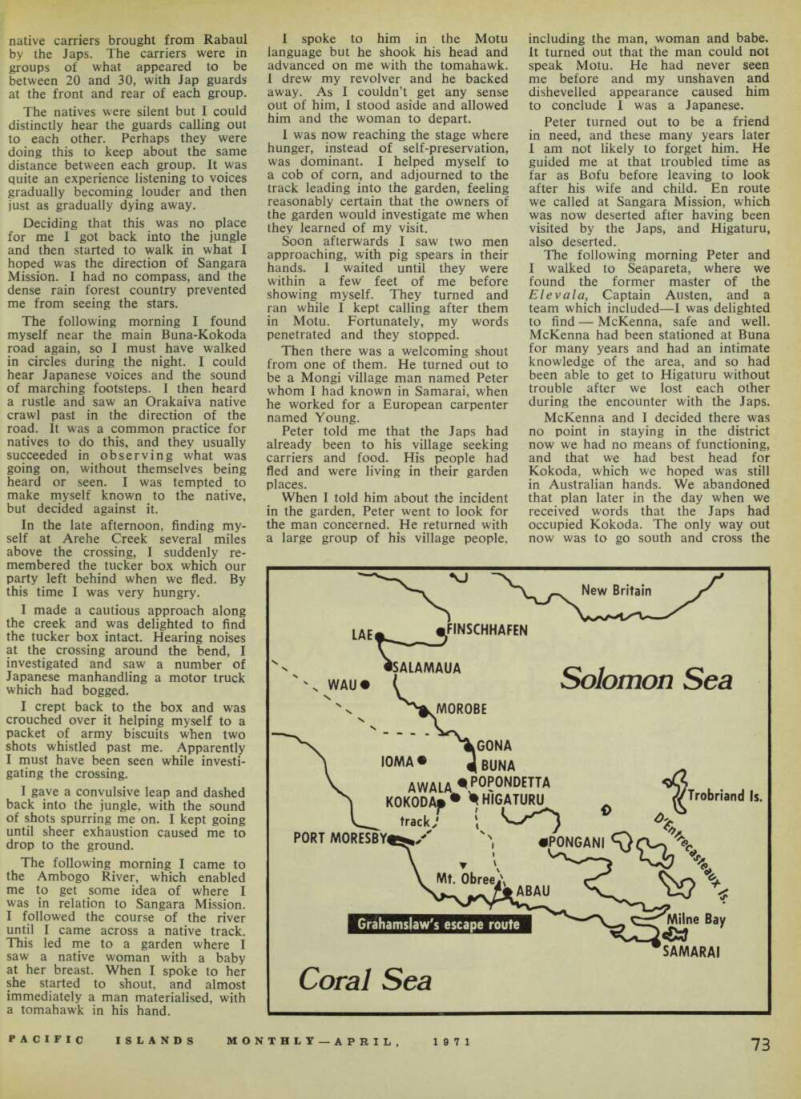
Deciding that this was no place for me I got back into the jungle and then started to walk in what I hoped was the direction of Sangara Mission. I had no compass, and the dense rain forest country prevented me from seeing the stars.
The following morning I found myself near the main Buna-Kokoda road again, so I must have walked in circles during the night. I could hear Japanese voices and the sound of marching footsteps. I then heard a rustle and saw an Orakaiva native crawl past in the direction of the road. It was a common practice for natives to do this, and they usually succeeded in observing what was going on, without themselves being heard or seen. I was tempted to make myself known to the native, but decided against it.
In the late afternoon, finding my self at Arehe Creek several miles above the crossing, I suddenly re membered the tucker box which our party left behind when we fled. By this time I was very hungry.
I made a cautious approach along the creek and was delighted to find the tucker box intact. Hearing noises at the crossing around the bend, I investigated and saw a number of Japanese manhandling a motor truck which had bogged.
I crept back to the box and was crouched over it helping myself to a packet of army biscuits when two shots whistled past me. Apparently I must have been seen while investi gating the crossing.
I gave a convulsive leap and dashed back into the jungle, with the sound of shots spurring me on. I kept going until sheer exhaustion caused me to drop to the ground.
The following morning I came to the Ambogo River, which enabled me to get some idea of where I was in relation to Sangara Mission.
I followed the course of the river until I came across a native track.
This led me to a garden where I saw a native woman with a baby at her breast. When I spoke to her she started to shout, and almost immediately a man materialised, with a tomahawk in his hand.
1 spoke to him in the Motu language but he shook his head and advanced on me with the tomahawk. 1 drew my revolver and he backed away. As I couldn’t get any sense out of him, I stood aside and allowed him and the woman to depart.
I was now reaching the stage where hunger, instead of self-preservation, was dominant. I helped myself to a cob of corn, and adjourned to the track leading into the garden, feeling reasonably certain that the owners of the garden would investigate me when they learned of my visit.
Soon afterwards I saw two men approaching, with pig spears in their hands. 1 waited until they were within a few feet of me before showing myself. They turned and ran while I kept calling after them in Motu. Fortunately, my words penetrated and they stopped.
Then there was a welcoming shout from one of them. He turned out to be a Mongi village man named Peter whom I had known in Samarai, when he worked for a European carpenter named Young.
Peter told me that the Japs had already been to his village seeking carriers and food. His people had fled and were living in their garden places.
When I told him about the incident in the garden, Peter went to look for the man concerned. He returned with a large group of his village people,
including the man, woman and babe.
It turned out that the man could not speak Motu. He had never seen me before and my unshaven and dishevelled appearance caused him to conclude I was a Japanese.
Peter turned out to be a friend in need, and these many years later 1 am not likely to forget him. He guided me at that troubled time as far as Bofu before leaving to look after his wife and child. En route we called at Sangara Mission, which was now deserted after having been visited by the Japs, and Higaturu, also deserted.
The following morning Peter and I walked to Seapareta, where we found the former master of the E lev ala, Captain Austen, and a team which included—l was delighted to find McKenna, safe and well.
McKenna had been stationed at Buna for many years and had an intimate knowledge of the area, and so had been able to get to Higaturu without trouble after we lost each other during the encounter with the Japs.
McKenna and I decided there was no point in staying in the district now we had no means of functioning, and that we had best head for Kokoda, which we hoped was still in Australian hands. We abandoned that plan later in the day when we received words that the Japs had occupied Kokoda. The only way out now was to go south and cross the
ranges to the south coast of Papua, at Abau.
Austen, stout and elderly, declined to come with us, because he felt the long walk over rugged terrain would be too much for him. He was sure his supplies would last until his party could be rescued, and he asked me to pass on a message to the Port Moresby naval commander to send him a launch at Pongani in Septem ber. His party was subsequently ioined by Rev. Vivian Redlich, the clergyman who had gone in search of his fiancee.
McKenna and I left the next morning, going as far as Bofu with Peter, and reached Natunga, where we were surprised to get a note from Bitmead (brought to us by a village councillor from Bofu).
Bitmead had escaped from his Japanese captors at the native hos pital, had been looked after by two of his medical orderlies and had been ioined by two Americans who had been shot down in an encounter with some Zeros. They all had been headed for Pongani when natives had told him about me, and he asked now for further instructions.
Bitmead had been given a bad time by the Japs. He had repeatedly been taken before a firing squad, and at the last second, as he braced himself for the bullets, the action had always been stopped. It was a form of torture.
I replied that McKenna and I would wait at Natunga for his party to join us. The following afternoon a native guide and one of the Ameri cans, a Sergeant Thompson, arrived with a further note from Bitmead saying he was on his way but making slow progress because Captain Bender, the other pilot, had a leg wound and was being carried.
As result of this news, McKenna agreed to stay behind and take charge of Bitmead’s party, while I pushed on to Abau, and organised rescue. I set out the following day, accompanied by a Dogura Mission native.
The long journey across the moun tains to the coast was quite an experience. There were many times when I longed for the comfort of a routine peacetime patrol, with police protection, rations and equipment.
Travelling on my own, and having to pay for food and services with promises (later fulfilled) gave me sufficient incentive to maintain a pace which enabled me to complete the iourney in about half the time it would normally have taken.
Coaxing village officials to provide a guide from one area to another was not always easy. The people who helped me most were the village councillors. On the whole, they were more helpful than the village con-
stables, some of whom were inclined to doubt my bona fides when I informed them that I was the “big” government from Buna.
On arrival at a village I would demand the production of the village constable’s register. Then I would write something in it to impress the village constable. Incidentally, four years had elapsed since the previous patrol in this area by “Mac” Rich from Tufi.
My story was invariably the same: that after the land hungry Japanese, killers of men and seducers of women, had over-run Buna and Kokoda, I had decided to walk to Port Moresby by the quickest route to
guide Australian soldiers who would kill the Japanese and restore the land to its native people.
The village people always provided sufficient food without demur. This was usually sweet potato, which was the staple food in the mountain regions. Sweet potato, without the benefit of salt, is most unappetising.
Your appetite goes after a few mouthfuls. However, it was necessary to eat about 5 lb each day to keep going.
One of my main difficulties was persuading village people to supply enough firewood to keep a fire going at night. I did not possess a blanket, and at heights above 4,000 ft it gets almost unbearably cold at night.
The mountain hamlets (there were no large villages) were built on treeless spurs (for safety reasons), and firewood had to be carried for a considerable distance hence the understandable reluctance on the part of the people to meet my requests, particularly as I was unable to proffer payment.
Yet perhaps the most trying part
(Continued on p. 117)
The battle of the Kokoda Track was long and tough. Grahamslaw was involved in it after escaping from Buna, and he sug gests (see p. 117) that native carriers who "went missing" at that time might in fact have been killed by unfriendly tribes in the area. In this Australian War Memorial picture, troops and carriers rest on the track.
of the journey was having to retell my story so many times in each village. Men returning from garden places late at night would insist on visiting my hut to see me and hear my story. On these occasions it was not good for my nerves to hear stealthy noises and then glimpse silhouetted figures peering at me from the ladder leading into the hut. I would sit up and, in a matter-of-fact voice, ask them what they wanted.
Then my story would have to be told once again.
More than once on that journey I had a feeling that if I tarried awhile in any place my number would be up.
These people were quite primitive, and patrols were few. This was the first time a lone white man had appeared amongst them and there must have been the temptation to dispose of him at times.
But I was aware that primitive natives rarely commit an act of this nature until they have discussed it among themselves at some length and formulated a plan, and I made a point of arriving late and departing at first light. In the high altitudes it was rare to see any sign of activity until the sun’s warmth began to pene trate, and by that time I was well on my way.
It was not until I reached Amau Mission, on the Abau side of the Owen Stanleys, that I relaxed. Amau was established by Rev. Cecil Abel, of Kwato, near Samarai. When I
arrived the mission was being run by an ordained native teacher from Kwato, and his wife, who were extremely kind to me. It was lovely to be able to bathe and change into clean clothing, to drink tea and indulge in solid food again.
By good fortune Cecil Abel arrived at Amau several hours after I reached there. So I went by launch to Abau and to Port Moresby by sailing lugger. The leisurely trip was just what I needed and by the time I reached Port Moresby I was fit again.
Meanwhile, McKenna’s party was rescued and taken to Abau by Patrol Officer David Marsh. The privations suffered by McKenna and Bitmead resulted in them having to be sent back to Australia for several months.
Captain Bender and Sergeant Thompson went back to America to recuperate, where their experiences received much publicity, and Captain Bender was awarded a decoration.
Captain Austen and his group were not rescued. The navy had no launch to send. They were dead by Septem ber, as it turned out.
The next few weeks were even busier for me. The Japs were now approaching Port Moresby via Kokoda and the Kokoda Track, and what became the “Battle of the Kokoda Trail” had begun.
I was given the job of reconnaisance on the track, looking for enemy infiltration with a party of native police. But an initial task was to give a lecture to fresh AIF troops about the terrain ahead, how to fend
A muddy bog
for oneself in the jungle and how to treat the native people.
One of the things I stressed in my talk was that I believed that the country between Überi (where we then were) and Kokoda, was tougher than anything these troops had encountered in Greece or Crete.
There were no graded tracks ahead of us you simply went straight up and then straight down. It was clear that nobody believed me.
They changed their tune the very next day after the long haul to lorabaiwa. Apart from the steepness of the track, it had been converted into a muddy bog by the constant movement of troops and carriers. All of us, from the commanding officer (Brigadier A. W. Potts) down, carried 45 lb packs, and it was extremely heavy going. , T , , In addition to my pack I had a lantern filled with kerosene which I had got with some difficulty in Port Moresby. I had calculated that when we reached Kokoda I would be involved in a lot of night time paper work after I got native administration working again, and that I needed the light. That lantern got heavier as each day wore on. When we reached lora Creek the Medical Officer bor rowed my lantern to use in a tem porary hospital of bush materials and I was glad I had brought it along.
We got as far as Isurava, where we were involved in various adven tures before it became evident that our troops were falling back. We kept off the main track until we met it again at lora Creek, where we found the troops pulling out as we entered. I spoke to the M. 0., who said I could have my precious lantern back if I wanted, as he had left it behind in the hospital.
He also said that there were two mortally wounded soldiers in the hospital whose end was near. There had been nothing he could do for them.
I still recall the eerie feeling as I entered the hut in the gathering dusk.
The lantern was almost empty and its fitful light made little impression.
Shortly afterwards, one of the men died. I’d heard of the death rattle but this was the first time I heard a sound resembling it. The other lad died a few minutes later.
That night the police and I slept together in a lean-to which, for safety’s sake, we constructed a few hundred yards away in the bush.
The following morning we were on the track at first light. The Japs were firing into the deserted camp as we made our way up the track.
By this time the troops were falling
Legendary figure
back from Myola, and we were instructed to follow suit.
One of the impromptu tasks per formed by my party at this time was to make stretchers for wounded and sick men, and to organise carriers for use as stretcher bearers.
Two of my police were carrying 16" scrub knives. Making a stretcher only took a few minutes. First, we would cut down a couple of saplings and use strips of bark from them to sew the two sides of a blanket together. The blanket would then be drawn over the two lengths of sapling, and the result would be a serviceable, if narrow, stretcher.
We would intercept a returning line of carriers and select six as stretcher bearers four to carry and two to act as reliefs. The task of making a stretcher rarely took longer than 10 minutes and we made them when ever they were needed.
During this period I saw quite a lot of Dr. G. H. Vernon. Apart from treating sick and wounded soldiers, he was responsible for the carrier lines and at this particular time he had established a native hospital at Efogi. He became a legendary figure to all who served on the Kokoda Track.
During August and September the carriers in the forward areas were worked to the limits of their endur ance. I particularly noticed this at lora Creek. The carriers who were based on this camp had to do two return journeys to the forward lines at 11010 each day. As I recollect it, the forward journey for a fully laden carrier took about two hours, and, if he came back empty-handed (which wasn’t often, because of the need for stretcher bearers), he could get back in an hour. Because of the urgency of the situation, they were not allowed any rest days. When they were fresh they could do the two return journeys in eight hours without undue difficulty.
However, constant exposure to rain and biting cold winds sapped their strength, and towards the end it would be as late at 8 p.m. or 9 p.m. before they got back to their base camp, after having been out on the job since dawn. I’ve seen them fall to the ground almost too exhausted to eat.
The carriers were mostly coastal people, but the fortitude they dis played in the high altitudes on such rough terrain, and under the most trying conditions, was remarkable.
It can truly be said that the Australian troops would have been in desperate straits without the services
On half rations
of the native carriers. Great credit is due to Territorian Captain Herbert Kienzle, of Kokoda, for the major part he played in organising and maintaining the carrier lines across the Owen Stanleys.
The last task assigned to me by Brigadier Potts when I reported to him at Manari. was to investigate a track which it was thought the enemy might be able to use to by-pass our troops. As the task was regarded as hazardous, the brigadier insisted that I take a bodyguard of Australian soldiers (one sergeant and 11 privates) in addition to my police squad. . , .
It was a useful experience tor the troops, particularly as I had to place the party on half rations after the first day. After ranging far and wide for six days, during which we exam ined numerous native tracks, none of which would have been of benefit to the enemy, I decided there would be no point in continuing, and in any case we were short of food. We could not return to Manari as it was now in enemy hands.
By this time I’d just about had it myself. Lack of a balanced diet, constant patrolling in difficult country where it rained almost every day, and mostly without adequate shelter at night, had taken toll. In those days we wore shorts, and shirts with short sleeves. The numerous scratches on my arms and knees had festered, and by the time I reached lawarere Plantation I was suffering from dysen try, and finally ended in a casualty clearing station.
Whilst being treated there I was visited by an officer from Angau HQ who told me that, if I wished, I could be granted compassionate leave.
In my weakened condition I could imagine nothing better than a break in Australia.
A fortnight later, much fitter, 1 reported to Angau HQ preparatory to departure, when 1 learned that New Guinea Force HQ was seeking the services of an officer with first hand knowledge of the Northern District to take charge of a party to investigate enemy dispositions and activity in the Buna area.
All the experienced officers, par ticularly Brewer, McKenna and Champion, had contracted severe doses of malaria during the hardships they experienced following the enemy landing at Buna and, as a result, had been sent to Australia. My duty was clear, so I volunteered to lead the party back into the enemy’s area.
• Next month: Natives executed.