Cook Islands History Is Buried
pp. 83-85 · Read in the full issue
In Its Lost Newspapers
By Dr. W. G. COPPELL, a former Deputy Director of Education in the Cook Islands.
Historians are searching for rare issues of the Rev.
James Chalmers’ Cook Islands newspaper, Manu Rere, which provides a rare insight into Cooks life around 1870. This period of the Cook Islands history is not well documented, and discovery of new copies of the paper would cause jubilation among those interested in this particularly valuable period of Pacific Islands history.
Manu Rere was not the first Cooks newspaper. One of the remarkable achievements of the London Missionary Society missionaries in the Cook Islands from 1823 to 1900, was the establishment of a printed Maori literature. As early as 1828 the Epistles of Paul to the Galatians was translated into Rarotongan by the Rev.
John Williams and printed at the LMS press at Huahine, and this was to be the first of a long succes sion of works in Rarotongan, some ecclesiastical and others practical.
The great translators were the missionaries John Williams, Aaron Buzacott, Charles Pitman, and the brothers George and William Gill. With few exceptions the printing was done at presses set up first at Avarua on Rarotonga, and later at Oneroa on Mangaia. (A few years ago, when secretary of the Cook Islands Library and Museum, I was able to arrange for the preservation at Avarua of the Oneroa printing machine.) Several very ambitious works came from the pen of Aaron Buzacott, who translated The Pilgrim’s Progress and printed the work in 1846 and also com piled and printed in 1854, Te akataka reo Rarotonga — A Rarotongan and English grammar with Maori and English words printed in parallel columns. The latter book was intended primarily for use at the Takamoa Theological Institution on Rarotonga.
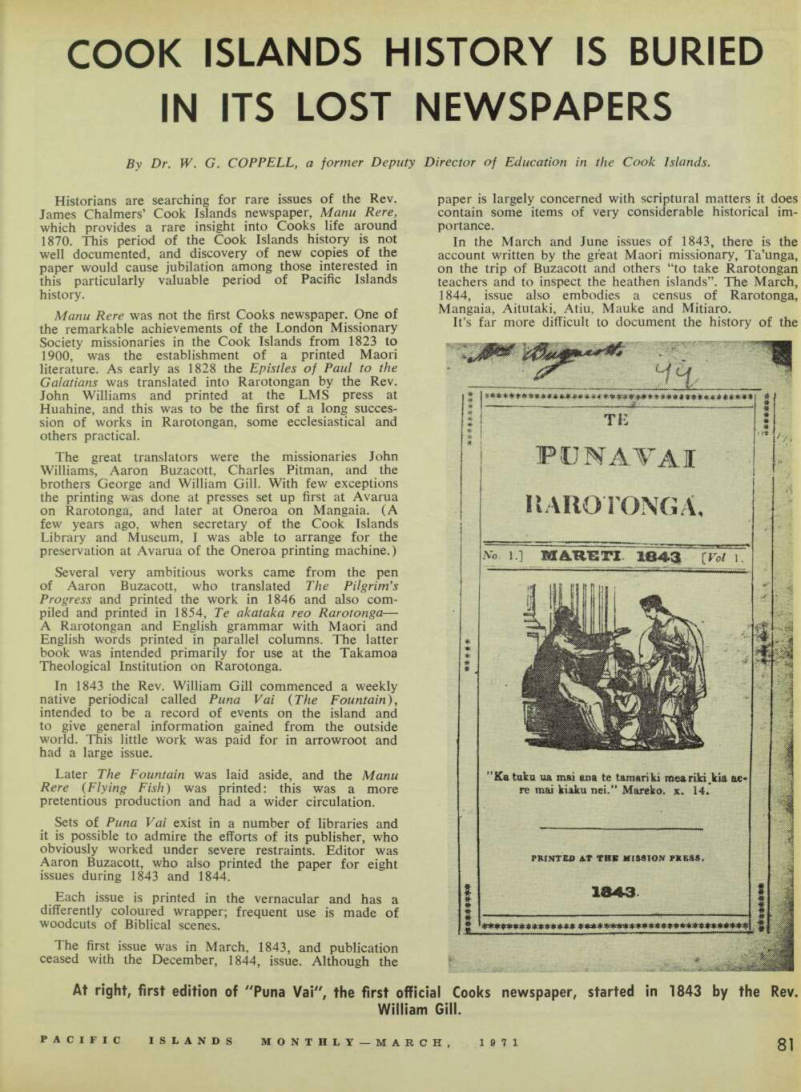
In 1843 the Rev. William Gill commenced a weekly native periodical called Puna Vai (The Fountain), intended to be a record of events on the island and to give general information gained from the outside world. This little work was paid for in arrowroot and had a large issue.
Later The Fountain was laid aside, and the Manu Rere (Flying Fish ) was printed: this was a more pretentious production and had a wider circulation.
Sets of Puna Vai exist in a number of libraries and it is possible to admire the efforts of its publisher, who obviously worked under severe restraints. Editor was Aaron Buzacott, who also printed the paper for eight issues during 1843 and 1844.
Each issue is printed in the vernacular and has a differently coloured wrapper; frequent use is made of woodcuts of Biblical scenes.
The first issue was in March, 1843, and publication ceased with the December, 1844, issue. Although the
paper is largely concerned with scriptural matters it does contain some items of very considerable historical im portance.
In the March and June issues of 1843, there is the account written by the great Maori missionary, Ta’unga, on the trip of Buzacott and others “to take Rarotongan teachers and to inspect the heathen islands”. The March, 1844, issue also embodies a census of Rarotonga, Mangaia, Aitutaki, Atiu, Mauke and Mitiaro.
It’s far more difficult to document the history of the
At right, first edition of "Puna Vai", the first official Cooks newspaper, started in 1843 by the Rev.
William Gill.
Search for "Manu Rere"
rare Manu Rere. Its guiding light was the Rev. James Chalmers, famous for his missionary endeavours in the Cook Islands and New Guinea, later to die a martyr in New Guinea.
Chalmers, who arrived in Rarotonga in 1869 wrote, “For some time we have felt it desirable to interest the natives in what was taking place outside our island, so we began a monthly newspaper of four pages. It contains short articles on subjects that happen to be uppermost at the time, shipping news, news from other islands, pieces culled from newspapers and books, letters from natives, articles on history and also small pieces on Scripture. The natives are much interested in it and look out for the first of the month when it is issued.
Our printing press is bad and our materials few. The children say they will buy a new press, but it remains to be seen if they can secure enough.”
The paper is commented upon by the Earl and the Doctor, authors of the book, South Sea Bubbles, who said, “nor would the Raritongan for a moment admit the lessened civilisation. For not only has Raritonga a newspaper printed in pure Raritongese, and therefore highly available to the general reader, but she has a stone church—a church as the churches of Britain.”
Searching for a set of Manu Rere I wrote to most of the libraries likely to hold old island newspapers. Miss
Irene Fletcher, librarian of the LMS library at Living stone House, London, could find no trace of the news paper in the records of the mission but eventually the issue of December 1, 1870, was located at the Alexander Turnbull Library, Wellington.
The Union List of Serials in New Zealand Libraries stated that the Auckland University Library held a copy of the November 1, 1870, issue, but, when ap proached, the librarian reported that the paper was missing from the collection.
The issue in the Turnbull Library, printed in the vernacular, is an intriguing historical item. Shipping news includes the arrival of the schooner Sea Breeze, Captain Probert, from Auckland; the schooner Ngariki, Captain losua, from Rimatara; and the cutter Forth, of 12 tons, Captain Hamlyn, from Aitutaki, Manuae and Atiu. It reports, on November 1, 1870, the Moa left Rarotonga for Coral Queen Island carrying J. T.
Arundel and R. B. Chave and 60 men destined for work on the guano islands. There is a warning against accepting Bolivian money and a message to the readers from Mr. Goodman, the British Consul at Rarotonga.
There are news items from districts on Rarotonga, from Manuae, Rimatara, Hawaii and London. The editor obviously had an eye for the educational message and there are sets of questions to test the skill of adults and children in calculating weights and measures and the parts of a pound in shillings and pence.
Other issues of Manu Rere, if they exist, would provide extremely valuable information. Let’s hope somewhere, someone has a copy.