Magazine Section
pp. 79-145 · Read in the full issue

When Undisciplined, Poorly Led
Troops Looted Port Moresby
By Tom Grahamslaw
When the Japanese attacked Pearl Harbour in December, 1941, I was Collector of Customs and Postmaster at Samarai, Papua. By the end of that month all commercial activity had ceased and the European women and children were being evacuated to Australia.
Civil administration was suspended on February 14, 1942. Then followed an instruction from Army HQ, Port Moresby, for the remaining civilians at Samarai, mainly officials, to go to Port Moresby. We went on the Administration vessel Elevala , and my last duty as a civilian was to hand her over in Port Moresby to the Australian Navy.
I wandered around Port Moresby.
It was very noticeable that morale among the troops was at a low ebb.
Because I was dressed in civvies, and presumably knew something about the territory, I was frequently asked by soldiers for advice as to the best way they could get to Dam, en route to Thursday Island, “when the Japs landed”.
Many of the troops were untrained lads of about 19. Their equipment was inadequate and their officers, particularly the junior ones, were in experienced, and lacked control over the men. It is no wonder that the men were disorderly and un disciplined.
The town was deserted at night because of enemy bombings. The troops slept in the bush, returning the following morning. With this sort of example it was not surpris ing that there was a general exodus of native labourers after the first air raid.
The civilian population had been evacuated to Australia, leaving their household possessions behind them.
Looting was rife, and apparently the military police did nothing to
prevent it. This attitude was, no doubt, due to the widespread feeling that the Japs would soon invade the place.
For the first few days after my arrival in Port Moresby I stayed with Arthur Wardrop in a cottage on Port Road immediately above the power house, and at sundown each evening Wardrop and I would sit on the verandah and watch RAAF men, each of whom carried a large, empty sack, trudging into town from the marine base. An hour or so later we would see them staggering back with laden sacks, containing goods looted from civilian homes.
These goods were subsequently flown to Townsville in Sunderland flying boats which would otherwise have been returning empty.
Rivalry between RAAF and army looters was pretty keen, but I would say that, overall, the air force chaps were more successful because they had a more reliable method of getting the stuff back to Australia.
The army looters had to smuggle their stuff out by ship, and they had to trust to the honesty of the crew to ensure that it reached its destination. It is not surprising that in many instances the final owners had no connection whatever with those who did the looting.
The majority of Territorians who were absorbed into the army early in 1942 remained as privates for some time, and a number of them were employed on tasks such as un loading transports in Port Moresby harbour. However, it was not long
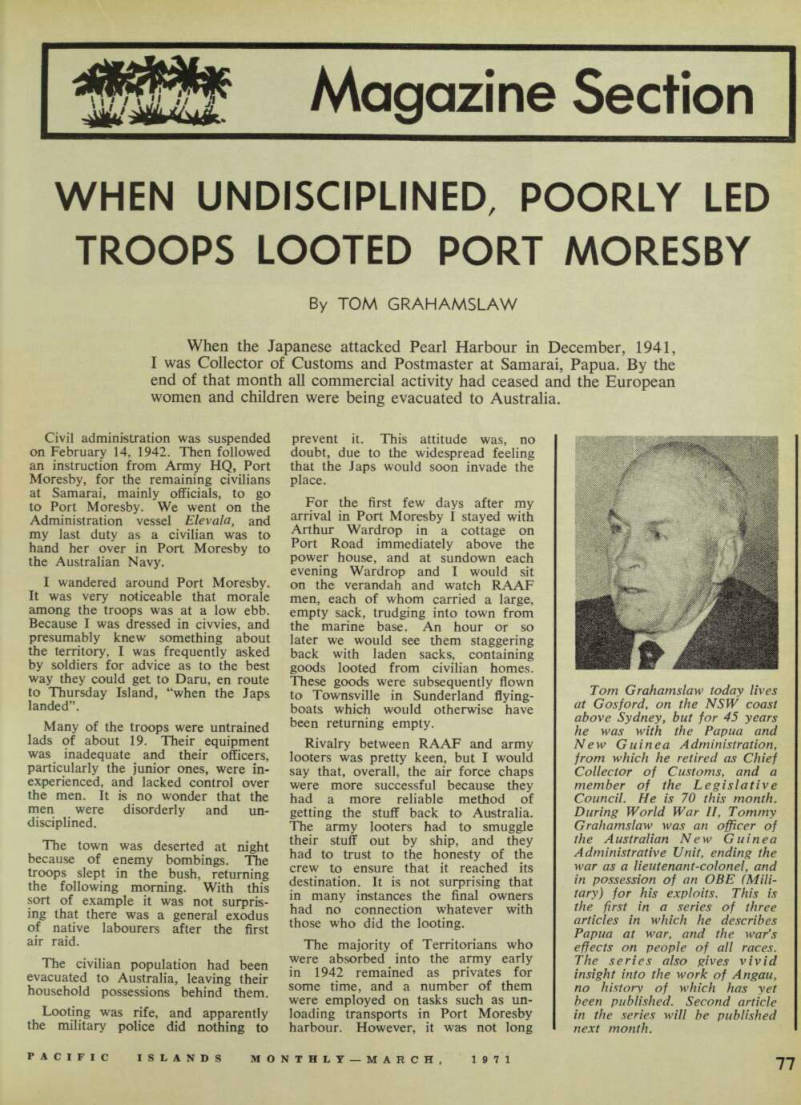
Tom Grahamslaw today lives at Gosford, on the NSW coast above Sydney, but for 45 years he was with the Papua and New Guinea Administration, from which he retired as Chief Collector of Customs, and a member of the Legislative Council. He is 70 this month.
During World War II, Tommy Grahamslaw was an officer of the Australian New Guinea Administrative Unit, ending the war as a lieutenant-colonel, and in possession of an OBE (Mili tary) for his exploits. This is the first in a series of three articles in which he describes Papua at war, and the war’s effects on people of all races.
The series also gives vivid insight into the work of Angau, no history of which has yet been published. Second article in the series will be published next month.
before the army found a better use for their talents.
Practically all the natives em ployed in Port Moresby had deserted after the first enemy bombing.
Coastal ships were without crews.
Gaols were opened and prisoners released. All these people returned to their villages, and soon there was a feeling abroad that now the government had gone the people could do as they pleased. Reports of inter-tribal fights and killings started to trickle into Port Moresby.
As maintenance of law and order was now an army responsibility, it was decided to create a special unit which, in addition to operational duties, would be responsible for the administration of native affairs, and for recruitment and control of natives employed by the armed services.
Major S. Elliott-Smith, who had been a senior Assistant Resident Magistrate in the Papuan administra stration, and was acknowledged as one of its most capable officers, played a major part in the planning and creation of the new unit.
The military organisation which resulted was first designated as the Papuan Administrative Unit. It sub sequently became the Australian New Guinea Administrative Unit, soon known as Angau.
One of Angau’s first tasks was to persuade native labourers and ships’ crews to return to their jobs.
Lieut. A. H. Baldwin was placed in charge of this task. He was a fluent Motu speaker who had spent most of his life in the territory; he was liked and respected by Papuans and in the early days of Angau he did more than any other man to induce native workers to return to Port Moresby and remain there, despite the frequent bombings.
Another immediate task was to man the seven districts in Papua with army personnel who had experience in native administration. My ex perience at Daru and other out stations, which included service as an Assistant Resident Magistrate, made me eligible for that job, and as I had now joined the army I nomina ted the Northern District and was appointed District Officer forthwith.
But I was told to make my own arrangements about getting there, and in selecting my men. Thus it came about that Lieutenants Peter Brewer and Gerry Brown became members of my team.
Our first need was to obtain a ship.
Happily, I was offered the Elevala.
The problem of a master was solved when I met Captain L. Austen, who was awaiting repatriation to Australia because of his age, about 60. Austen was a master mariner who had serv ed in the Royal Navy in World War I. After retiring from the sea he was employed by the Papuan Administra tion as Controller of Native Coffee Plantations, with headquarters at Higaturu, in the Northern District.
He had no wish to leave the territory and readily volunteered.
I next ran into Warrant Officer Oberdorf, who, in civilian times, had been working as an engineer in the desiccated coconut factory at Gili Gili. He had a large tropical ulcer on his leg and was awaiting move ment to Australia for medical treat ment. Oberdorf also had no desire to leave the territory and he willingly agreed to go as engineer.
The original native crew of Ele vala, mainly from the Samarai area, gladly re-joined the vessel.
When we boarded Elevala we found that every thing movable had been taken. The looters had been there, too. What to do about it?
At that time Port Moresby Harbour lacked protection from bombing raids, and the practice when ever an air alert was sounded was for the ships’ crews to make their way to dugouts ashore and stay in them un til the siren sounded “all clear”.
The very next day Port Moresby was visited by nine enemy bombers with a Zero cover. This was the big gest air raid so far, and there was a hasty exodus from ships in the harbour. We took the opportunity to board various smallcraft, where we had no difficulty in finding the miss
ing equipment.
Next, we had to ration the ship.
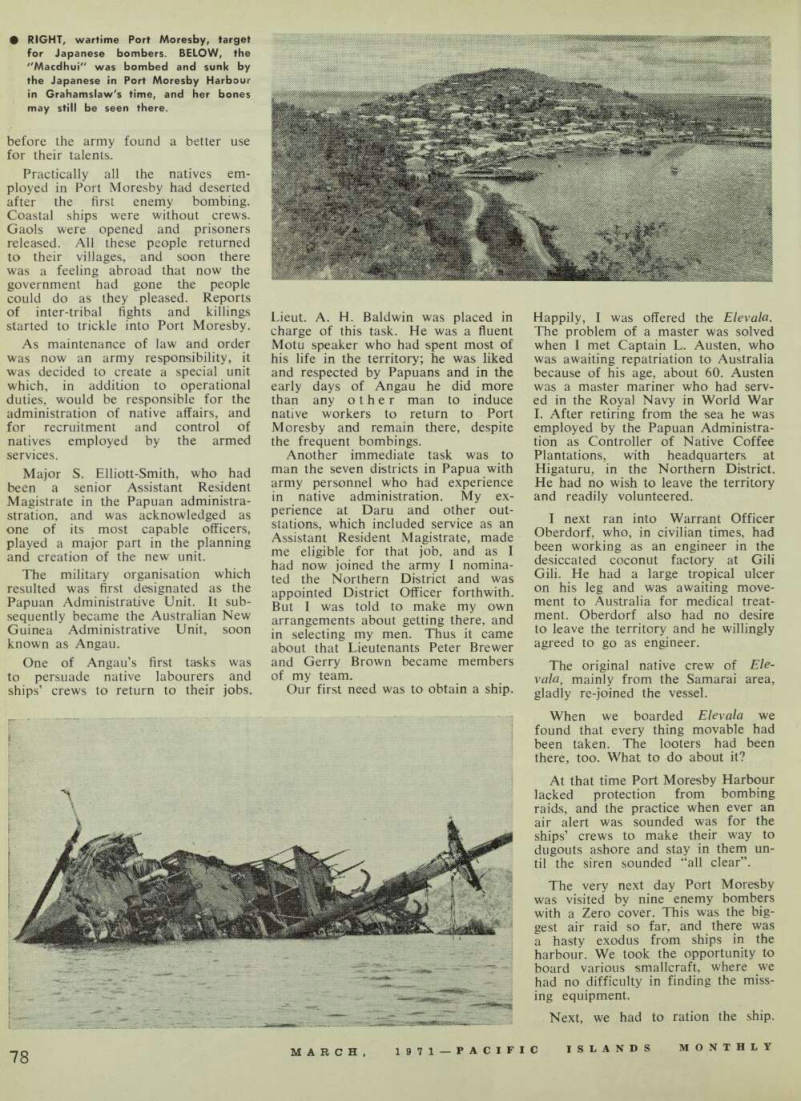
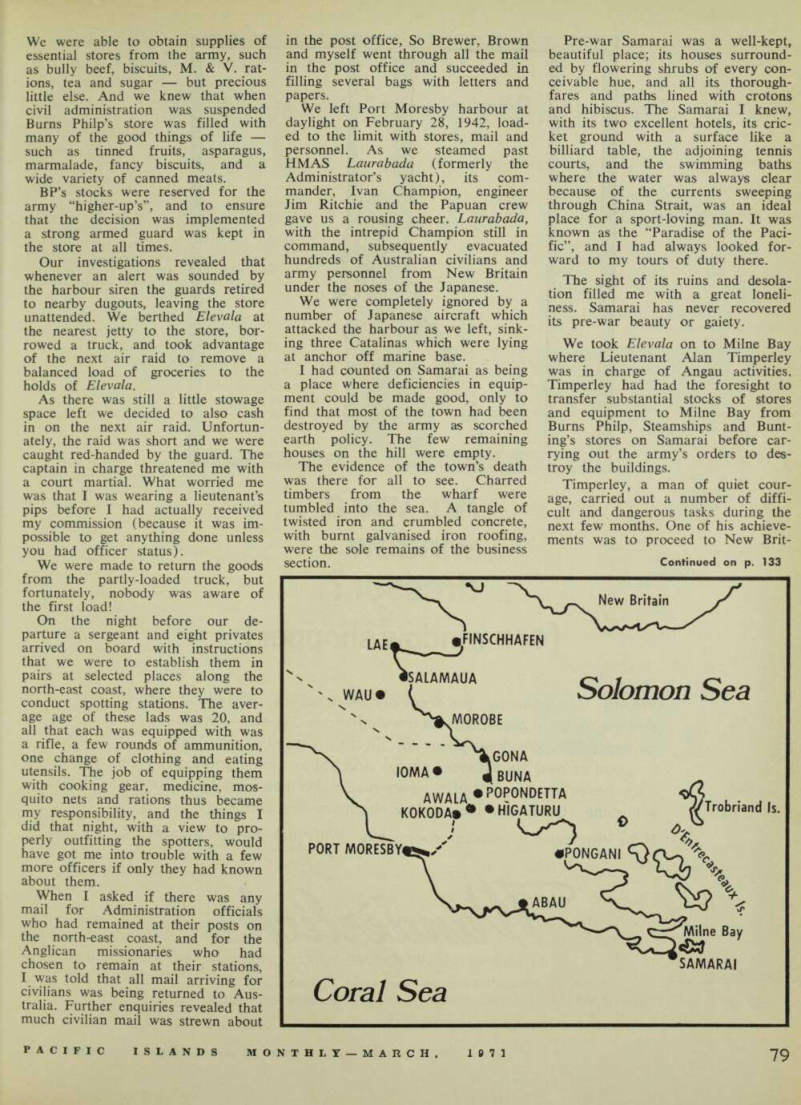
RIGHT, wartime Port Moresby, target for Japanese bombers. BELOW, the "Macdhui" was bombed and sunk by the Japanese in Port Moresby Harbour in Grahamslaw's time, and her bones may still be seen there.
We were able to obtain supplies of essential stores from the army, such as bully beef, biscuits, M. & V. rat ions, tea and sugar but precious little else. And we knew that when civil administration was suspended Burns Philp’s store was filled with many of the good things of life such as tinned fruits, asparagus, marmalade, fancy biscuits, and a wide variety of canned meats.
BP’s stocks were reserved for the army “higher-up’s”, and to ensure that the decision was implemented a strong armed guard was kept in the store at all times.
Our investigations revealed that whenever an alert was sounded by the harbour siren the guards retired to nearby dugouts, leaving the store unattended. We berthed Elevala at the nearest jetty to the store, bor rowed a truck, and took advantage of the next air raid to remove a balanced load of groceries to the holds of Elevala.
As there was still a little stowage space left we decided to also cash in on the next air raid. Unfortun ately, the raid was short and we were caught red-handed by the guard. The captain in charge threatened me with a court martial. What worried me was that I was wearing a lieutenant’s pips before I had actually received my commission (because it was im possible to get anything done unless you had officer status).
We were made to return the goods from the partly-loaded truck, but fortunately, nobody was aware of the first load!
On the night before our de parture a sergeant and eight privates arrived on board with instructions that we were to establish them in pairs at selected places along the north-east coast, where they were to conduct spotting stations. The aver age age of these lads was 20, and all that each was equipped with was a rifle, a few rounds of ammunition, one change of clothing and eating utensils. The job of equipping them with cooking gear, medicine, mos quito nets and rations thus became my responsibility, and the things I did that night, with a view to pro perly outfitting the spotters, would have got me into trouble with a few more officers if only they had known about them.
When I asked if there was any mail for Administration officials who had remained at their posts on the north-east coast, and for the Anglican missionaries who had chosen to remain at their stations, I was told that all mail arriving for civilians was being returned to Aus tralia. Further enquiries revealed that much civilian mail was strewn about
in the post office, So Brewer, Brown and myself went through all the mail in the post office and succeeded in filling several bags with letters and papers.
We left Port Moresby harbour at daylight on February 28, 1942, load ed to the limit with stores, mail and personnel. As we steamed past HMAS Laura bada (formerly the Administrator’s yacht), its com mander, Ivan Champion, engineer Jim Ritchie and the Papuan crew gave us a rousing cheer. Laurabada, with the intrepid Champion still in command, subsequently evacuated hundreds of Australian civilians and army personnel from New Britain under the noses of the Japanese.
We were completely ignored by a number of Japanese aircraft which attacked the harbour as we left, sink ing three Catalinas which were lying at anchor off marine base.
I had counted on Samarai as being a place where deficiencies in equip ment could be made good, only to find that most of the town had been destroyed by the army as scorched earth policy. The few remaining houses on the hill were empty.
The evidence of the town’s death was there for all to see. Charred timbers from the wharf were tumbled into the sea. A tangle of twisted iron and crumbled concrete, with burnt galvanised iron roofing, were the sole remains of the business section.
Pre-war Samarai was a well-kept, beautiful place; its houses surround ed by flowering shrubs of every con ceivable hue, and all its thorough fares and paths lined with crotons and hibiscus. The Samarai I knew, with its two excellent hotels, its cric ket ground with a surface like a billiard table, the adjoining tennis courts, and the swimming baths where the water was always clear because of the currents sweeping through China Strait, was an ideal place for a sport-loving man. It was known as the “Paradise of the Paci fic”, and I had always looked for ward to my tours of duty there.
The sight of its ruins and desola tion filled me with a great loneli ness, Samarai has never recovered its pre-war beauty or gaiety.
We took Elevala on to Milne Bay where Lieutenant Alan Timperley was in charge of Angau activities.
Timperley had had the foresight to transfer substantial stocks of stores and equipment to Milne Bay from Burns Philp, Steamships and Bunt ing’s stores on Samarai before car rying out the army’s orders to des troy the buildings.
Timperley, a man of quiet cour age, carried out a number of diffi cult and dangerous tasks during the next few months. One of his achieve ments was to proceed to New Brit-
Continued on p. 133
ain in a small, 4-knot launch, to as sist in assembling European evacuees at a pre-determined embarkation point for Laurabada to rescue them.
His task completed, Timperley re turned to Milne Bay in the same launch after braving the elements and enemy aircraft which dominated the skies at the time.
We unloaded Elevala at Gili Gili wharf. Then all hands set to the task of making up a three months’ supply of stores for each spotting unit, and for the government sta tions at Tufi, Buna, Kokoda and loma.
When we heard over the air that night that Salamaua had been occu pied by the Japanese, I got an un easy feeling that if we didn’t shake it up the Japs might reach Buna before us. So we worked all that night re-loading Elevala, and dawn found us heading for East Cape and the north-east coast of Papua.
Ours was the first ship to travel up the north-east coast after the suspension of civil administration.
Naturally, we received a warm wel come from the missionaries and of ficials who had stayed put. The mail we brought was the first they had received for almost three months.
At Tufi we were met by the ADO, Lieutenant George Andersen, who reported that everything was under control. While at Tufi the Anglican Mission vessel, MacLaren King, ar rived from Buna with the Bishop of New Guinea (Bishop Philip Strong) on board. The bishop told me that the MacLaren King had been shot up by a Japanese float plane while lying at anchor at Buna the previous afternoon. The plane straffed the sta tion before it turned its attention to the ship.
The bishop had a narrow shave.
He was in the cabin writing when the plane attacked, and a bullet pierced the prayer book near his right hand, and another left a gap ing hole in a tin of Sal Vital on his table.
The ADO at Buna, Alan Cham pion, had an equally narrow shave.
When the plane was shooting up the MacLaren King he endeavoured to call Port Moresby on his radio set. This must have attracted the at tention of the plane, for it returned and shot up the office building. Bul lets whistling through the roof and past his ears made him postpone transmission of his message until the plane left.
The bishop’s news caused me to
The war in Papua
decide to do the remainder of our travelling at night. We left Tufi in the late afternoon and arrived at Oro Bay at first light. The native village at Biama was deserted but we were able to contact some of the village people at their garden places. As they were uncertain about the situa tion at Buna I decided to leave Ele vala at anchor while, accompanied by Brewer, I pushed on to Buna by canoe.
At Buna we were greeted by Champion and Lieut. H. I. lesser, who was in charge of a detachment of PIB based on Buna. We brought Elevala up with a radio signal, and Elevala became the mainstay of the Northern District until the Japanese landed at Buna on July 21. She brought stores and mail at six-week ly intervals. Captain Austen left her after the second trip and returned to Higaturu, where he got the native coffee industry going again. The Japs sank Elevala at Milne Bay in August, 1942, Shortly after my arrival at Buna, Lieut, Clen Searle reported to me for duty, after walking overland from Port Moresby. Searle had been a rubber planter whose plantation was situated at Awala, which was about half way between Buna and Kokoda.
My instructions were to set up Northern District headquarters at a centrally-situated place, from where I could maintain close contact with sub-stations of Kokoda and loma, as well as Buna. Searle suggested that I base on Awala, where I could make use of his plantation buildings to accommodate Europeans and natives. He pointed out that good native tracks led from Awala to loma. Searle’s advice was sound.
One of my first tasks was to make Awala also the headquarters of the district spotting stations, of which there were nine. Warrant Officer Jack Mason, who had been a planter before he joined up, was placed in charge of communications. Jack was an enthusiastic wireless ham, and he possessed an intimate knowledge of teleradio sets. It was quite aston ishing what Jack could do with a pair of pliers and a screwdriver.
In addition to keeping the station set in top condition, Jack always had a spare set in full working order for instant despatch to any of the spot ting stations for which we were re sponsible. The arrangement we had was that if any station was off the air for 24 hours we would despatch a
The war in Papua
replacement set from Awala with re lays of carriers. The defective set would be brought back to Awala for repair.
My first important court case in Buna was the trial of a village con stable named Kenneth, whose vil lage was situated in the Sangara area.
Shortly after the fall of Rabaul a party of European men and women, led by the New Guinea Director of District Services, the late R. M. Mel rose, had gone by small craft from Salamaua to Buna. The Resident Magistrate at Buna, the late O, J.
Atkinson, assigned Kenneth to ac company Melrose’s party on the walk to Kokoda, where the nearest aerodrome was.
On arrival at Kokoda one of the European members of the party pre sented Kenneth with a ring as a token of appreciation of his services.
Kenneth spoke English fluently.
Listening to the conversation of some members of Melrose’s party, coupled with the obvious fact that they were fleeing from the territory, must have convinced him that the Japanese would soon be taking over.
When Kenneth returned to his vil lage he announced that the King of Japan had appointed him as King of the Sangara region. As evidence of his appointment, he displayed the ring which he said had been sent to him by the King of Japan.
Kenneth called a meeting of his people and informed them that when the Japanese came they would re quire an aerodrome for their planes and barracks for their soldiers. He then appointed a number of men as “captains”, and placed them in charge of villagers and began to build barracks and clear land for an airstrip.
When the news reached Alan Champion at Buna he arrested Ken neth on a charge of sedition. I sen tenced Kenneth to a term of im prisonment and as I felt he would be a dangerous man to have about the place in the event of an enemy landing, I sent him to Port Moresby to serve his sentence.
I mention this case to illustrate the thinking of some elements of the Orakaiva people at that time. The people from Kenneth’s village and adjacent areas subsequently assisted the Japanese in many ways, and were responsible for the betrayal of missionaries and other Europeans to the Japanese.
From the middle of March until the Japanese landing at Buna in July
The war in Papua
I was almost constantly on patrol.
In addition to regular inspections at Buna, Kokoda and loma I visited all the spotting posts, each manned by two members of a signals unit.
Theirs was a lonely and largely monotonous job. They had to keep a 24-hour watch for enemy aircraft and shipping, and I found regular visits by Angau patrols did much for the morale of these men.
On my first patrol to Kokoda I was within less than an hour’s walk from the station when I saw the shooting down of a Japanese bomber by two Australian Kittyhawks.
The bomber was one of a number returning to New Britain from a raid on Port Moresby. They were flying in perfect formation with a Zero cover when the Kittyhawks dived out of the clouds, attacked the lead ing bomber, and then darted back into the clouds with the Zeros in hot pursuit. I watched the bomber crash into a mountain behind Kokoda station.
On arrival at Kokoda I found that Peter Brewer was about to depart with a small party of native police in search of the bomber, so I joined him. With the help of a village con stable we found the wreckage of the bomber, with its dead crew, at a height of about 7,000 ft.
We made two discoveries there which we felt would be of major interest to army intelligence. The first was a figure code book with English numerals. The other was an excellent map of the territory and of northern Queensland. The part which related to north Queensland had several ringed markings on it which we thought had some special significance to the enemy.
Another interesting find was a machine gun which appeared to be an exact replica of the Lewis gun held in Kokoda station (we subse quently found that its parts were interchangeable with the station gun).
In those days most of us had the feeling that it was only a matter of time before the enemy landed, so we prepared the native population for this possibility. We made our propaganda simple. The gist of it was that the Japanese were a land hungry people who wanted to settle in New Guinea, and that in addi tion to taking the natives’ land, they would kill off the menfolk and take the women as wives.
We stressed that if the Japanese did come, we, the Angau officials, would go to Port Moresby and then
The war in Papua
lead back large numbers of soldiers to drive off the enemy.
One problem was how to give a description of Japanese to people who had seen only other natives and Europeans before. This problem was simplified when we acquired our first Japanese prisoner in April. He was captured by Lieut. Eric Turner (who subsequently became manager of Burns Philp Ltd., Samara!).
Turner was on a routine patrol about a week’s walk in from loma when some natives ran up and said that a white man was coming. Tur ner was wondering as to who could possibly be in such a remote area without his knowledge, when they met face to face. Turner aimed his rifle as the Jap tugged at his re volver. The Jap was a Zero pilot who had made a forced landing.
Turner brought the prisoner to me at Awala, where I kept him for sev eral days so that the natives could come from far and near to inspect him.
This man had the distinction of being the first Japanese to complete ly traverse the Kokoda Trail. He, of course, did it as a prisoner-of-war.
We were also involved during those months with the problem of recruiting native labourers for work in Port Moresby, and this was diffi cult because Angau HQ had instruct ed me that I was to offer them 6/- a month, which was the going rate in the adjoining Mandated Ter ritory of New Guinea. But minimum rate in Papua had always been 10/-.
As exaggerated stories were al ready rife among the native people of the effects of enemy bombing in Port Moresby, the low pay rate made it virtually impossible for us to get anybody. HQ peremptorily re plied to my message querying the rate, ordering me to start recruiting.
But since all our efforts to get re cruits at 6/- failed, I took it upon myself to recruit the 500 men they wanted at 10/-. These were assembl ed at Kokoda and sent overland, with a note from me explaining my reasons for the pay “increase”. I heard nothing more on the subject.
A new request for another 500 men took all the persuasive powers of Brewer, Searle, Champion, Jack McKenna (loma) and myself to convince the native people that the services of their young men was a necessary part of the war effort.
When this lot went over the Kokoda Track I took the opportunity to make it clear to HQ that quite a deal of resentment was felt by the native
The war in Papua
population, and I expressed the hope that the Northern District would not be called upon to provide any more recruits.
Meanwhile, the Japs were appar ently becoming very interested in Buna, because in April I got a re port from the ADO at Morobe, Lieut. J. A. Costelloe, saying that a launch had arrived from Salamaua with enemy troops seeking informa tion from the natives about the road from Buna to Kokoda and about the Kokoda Track to Port Moresby. An ex-sergeant of native police spoke to the Japs in the launch without re vealing his former position, and it was he who reported the conversa tion. This news was transmitted to Port Moresby without delay.
Early in May I was returning to Buna in a powered skiff after in specting the spotting station at Am basi when Constable Christian Arek drew my attention to two large ves sels which appeared to be steaming in the direction of Buna. They look ed like transports or supply ships, and were obviously Japanese, and my first thoughts were that they were part of a Buna invasion force. How ever, to my great relief, they changed course in the direction of the D’Entrecasteaux group of islands.
Army headquarters at Port Mores by was radioed, and we learned later that these ships were headed for an unexpected rendezvous in the Coral Sea, and that Christian Arek was one of the first people to re port the approach of enemy shipping for the Coral Sea Battle.
We had the job of scouring the coast for survivors, with no result.
Tufi station was now bombed, and at Gona, I resumed my endeav ours to persuade the Rev. James Benson to send the two Australian Anglican Mission sisters back to Australia. The most telling point I made was that if the enemy landed, lives of Angau personnel could be endangered while endeavouring to rescue the womenfolk.
Benson said that he had already taken up the matter with mission headquarters at Dogura and had re ceived a reply to the effect that the women could go if they wished, but the bishop considered it was their duty to remain. Miss May Hayman and Miss Mavis Parkinson, being dedicated women, had elected to re main.
This, as it turned out, was a tragic decision. • Next month: "Behind the Jap lines"