Land-And Speculators
pp. 42-44 · Read in the full issue
Growing Concern In Fiji Over
From SUE WENDT, in Fiji Land is Fiji’s greatest asset~and one of its biggest headaches. Land in all its facets is currently a controversial subject in the newly-independent dominion. One important aspect is the growing criticism of speculative land transactions. “Speculator” is just about the most insulting word in Fiji right now, and even genuine investors are having to talk hard and fast to disprove the image.
Propositions relating to residen tial subdivisions, where there is no obligation for buyers to build with in a specified time, are particularly suspect. Many people are conscious of the Hog Harbour “non-develop ment” in the New Hebrides. Land laws securing Fiji’s future are long overdue.
Most ardent advocate of protec tive legislation in recent months has been the Nation, a locally-published bi-monthly newsmagazine supported by the Alliance Party.
Nation’s anti-speculation articles no doubt point to the fact that some sort of legislation will be forthcom ing in due course. The astonishing thing is that its urgings haven’t been acted upon already.
The problem is to formulate laws designed to discourage the wheeler dealers, without inhibiting the bene ficial activities of genuine investors.
But it is taking caution to ludi crous, and irreversably dangerous, lengths to allow the present situation whereby outsiders can reap huge profits without paying a cent in tax to Fiji to continue in the midst of the current land-buying boom.
Best-known sub-division develop ment is no doubt the Pacific Harbour development at Deuba (see p, 42 for the latest moves on that) but new schemes are being announced every week, it seems.
Other Fiji
land moves
Other Fiji land moves include an application for the lease of crown land around Denarau Island, by Com mercial Investment Properties Ltd.
Leasing of the 180-acre island in Nadi Bay was completed several weeks ago, according to the director of the company, Mr. Dennis McElrath. Plans for development include the erection of a multi-million dollar hotel.
The company is now asking for a 99-year lease covering about 350 acres near the mouth of the Nadi River (between Denarau and Buabua Islands), 44 acres between the river mouth and Buabua and four acres
off the north-west point of Denarau.
Permission has also been sought for the company to remove soil from the sea bed over an area of about 180 acres at the river mouth.
If the leases are granted, the com pany will undertake to reclaim, road and drain the area within 10 years.
Commercial Investment Properties started to clear Denarau Island for the building of access roads and bridges late last year.
Mr. McElrath told PIM that it was hoped that work on a 300-room hotel, to cost around $4 million, would start at least before the end of 1971. The master plan calls for five hotels to be built over seven years.
More than 450 Fijians - members of 11 mataqalis in the area will benefit from the rental and share participation provided for them under the lease for Denarau Island.
Another development proposal is a $1 million scheme planned for part of a 2,030 acre plantation at Buca Bay, on Vanua Levu. The property is owned by Nukudamu Estate Ltd.
A spokesman for the developing company, J. H. Mair Ltd., said plans included provision for an initial 100 home sites, which would be made available to local and overseas inves tors.
“These will be run on a condo minium basis and made available for rental to visitors,” he said, “First step in the development will be the erection of a two-storey colonial-style hotel on the beachfront, at a cost of around $400,000, with 40 three-room air-conditioned suites.
“Tenders are due to go out within the next couple of months and work should start by mid-1971.”
The spokesman said the cost of developing the residential resort, in cluding putting in reading, a golf course, tennis courts and a dam for water reticulation is expected to be more than $1 million over the next five years.
“Some of the finance is being pro vided by a Honolulu investment group and some of it from local sources,” he said.
The plantation, which has a sweep ing view of Buca Bay and the Islands
of Kioa, Rabi and Taveuni, was one of the first established on Vanua Levu. Over the years it was divided into three separate properties. Last year they were bought for a total of $200,000 by Nukudamu Estate Ltd and re-established as a single operating plantation. It’s located 45 miles along the Hibiscus Highway from Savusavu.
Meanwhile, in yet another Fiji land deal, an American called George Isaacs is believed to be planning a big subdivision project on Soqulu Estate, a 3,600-acre Taveuni planta tion.
He was in Fiji in February, to hold discussions with government officials.
Apparently his plans for subdivision of the land into 3,000 lots has met with some opposition.
The estate is owned by Soqulu Estate Ltd, in which Mr. Isaacs is a principal shareholder. His biggest company, however, is the huge Inter national Land Marketing Corporation, which has offices in Honolulu and Los Angeles.
The corporation is reputed to have participated in the development, sale and purchase of more than one mil lion acres of land in Western USA.
Land needed
for "that" road
A real estate headache for the Fiji Government is the prospect of securing sites necessary for the re routing of the proposed Nadi-Suva Road.
In February, Minister for Com munications, Works and Tourism, Mr. Charles Stinson, appealed to landowners to co-operate with the government over the acquisition of land for the project.
Emphasising the need for urgency, Mr. Stinson said he had had dis cussions with World Bank officials about negotiations for the bank to finance the project estimated (somewhat optimistically) at SFI3 million.
He stressed that it was important to apply officially to the be fore the end of its current fiscal
year in June. It wouldn’t help Fiji’s case at all, he said, if only a few people had agreed by June to trans fer their land.
Compensation, he explained, would be based on the value of the land. This would be a matter of agreement between the owner and the Lands Department, which had already started property inspections and negotiations on the Suva-Galoa section.
All landowners would be con tacted and supplied with individual plans and information explaining how their interests were effected. If landowners who include Euro peans, Indians and Fijian mataqali could not come to an agreement with the government, the alternative was legal compulsion.
'Misunderstood 7 rates Current legislation relating to the rating of Fijian-owned land is one of the most confused issues of all.
Controversial head of the Native Land Trust Board, Dr. Rusiate Nayacakalou, describes it as “the most misunderstood piece of recent legislation in Fiji”.
The system, which was designed by Dr. Nayacakalou, is the means for collecting money from Fijians to pay for the administration of their respective provinces. It has come under fire from several directions, most vociferously from the Opposi tion’s Pacific Review.
Four of Fiji’s 14 provinces are now employing the system on an experi mental basis. The remaining 10 are still using the old system of provincial tax.
The people of Tailevu, which is following the new system, have com plained that their rates are higher than the rents they receive for their land.
Replying to the criticism recently, Dr. Nayacakalou said ill-conceived pronouncements had been made about the land-rating system and in some cases, political propaganda had been made out of the issue.
He claimed that the legislation provided ways and means by which a provincial council could waive in whole or part, the rates charged on any particular mataqali land.
Fijian landowners could set aside areas not needed for their own use and could then ask the Native Land Trust Board, through the provincial council, to try to lease this land in
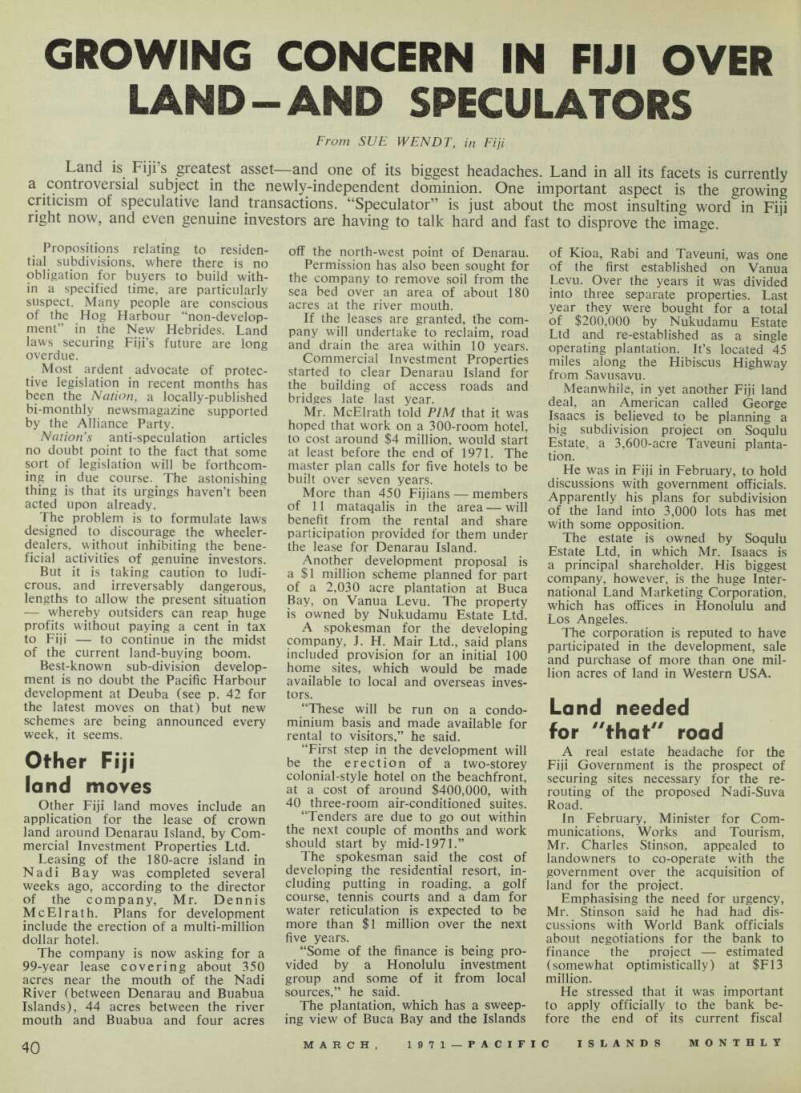
Swift-changing Suva, where land values are rising steadily. This latest aerial view, by Nitin Lal, shows the city's heart. Top right, next to the smooth sweep of Albert Park, are the Government Buildings (with clock tower), with the relatively new air conditioned wing on the left. Travelodge and the Grand Pacific hotels are in top righthand corner of the picture. Fore ground, Sukuna Park, Stinson Parade and the odd-shaped Civic Centre.
order to obtain the money required for their provincial rates.
“Where lessees cannot be found either by the landowners or the pro vincial council, the council is required to waive the whole of the rates until lessees can be found or until the landowners use the land themselves or allow others to use it,” said Dr.
Nayacakalou.
The whole legislation had a double barrelled aim, he said. The first was to raise provincial revenue and secondly to “expedite the development of Fijian land”.
Cases had been quoted where the income from the land is infinitesimal compared with the rates levied on it.
The most likely answer, Dr. Naya cakalou said, was that only a small proportion of the land had been
leased.
The land rate needn’t cause any difficulty if the provincial administra tors knew the regulations covering its use and were not afraid of making the deductions allowable under the regulations, ne added.
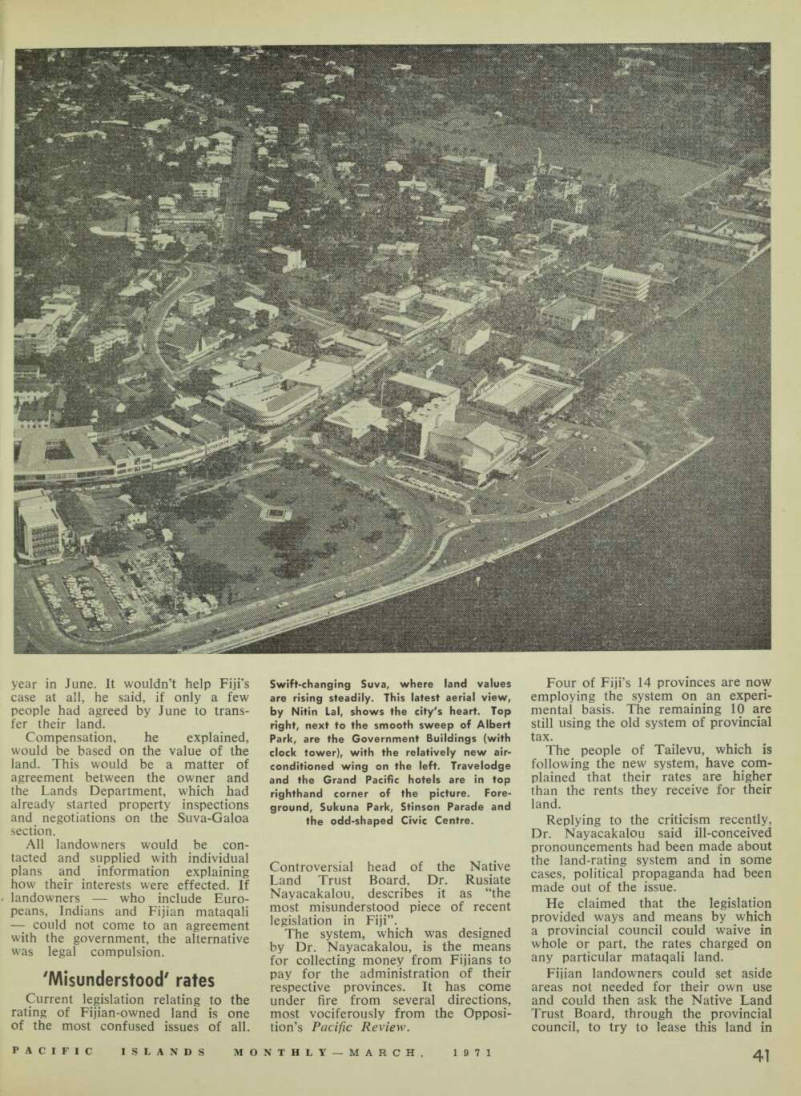
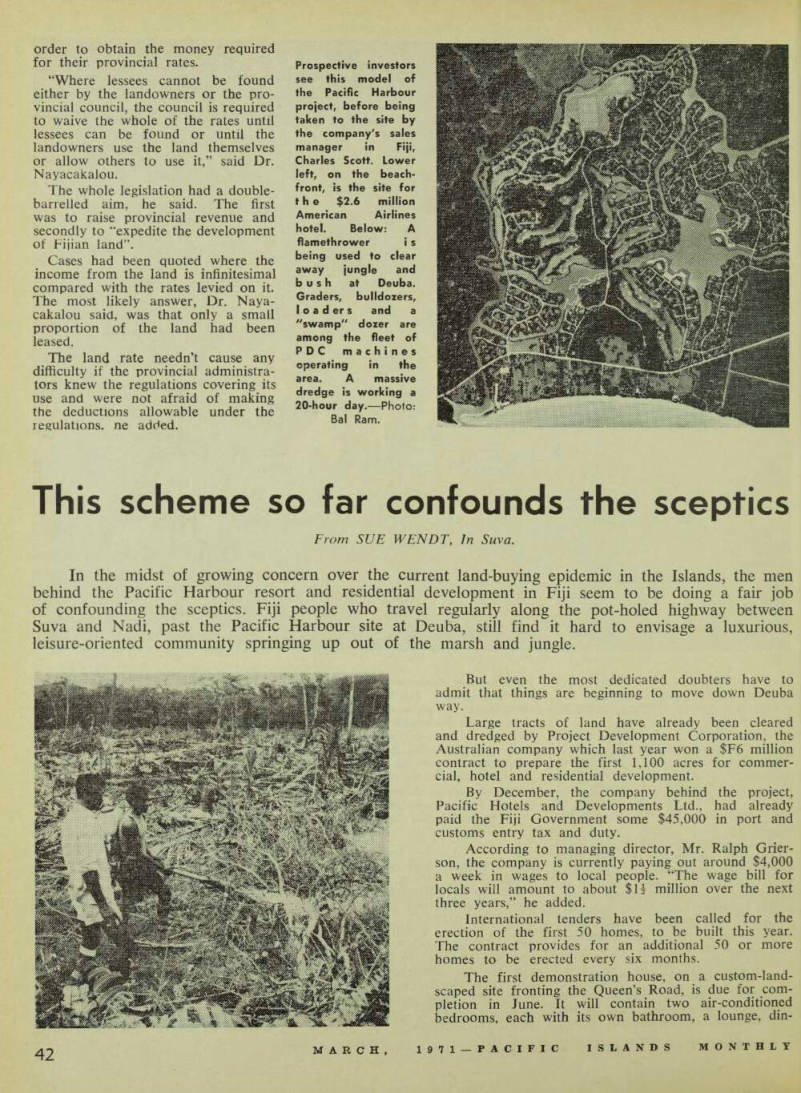
Prospective investors see this model of the Pacific Harbour project, before being taken to the site by the company's sales manager in Fiji, Charles Scott. Lower left, on the beach front, is the site for the $2.6 million American Airlines hotel. Below: A flamethrower is being used to clear away jungle and bush at Deuba.
Graders, bulldoxers, Ioaders and a "swamp" dozer are among the fleet of PDC machines operating in the area. A massive dredge is working a 20-hour day.— Photo: Bal Ram.