Footnotes
pp. 40-41 · Read in the full issue
Ng: Dawdling
On The Way To
The Dentist
]V|R. PAULUS AREK, MHA, much tried 1 A chairman of our select committee on con stitutional development was recently reported as claiming that Papuans and New Guineans were being more thoroughly consulted about their future than the people of any other “emerging nation” in the world.
In the light of recent events in Niugini (it now looks as if “Pagini” was a bad bet after all) the truth of this claim can hardly be questioned.
First we had Gough Whitlam and his merry men. Then simultaneously, and crossing each other’s tracks in places, the four-man United Nations visiting mission and our own select com mittee. Niuginians may well be pardoned for becoming confused, and it is said that at one place in the Highlands an impassioned speech was brought to an abrupt halt when someone ex plained to the speaker that it was the UN mission
he was addressing, and not, as he had thought, the select committee.
Does any sort of pattern emerge from this furore of consultation and this spate of mutually contra dictory and sometimes angry words?
I think that there does.
It is clear that, whether we give Gough Whitlam the credit for it or not, there has been an enormous swing during 1970 in
Niuginian public opinion on the
subject of timetables and target dates for home rule. This change
in thinking has manifested itself not only in the coastal and island areas, but even, though as yet
timidly, in the Highlands.
It is also clear that, in spite of the bandying around of the catch phrase “political education”, many Niuginians, alike among those who are shouting for self-government tomorrow and those who want to put it off for as long as possible, have very little idea of what it is all about, and no idea at all of the extent to which we are
already self-governing.
It is an indictment of our educational system when high school students write to the news papers to explain condescendingly to their less “educated” compatriots that we are not yet ready for self-government because we have no factories turning out transistor radios. And it is a sad
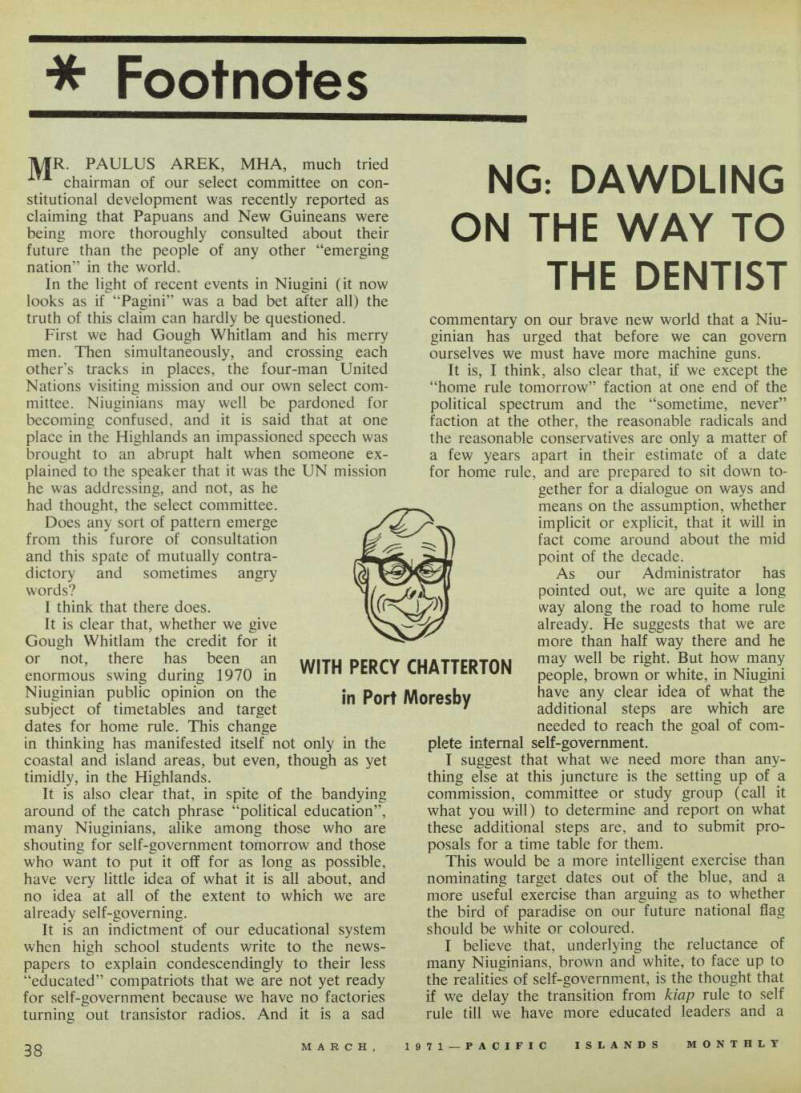
With Percy Chatterton
in Port Moresby
commentary on our brave new world that a Niu ginian has urged that before we can govern ourselves we must have more machine guns.
It is, I think, also clear that, if we except the “home rule tomorrow” faction at one end of the political spectrum and the “sometime, never” faction at the other, the reasonable radicals and the reasonable conservatives are only a matter of a few years apart in their estimate of a date for home rule, and are prepared to sit down to
gether for a dialogue on ways and means on the assumption, whether implicit or explicit, that it will in fact come around about the mid point of the decade.
As our Administrator has pointed out, we are quite a long way along the road to home rule already. He suggests that we are more than half way there and he may well be right. But how many people, brown or white, in Niugini have any clear idea of what the additional steps are which are needed to reach the goal of com
plete internal self-government.
I suggest that what we need more than any thing else at this juncture is the setting up of a commission, committee or study group (call it what you will) to determine and report on what these additional steps are, and to submit pro posals for a time table for them.
This would be a more intelligent exercise than nominating target dates out of the blue, and a more useful exercise than arguing as to whether the bird of paradise on our future national flag should be white or coloured.
I believe that, underlying the reluctance of many Niuginians, brown and white, to face up to the realities of self-government, is the thought that if we delay the transition from kiap rule to self rule till we have more educated leaders and a
better understanding of political matters at village level the transition will be easier and less troublous—self-government without tears, as it were.
I am sure that this is an illusion.
The widely held view that the new nations in Africa would have had a more trouble-free passage to independence if they had delayed the change is pure assumption, unverified and unveri fiable. The uncritical faith of many Niuginians In western-style academic education is just cargo cult.
Government is basically decision making, and the history of the old-established nations does not support the view that the best educated leaders make the wisest decisions and the fewest mistakes. In my experience, Niuginians who have had little or no formal education are often capable of making very intelligent and sensible decisions.
Like their counterparts in the older nations, our leaders, when they have made their decisions, will have to hire experts to carry them out. If they can’t get them locally they will have to get them from overseas and pay the market price for them.
One hears a lot of argument about whether or not we are “ready” for self-government. What does being “ready” mean? If it means that we must have the right clues for solving all our social and economic problems, we are not ready.
Neither is Australia. Nor America. Nor any of
the countries of the western world, not to speak of the newer nations. On the other hand, if being “ready” means that our leaders can carry out their task of decision making without making more mistakes than their counterparts elsewhere, I think that we’re ready now.
The mistakes have got to be made. The early years of self-government and independence in this country will be stressful, perhaps stormy, ones.
They will not be made less so by putting them off. As a septuagenarian I might perhaps be for given for saying “Let’s put them off till I’m dead”. But I say “Let’s get on with them and get them over”. At present we’re like a man dawdling on his way to the dentist.
A ND now to finish on a less serious note. Prior to 1963, Niuginians were forbidden by law to obtain, possess or consume alcoholic beverages. Some who rejected the white man’s claim that what was good for him was bad for them resorted to all manner of exotic concoctions.
A favourite in at least one part of Papua was reputed to consist of methylated spirit laced with
shoe polish.
I was reminded of this fragment of territory history when I heard that shoe polish manufac turers in Australia are buying up wineries. What does this foreshadow? Are we to anticipate that in future Australian sherries will be given an extra kick by a judicious admixture of the firm’s other product?
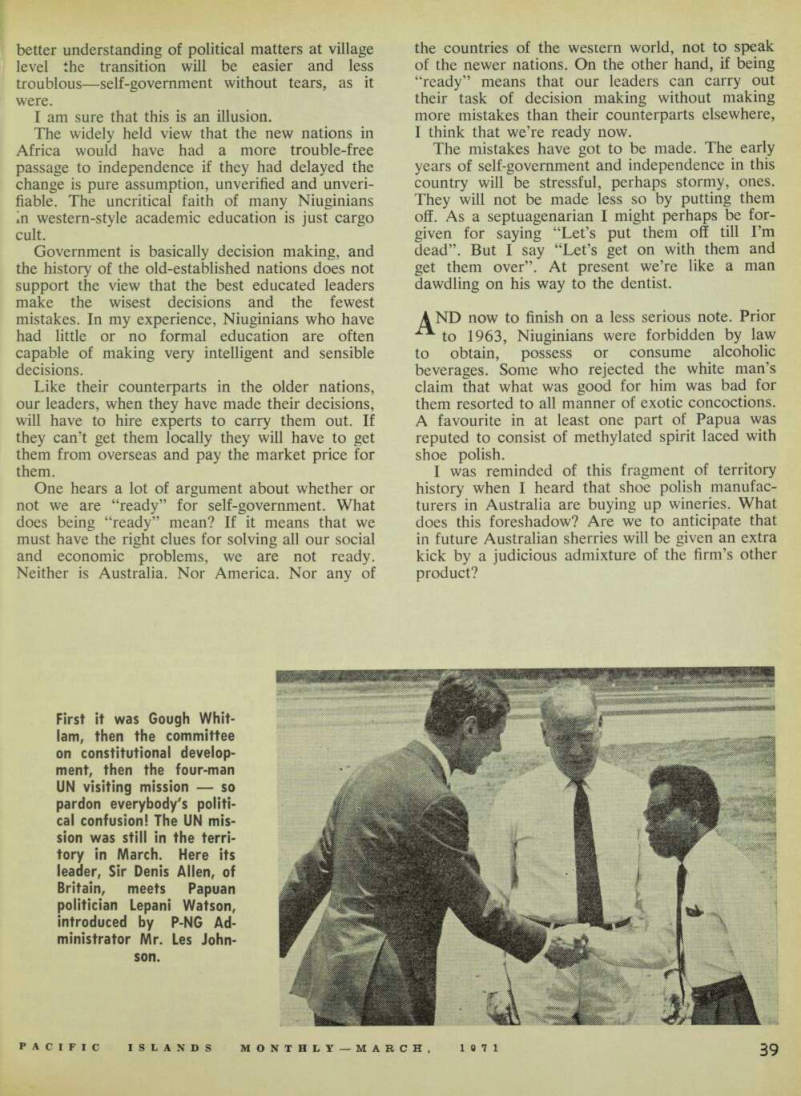
First it was Gough Whit lam, then the committee on constitutional develop ment, then the four-man UN visiting mission so pardon everybody's politi cal confusion! The UN mis sion was still in the terri tory in March. Here its leader, Sir Denis Allen, of Britain, meets Papuan politician Lepani Watson, introduced by P-NG Ad ministrator Mr. Les John son.