Tropicalities
pp. 34-39 · Read in the full issue

A bill which in February had its second reading in the Cook Islands Legislative Assembly, has been termed “racial dis crimination at its worst” and “likely to discourage foreign invest ment”, by local residents.
The bill amends the Cook Islands Entry and Departure Ordinance 1963 and gives the Minister of Immigra tion additional power to deport any one who is not a Polynesian (50 per cent, or more) born in the Cook Islands or a child of such a person.
Permanent residents (those who have lived in the Cooks continuously for five years) would in future have only immigrant status, and no se curity. They cannot opt for citizen ship.
Specified in the amendment is that deportation is justified “if in the opinion of the Minister the immigrant has been conducting himself in a man ner that is undesirable, having regard to the attitudes, standards or require ments of the community.” A pretty wide clause!
One writer to the Cook Islands News, Mr. A. Armistead, protested that this meant the minister could virtually deport people at will—no consideration given to a person’s in vestment in the Cooks, his family relationship or any matter.
He added, “This legislation is likely to discourage overseas investment at a time when we most need it, and it certainly does nothing to encourage many people who have an interest in the future of the Cook Islands, and who are at present permanent resi dents, to settle here and take an active part in planning and working for a better future for the people of these islands.”
He urged the Legislative Assembly to throw the bill out.
Another writer, Mr. O. B. Mulhane, said, “It does seem strange that at the very time when the Commonwealth Prime Ministers’ Conference has re cently passed a resolution condemning racial discrimination, and at a time when the United Nations Charter of Human Rights is also endeavouring to stamp out racial discrimination through the world, the Cook Islands Government has tabled in our Legis lative Assembly an amendment to the Entry and Departure Ordinance, which in effect would give political sanction through law to racial dis crimination at its worst.”
"Racial discrimination at its worst"
“I believe that this government honestly believes that such amend ments will only apply to extreme cases,” he said. “However, it is not the intended use of the law that mat ters; it is what it could become under less benign circumstances, its abuse, that must chill the spine of all per manent residents.”
He added that particularly when Cook Islanders are accepted totally, for both their worth and failings, in New Zealand, the Cooks should ac cept its permanent citizens with full rights. The government was quite justified in choosing its naturalised subjects from its aliens, but once they were chosen, the laws of the land should apply equally to all citizens, born and naturalised alike.
He called for a new bill giving equal status to all citizens.
With good reason, in our view. The Cooks’ amendment stinks of discrimi nation. But worse, it can too easily be the means of depriving citizens of human rights. It’s a detestable amendment that should go no fur ther.
Fiji also tightens
immigration
Fiji’s Minister for Labour, Ratu Sir Edward Cakobau, in February moved a bill in the House of Repre sentatives, to replace the present Immigration Ordinance, to require long-time Fiji residents who did not take up Fiji citizenship to apply for permits to enter the country.
But Ratu Sir Edward said, moving the bill, that it would be his policy to give such people permits to enter and reside which would be valid for a considerable number of years.
“Belongers” could meanwhile move in and out of Fiji freely until October
10 next year, the deadline by which they had to make a decision about citizenship.
He explained that some “be longers” in government service did not want to take citizenship because they would lose pensions due to them under the British Overseas Aid Scheme. His advice to them, Ratu Sir Edward said, was to continue in the scheme until retirement and then decide about citizenship.
Most of the new immigration legis lation followed the lines of the existing laws, but there were some important changes. The powers of
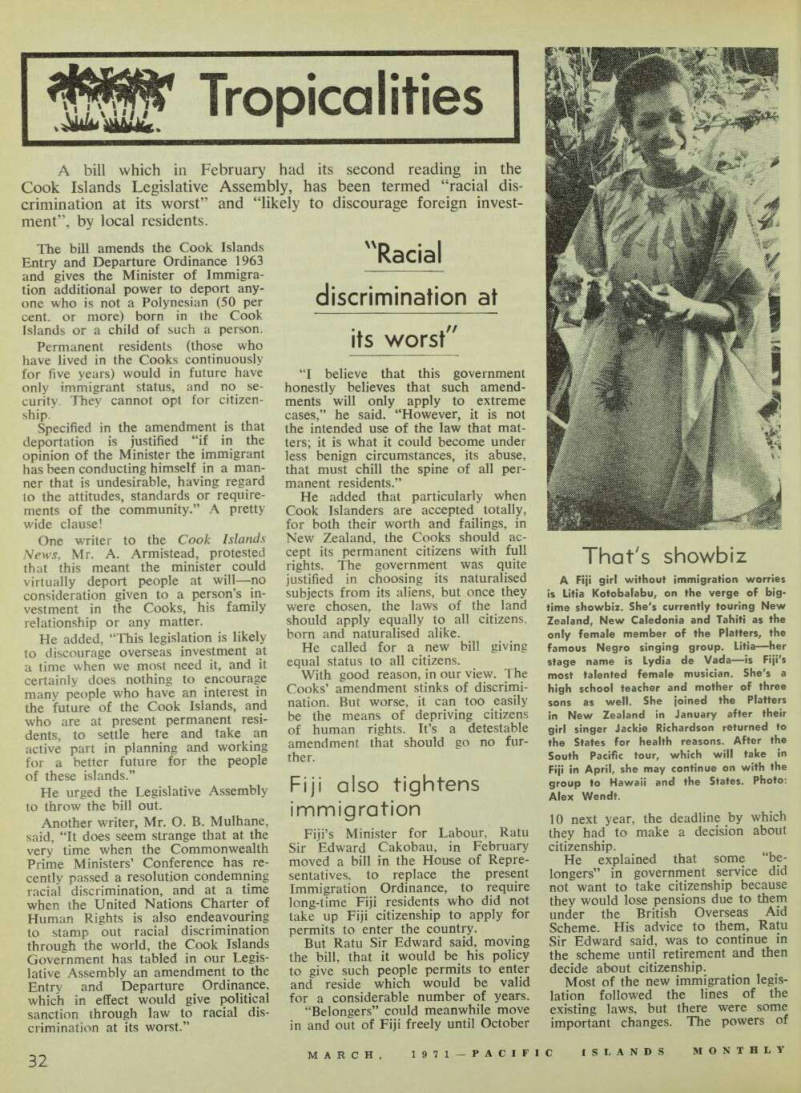
That's showbiz
A Fiji girl without immigration worries is Litia Kotobalabu, on the verge of big time showbiz. She's currently touring New Zealand, New Caledonia and Tahiti as the only female member of the Platters, the famous Negro singing group. Litia—her stage name is Lydia de Vada —is Fiji's most talented female musician. She's a high school teacher and mother of three sons as well. She joined the Platters in New Zealand in January after their girl singer Jackie Richardson returned to the States for health reasons. After the South Pacific tour, which will take in Fiji in April, she may continue on with the group to Hawaii and the States. Photo: Alex Wendt.
Principal Immigration Officer would be transferred from the Commis sioner of Police to the Permanent Secretary in the Ministry of Labour.
The Immigration Appeals Tribunal would be abolished and appeals would be made to the minister, whose decision would be final. The name “visitor’s permit” would be changed to “tourist’s permit”.
Ratu Sir Edward said non-citizens who worked in Fiji in breach of their permits would commit an offence for which they and their employer would be prosecuted.
In February, a House select com mittee was studying the legislation the government proposes to cover the conditions of citizenship, the issue of Fiji passports, the deportation of non-citizens and immigration.
The Attorney-General, Mr. J. N.
Falvey, told the House he hoped the committee would report back before the end of the February session so that the four bills con cerned could be sent to a meeting of the Senate due to open on March 1.
Tahiti's visa
rules eased
Australian, United States and New Zealand tourists may now visit Tahiti and other islands of French Poly nesia for 30 days without a visa, in stead of 15 days as previously.
The extension was recently an nounced in the Journal Officiel de la Polynesie Francaise.
Visitors to French Polynesia are divided into three categories: French citizens, who do not need visas; citi zens of the Common Market coun tries, who may stay for three months without visas; and others, such as Australians and New Zealanders.
The relaxation in favour of visitors in the third category recognises the fact that they make up about 70 per cent of French Polynesia’s tourists.
Figures released recently by Tahiti’s Tourist Office show that in the first nine months of last year 61.9 per cent, of the territory’s tourists came from the United States, 8.42 per cent, from France, 5.95 per cent, from Australia, 5 per cent, from England, and 4 per cent, from Canada.
To the end of September, the terri tory had 37,299 tourists compared with 34,202 for the whole of 1969.
'Be nice to visitors,
they have dough!'
Tourists to Papua-New Guinea are being asked to wear badges in the territory emblazoned with the legend,
“New Guinea visitor.” The idea is that they will then receive better treat ment from people who take the trouble to read the message.
As part of the campaign to have tourists treated in a better manner (we didn’t know they were treated badly), the Papua and New Guinea Tourist Board has also been placing large advertisements in the local Papua-New Guinea Post- Courier, featuring the badge and sug gesting, “When you see this badge . . . it is a sign of progress.”
The message then runs, “The wearer of a Tourist Board Visitor’s Badge has travelled many thousands of miles to spend some time—and monev—in our country. This makes
Them' Very Important
People”.
It goes on to say, “Visitors to the territory may be interested in invest ing thousands of dollars to promote industry in the country . . . some may
simply come here for a holiday—but may spend up to $5OO in a fortnight.
Many visitors spend over $l,OOO dur ing a short stay.
“Tourism is a REAL benefit to any country. It will bring millions of dol lars to Papua and New Guinea and thus help to provide better facilities for us to use. Treat tourists as a vital part of your income. Welcome them —make them feel wanted—make them feel at home.”
Our own view is that the kind of people who will wear these badges are the kind of people who are so obviously visitors that they won’t need to wear them.
Tahiti: "Populoss
country" again
A census held in French Polynesia in mid-February is expected to reveal that the population of Tahiti has now passed the 100,000 mark.
The census was only the second scientifically-conducted count to be held in the territory.
The first, in 1962, showed Tahiti’s population as 84,551, compared with an estimated figure of 24,820 in 1946.
The island’s population has thus approximately quadrupled in the past 25 years, and it is now possibly in the region of what it was when HMS Dolphin discovered it just over two centuries ago.
George Robertson, the Dolphin’s master, described Tahiti as “the most populoss country I ever saw,” and added: “I dare venter to say their is upward of a hundred thousant Men, Women and Children on it.”
However, when Captain Cook was in Tahiti in 1774, he estimated the population at not less than 204,000, while George Forster, one of his scientists, put it at 120,000.
Later visitors were much more con
servative. Maximo Rodriguez, a Spaniard, who lived on the island for 12 months in 1774-5, estimated the population at approximately 15,000; while James Morrison, of the Bounty, who was there for a couple of years in 1788-91. put the figure at “near 30,000.”
These and other widely varying estimates for Tahiti’s population around the time of its discovery have greatly puzzled modern demographers and historians, although most have felt confident that it was very much less than Robertson, Cook and For ster estimated.
Perhaps when the latest census figures are published they will have another think, for there are still parts of Tahiti—Tautira and the Papenoo Valley, for example—which seem to have considerably fewer people than in Captain Cook’s time, although the heavy present-day concentrations in Papeete and environs did not then exist.
Watch where you
walk in Suva
The times they are a-changing in Fiji . . and not always for the better.
The latest imitation of overseas trends seems to be in the manner and attitudes of some of Suva’s young people, who’ve taken to loiter ing in gangs, molesting others and sometimes taking part in unprovoked bashings in dark streets.
According to recent reports in The Fiji Times, violence and robbery has swept an area of about one square mile in central Suva.
The newspaper cited five cases of robbery over a six-week period, all of them taking place in heavily populated areas.
In reply to an article headed “Bashing Gangs Terrorise Central Suva Area”, the Fiji Government is sued a statement declaring that the heading was not justified and may arouse unnecessary alarm.
The statement criticised what it described the “alarmist nature of the heading and report” and said that only in one of the cases report ed was a group (or gang) found to be involved.
The following day The Fiji Times quoted a Fiji Senator, Senator Felix Emberson —a doctor and president of the Part-European Association— as supporting the violence and rob bery report.
He was quoted as saying that he had been concerned for some years about misbehaviour in the streets.
“In countries like Australia where people come out of the bars, they
do not fall all over the place, but here the police seem to accept it as the normal thing,” he said.
Other citizens supported the reports and complained of poor street lighting and thick foliage overhanging footpaths, giving protection to prowlers.
Another unpleasant development has been the attitude to visitors of souvenir-sellers and vendors in the market. Women have complained of being pinched and pulled to various sians. The same kind of behaviour has been reported as having happened in duty-free stores as well, particularly on days when cruise ships are in port.
And WQtch where
you walk in Goroka
The times are changing, too, in the Eastern Highlands of New Guinea.
Similar reports of gangs and bashings are coming from Goroka.
There is one gang there reported to be calling itself The Rascals, and their object seems to be to wage war on coastal natives working in the area. It’s Highlanders against The Rest, and young school dropouts and unemployed are at the root of the
trouble. A number of people are concerned at the trend, when there is need for unity among New Guineans,
Jijcf rnll mq
T-Um U 5
Eu ronpsinn^f
Call us Vasu or even Euronesian— but dont call us part-Europeans.
That’s the call that has gone out from Fi ii’ s newest political party, the Pari- European Association, Senator Felix Emberson, 37, presi dent of the association, which only began last year, said in Suva in Feb ruary that the name part-European was like holding a red flag to a bull.
The searcb f° r a new name would be one of the party’s main tasks for 1971.
“Up to Ratu Sukuna’s time, the part-European was called a half-caste by the British Government,” he added. “I believe Ratu Sukuna ob jected and recommended the term part-European. This was an improve ment, but they still object to it. They think it contains derogatory connota lions.”
When the association finally de cided on a new name, it would ask
the government to make it official.
One name suggested was Vasu, the senator said. This meant you were re lated to a particular community, in Tongan or Fijian. Another suggested name was Euronesian.
Senator Emberson said he did not favour racial organisations in prin cipal. But they were a fact of life, and to protect the interests of part- Europeans this “retrograde” step had to be taken. “It is going backwards, but it is the only way we can cope with the problems of a multi-racial society,” he added.
Home of a sea god
found in Fiji
A mystery cavern with possible archaeological and legendary signifi cance has been uncovered on the island of Beqa, home of Fiji’s famous firewalkers.
The discoverers are the people of Rukua village, who believe that the cavern and its connecting subter ranean tunnel were the home of the powerful Fijian seagod, Dakuwaqa.
The villagers believe this because —although it has never been seen before—the cavern is mentioned in the words of a chant for a meke.
The hole itself is about 9 feet deep and contains fresh, although murky, water. The subterranean tunnel, high in some parts, extends 400 yards from the coast to the cavern.
The discovery was made during excavation work by the Fiji Public Works Department, which is cutting away a headland and using the material to reclaim land in front of the village.
After inspection, the Minister for Communications, Works and Tour ism, Mr. C. A. Stinson, said work would continue. Efforts would be made to avoid damage to the cavern, but if this couldn’t be done, consider ation would be given to either filling it in or leaving it as a small, open lake.
He's in charge of
SRC celebrations
Australian Victor Carell, well known name in the arts, has been appointed executive director of the South Pacific Arts Festival, planned for Fiji next year.
The Fiji Government is giving offi cial support to the festival, which will be held in Suva between May and August, 1972, to mark the 25th anniversary of the South Pacific Com mission.
An organising committee in Fiji was set up last September under the chairmanship of the Minister for Social Services, Mr. Jonate Mavoa.
Planning will include the formation of local committees to organise vari ous aspects of the festival. They have already been set up in the New Hebrides and the Gilbert and Ellice Islands.
Other territorial administrations have been asked by the SPC to form local subcommittees so that they will be in a position to discuss ideas and problems with Mr. Carell.
Mr. Carell and his wife—writer, critic and dance expert, Beth Dean — have studied dance and music culture for many years in the South Pacific.
Mr. Carell has an impressive list of achievements—including that of opera singer, film director and producer, arts tours’ director, pageant director and author.
In 1969, at the invitation of Mr.
Albert Henry, the Premier of the Cook Islands, Mr. and Mrs. Carell helped launch the successful Cook Islands National Arts Theatre. During last year’s bi-centenary of the landing of Captain Cook in Australia, Mr.
Carell produced the Ballet of the South Pacific, which included the Cook Islands National Arts Theatre, and was presented to enthusiastic Australian audiences.
Victor Carell leaves Sydney for Suva to take up his new post on March 6, and his wife will follow a few weeks later. He expects to do a lot of travelling from now on.
A few days before he was due to depart he heard that his latest film, a documentary on New Guinea poli tician Brere Awol, had been accepted by the Australian Broadcasting Com mission for general viewing.
Cooks dance team
a hit in Papeete
Which reminds us, when the 52strong Tereora College Cultural Dance Team from Rarotonga recently spent a few weeks in Tahiti, they were entertained and feasted by Cook Islanders living there.
Delegates from the team visited the Governor of French Oceania and the Mayor of Papeete, and the same day girl members of the team made a TV appearance.
A few days later the dance team gave two shows at the Opel Theatre on successive nights—and were a sell-out on both occasions. Although extra seating had been provided in the hall, hundreds were turned away.
Fascinating
figures
Fiji taxpayers were fascinated to learn that, according to recent figures, nearly one fifth of the $lO million paid in income tax in 1969 came from only 142 people.
These up-status earners, with salaries of more than $lO,OOO per annum, paid almost $2 million into the government’s coffers.
They represented only 0.66 per cent, of all individual taxpayers, but they earned nearly per cent, of the total income and paid more than 17 per cent, of all individual income tax!
The figures are given in the 1969 Inland Revenue Department report.
They show that the income tax
Was it a rhino?
What caused the damage to the fronds of the coconut palms next to the Otintai Hotel, at Bikenabeu, Tarawa (see above). To the un trained eye it appears that the rhinoceros beetle has been at work, but the Agriculture Department in the GEIC prefers to believe some thing else caused the damage. If it was the rhino’ which did the damage, the consequences could be serious.
PIM showed the picture to Mr.
Barney O’Connor, in Sydney. Mr.
O’Connor, who was a senior ento mologist in the Fiji Department of Agriculture, retired in 1965, said he considered the damage was caused by the rhino’. “It certainly looks like it, but you can’t be absolutely cer tain,” he said. The straight cuts across the fronds were similar to fronds attacked by the beetle in Fiji.
Sometimes, however, a close exami nation of the frond revealed frayed edges on the cut, and in that case something else had caused the damage. Mr. O’Connor said a definite sign of the rhino’ was a hole near the base of the frond, often as big as an old type penny, and even bigger. So what about it, GEIC.
Rhino or not? —Photo: A. G. Shearer.
collection of $9,863,904 in 1969 was 16 per cent, higher than in 1968.
Of the total, $4,338,000 was derived from company taxation; $3,046,000 from workers; $2,169,000 from self-employed persons and $310,000 was paid in dividend tax.
The yield would have been even higher if not for the free-of-tax con cessions to some new industries, ac celerated depreciation and the invest ment allowance concessions in respect of building and extending hotels.
New industries received tax relief totalling $42,511; hotel investment allowances totalled $18,752 and cash grants for new hotels or ex tensions to existing ones totalled $17,929.
Canada joins
the NG volunteers
Pierre Trudeau’s Canada has answered a call from the Australian Government for skilled volunteer workers to help out in Papua-New Guinea.
A few years ago, Port Moresby and Canberra “killed” repeated sug gestions for American Peace Corps volunteers in P-NG, apparently because of delicate “international considerations”.
Now, the government-backed Canadian Volunteer Service Overseas organisation has placed nine volunteers in P-NG, all graduates with desperately-needed technical and professional skills ranging up to ac countancy for P-NG’s troubled co operatives movement.
The CVSO Resident Director, Mr.
Fred Harland, hopes to have another 30 or 40 young Canadian volunteer graduates reach P-NG in July-August and, according to his research so far, P-NG badly needs technically qualified middle level people like mechanics, carpenters, plumbers, etc.
Volunteer ages range from 18 to 80, and one already in P-NG is 56.
The Canadian Government finances CVSO 90 per cent., and the rest comes from private subscriptions.
All postings are decided by the
organisation itself, and normal pro cedure is for CVSO to pay fares to and from a host country.
The volunteer spends two years on a posting, is housed by his employer or the employer-organisation—but paid only the native wage for the job. This is why the scheme looks so attractive to P-NG organisations, whose salary overheads for a CVSO volunteer are reduced by up to two thirds of the salary for an Australian doing the same job.
Fiji plays its part
in moon mission
Fiji played an important role in the Apollo 14 splashdown in Feb ruary, after the successful moon mission by American astronauts Alan Shepard, Edgar Mitchell and Stuart Roosa.
Four US Air Force ECl3s’s, crammed with millions of dollars worth of sophisticated electronic equipment, were based at Nadi Air port.
They conducted successful experi ments which improved relay to the Houston Space Centre of telemetry
data from the space capsule, during its re-entry into the earth’s atmos phere.
On previous missions such data reached Houston after a consider able time lag, the information being picked up by EC 135 aircraft which in turn relayed it to a Cl4l Star lifter.
After recording the data, the Star lifter would then fly to the space centre, where the data was processed and analysed by mission control.
In the Apollo 14 experiment, in formation was fed direct to space control via a communications satel lite station over the Pacific.
A senior officer with the task force. Colonel Richard Smith, said the task force had been praised for its direct voice relays of the astro nauts’ conversations during the re entry and recovery phases of the mission.
“The astronauts and NASA offi cials have reported that the quality of voice relays was the best ever ex perienced on an Apollo mission,”
Colonel Smith said. He added that he expected the task force to return to Fiji to take part in the Apollo 15 programme, scheduled for late July.
They have tree-climbing kan garoos in Papua-New Guinea, but not fellows like this kangaroo, who is pure Austra lian. Admiring him are three New Guinean members of a party of 20 young New Guineans who recently spent five weeks in Australia on a visit sponsored by the Madang Youth Travel Association.