Diary
pp. 32-33 · Read in the full issue
New Guinea
With John Ryan
Are There Missiles In Irian?
If 11 necessarily nameless people have been speaking the truth, then Australia, New Zealand and the United States have been collaborating to build an anti-missile pad in Indonesian West Irian. , I agree . . . it’s a fantastic proposition!
The complicating factor in trying to sift fact from fiction is the willingness of eight of the 11 to talk about the project, and their demonstrable belief in what they’ve said. . . .
To name any of the 11 would cause them to lose their jobs. I spent 15 days talking to a lot of people and travelling 1,000 miles to try to find out if their jobs are worth saving . . . and I’ve come to the conclusion (based on what they have said about the ANZUS Pact project in West Irian) that there could be enough truth in the report for the three govern ments to make firm statements on the claim.
That experienced old South-East Asia traveller, journalist Peter Hastings (Sydney Morning Herald) describes to me as “emphatically wrong” the claims that an anti-missile pad is underway in West Irian.
Hastings knows Indonesia pretty well, and he may know exactly what the Indonesians are or are not doing in West Irian. . .
First report of the rumoured electronic gimmick m West Irian came to me from an American in an unsolicited telephone call from overseas, and I began back-checking in Australia. Two Australians in work allied to aero-space engineering were quick to confirm that they “knew what was happening in West Irian and that my primary source was “one of the top men in his field”.
To make sure that nobody was misquoted or mis interpreted during the back-checking of this difficult piece of primary information, all conversations were tape-recorded and hidden away on a master tape.
First publication of the claim (in the newsletter Inside New Guinea) about the work in West Irian brought a reaction from Djakarta that the US, in feet, was building a missile pad in East New Guinea the Australian-administered territories of Papua and New Guinea. To this, one Washington Government man snorted a denial. Another American spokesman denied that the Americans were building anything electronic “anywhere near New Guinea”.
In the middle of the furore, newspapers carried the story that Britain had just given the US permission to build a missiles communications centre on Canton Island, north-east of New Guinea. Nobody is suggesting there’s any connection between Canton and the claims about West Irian, but the timing of the news release was interesting to say the least. . .
In Port Moresby, other people were beginning to talk about what was rumoured happening in West Irian.
Speaker of Parliament, Mr. John Guise, was “briefed” by one source of information. Later, an Australian political adviser to Minister for External Territories,
Mr. Barnes, received a Port Moresby letter saying that the “missiles cat is out of the bag”.
In view of the fantastic claim about the missiles pad, there was surprisingly little reaction from Canberra . . . and even the Labor Opposition Party appeared unwilling to press the government for a statement.
The claim either was being ignored as a crazy rumour, or was being carefully sidestepped.
The primary source for the information had said (on tape) that “a bogus airline” was being used to help supply the men working on the missile pad buildup, and that “one of the oil exploration firms in West Irian is a ‘front’ for the work” on the pad. There are many firms at present exploring West Irian, including the highly respected American Kennecott and Freeport Sulphur companies.
It didn’t take long to discover that two Ansett DC3s each with top-level Australian crews were doing some unusual work in West Irian, along with an Indonesian Air Force DC3, and later a Bali-based DC3 with an American captain and an Indonesian crew.
Kennecott Copper Corporation began working a couple of years ago in the very expensive search for copper in north-western Papua, and Kennecott and its geologists and core-test drillers are now well across the un-marked border into West Irian. Kennecott needs a lot of Avtur fuel for its small fleet of Alouette turbo-helicopters originally based at Oksibil airstrip, 40 miles on the Indonesian side of the border. . .
Freeport Sulphur is in the final stages of pre-mining 11,000 feet above sea level in the range originally known as Carstensz Toppen north of Kokonao, a long way further west of Oksibil.
The two Ansett DC3s (now increased to four) began working flat-out in January from Vanimo, 20 miles from the West Irian border in the West Sepik of P-NG.
Daily, they flew across the border to West Irian’s capital Djajapura (40 miles from Vanimo) to load up to 15 drums (each of 44 gallons) of Avtur to be flown 200 miles south-west to Wamena, in West Irian’s so far undeveloped central highlands. The Indonesian DC3s were taking five drums to another airstrip in the foothills.
The Ansett pilots were not sure what it was all about, and in February when one of them asked, he received a very curt “mind your own business it’s only distillate” from an Indonesian Army officer.
At Wamena, the Indonesians using village “volunteers” had dramatically upgraded the short airstrip to Indonesian Air Force Hercules standards, and 15 Hercules landings were made from August, 1970, to February this year.
Another 87 tons of equipment, reportedly including tarseal, was being flown by Ansett DC3s from Biak Island to Wamena, and missionary and Ansett pilots reported that Wamena runway was being sealed.
Kennecott is a big company and Wamena could become a strategic airstrip for Indonesian civilian development work among the tribes . . . but the activity
was highly unusual. There was no apparent connection between the Wamena project and the fantastic claim about an anti-missiles pad. However, there were far too many unanswered questions.
Until the Wamena project began, the Indonesians had only once ventured in strength into the un-mapped, mountainous 50,000 square miles of country between Wamena and the border with P-NG. That was at the end of 1968 to shoot (by their own public admission) dozens of Jele tribesmen who’d killed and ceremonially eaten missionaries Stanley Dale (from Smithton, Tas mania) and P. C. Masters, from lowa.
Sentani airstrip outside Djajapura was breaking up through sheer lack of maintenance, yet nearly $1 million was being spent in fuel, charter costs, earthworks and sealing in the huge and (in the face of any official statements to the contrary) somewhat mysterious business at Wamena, From Canberra, the Indonesian Embassy’s weekly newsletter reported that Djakarta was about to spend huge amounts to upgrade major airstrips throughout the republic. A list followed ... but it did not include Wamena.
Action On Papua?
New Zealand-born British Peer Sir Denis Allen had done his homework on P-NG much too well to make a careless mistake.
It was Australia Day (February 1) and everybody in P-NG, including the village crowd at Kabwum Patrol Post in the Morobe District, was on holiday.
It was no mistake then that Sir Denis chose, at Kabwum on Australia Day, to say publicly that there’ll be quite a few words about Papua in his United Nations Visiting Mission’s report back home in New York.
Throughout the mission’s tour of the New Guinea Trust Territory to check on Australia’s performance there since 1968, the four-nation team (Britain, Sierra Leone, Iraq, France) had been questioned about Papua’s relationship to New Guinea, and had heard suggestions on what should be done with Papua.
Way back in 1883 the British colonists in a convention at Sydney had virtually blackmailed Britain into declaring (effective 1884) a colonial interest in the south-eastern portion of the New Guinea Island . . . because Holland
had the western half, and Germany was grabbing the north-eastern slab of the main island, plus the outlying islands groups.
In 1906 Britain gave its slice British New Guinea back to the newly-Federated Australians. They called it Papua, and it became Australian soil and its villagers Australian citizens and British subjects. By 1949, Papua remained unchanged except for Canberra’s decision to administer Papua and the New Guinea Trust Territory as a single administration unit . . . from the “capital”
Port Moresby in Papua.
Not until now has the United Nations Visiting Mission been asked to show any official interest in Australian owned Papua, and the mission is looking now only because New Guinea and Papua village people have been demanding that something be done about the separate statuses of the two territories.
Some Papuans want to sheer off from the New Guinea and take up their very dubious “Australian citizenship”.
Uther Papuans, including a good many working in New Guinea, have told the UN that Papua should become a Trust Territory like New Guinea so that both territories approach a common future with a common, if very basic, constitutional foundation.
In the West Sepik section of the UN tour, Sir Denis decided that he’d better explain the UN standpoint a little further, on the question of Papua.
The decision, he said, would have to be made by the village people themselves. Having fobbed the thorny problem of Papua back to the tribes, Sir Denis doubtless began thinking of the diplomatic way in which (in his report to the Trusteeship Council) he would urge for quick action on Papua.
Secret Service Changes
Papua-New Guinea’s “secret service” is being re vamped and transferred from police to civil control.
The Police Special Branch was formed in 1965 by Dr. John Gunther when he was still Assistant Adminis trator for Services ... and the branch got off to a bad start! Its security took a tumble when, somehow, the first new positions in the branch were advertised openly in the Government Gazette.
Now, after five years of operations as the early warning system enabling central government at Kone dobu to anticipate and to try to head off trouble (disaffection in the Public Service, questionable political activities, etc.), Canberra and Konedobu are taking the Police Special Branch out of the Police Department and giving it to the Administrator’s Department.
This means that former Director of District Adminis tration (the boss of all patrol officers), T. W. Ellis, will strengthen his paper-work control over the “secret service.”
With P-NG becoming more sophisticated, there’s another strong factor in the change: almost all of the existing Special Branch officers are policemen . . , and they’re known far and wide by appearance and reputa tion.
Minimum entry standards to the new force are going to be increased, and existing police officers will be given the chance to re-enlist if they choose. The long-term effect of the transfer of secret service control will be that there’ll be a lot of unknown faces wandering around the country on secret service work—an eminently reasonable situation if they want to maintain their own personal “security” while working.
Some native leaders are worried about the service being transferred from police to civil control, and warn darkly that it will make it just so much easier for un scrupulous leaders of the future to get their political administrative hands on the service for their own purposes.
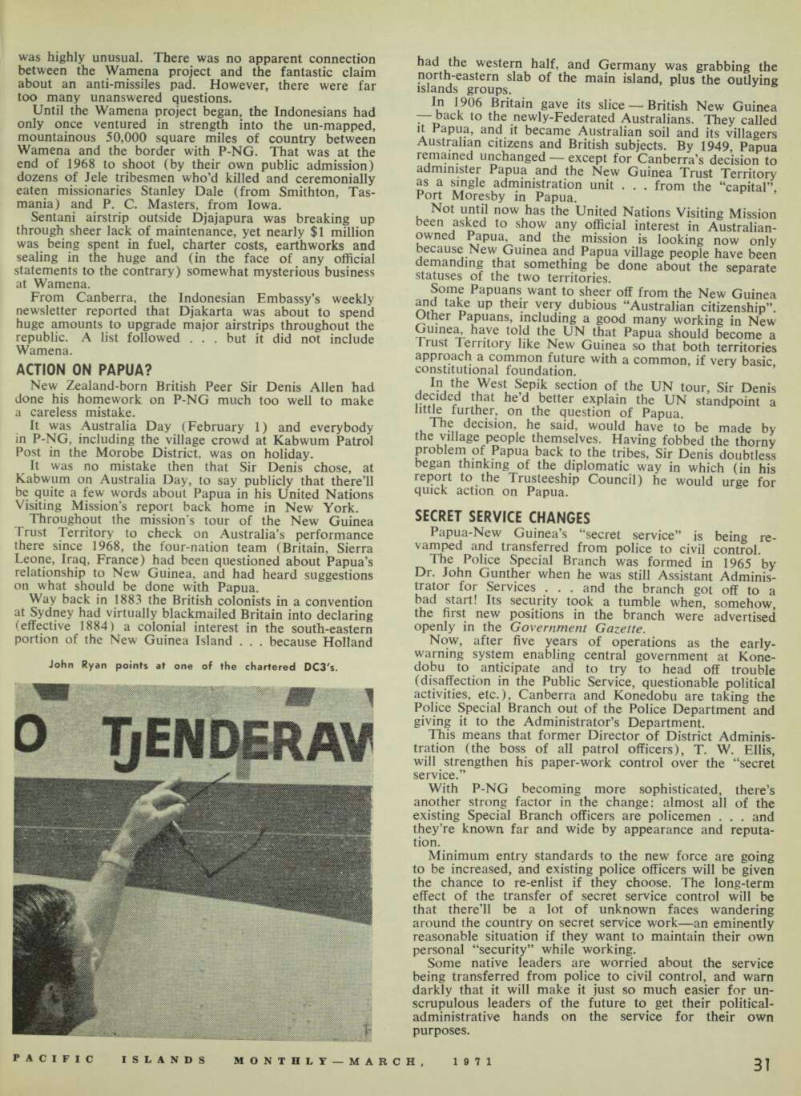
John Ryan points at one of the chartered DC3's.