It's tough finding a place
p. 30 · Read in the full issue
to sleep in Honiara
Prom a Honiara correspondent An acute housing shortage for government officers is bringing a booming trade to Honiara’s hotels, which are already well booked with tourists. Vacan cies are scarce and available for only a few days at a time.
The Hotel Mendana is going ahead with plans to double its ac commodation, but all the hotel own ers regret that they did not expand sooner. A few expatriate officers have built their own homes, and, if they were wise enough to build in the wife’s name, are now doing very nicely thank you. They can live in their government quarters, for which they pay only a nominal rent, and lease out their own house at an open market rental.
The accommodation pinch began to be felt soon after Christmas, when officers returning from leave found that they were allocated to one or another of the three hotels for some weeks until a government house was vacated. The Government picked up the bill for accommoda tion and three meals a day, but life was a bit dreary and circumscribed.
Later arrivals fared still worse, as no promise of a house within the foreseeable future could be given to them. Then came the hardest part when an influx of tourists who had been booked into the hotels months before, drove officers out to find temporary refuge with friends.
In the BSIP Civil Service, only a few senior officers enjoy the privi lege of ‘tied’ houses, the remainder having to relinquish their quarters when they go on leave every two years and take whatever is offering when they return.
The crisis is yet to come, accord ing to reports from the Establish ment Branch of the government. The graph of un-housed officers is said to reach a peak in April and then fall away gently for the rest of the year; by September it is hoped that the worst of the emergency will be over.
How the housing shortage was ever allowed to develop is beyond everyone’s comprehension, but it was bound to come when the building programme for higher grade houses was halted and expatriate officers were still recruited in increasing numbers.
No recriminations have been made publicly, but Messrs Martin and Hall of the British Overseas Development Administration, who are currently in Honiara investigating the problem
of the supply of specialist manpower, are sure to get an earful.
Perhaps it’s all a ploy (but an ex pensive one) to gain acceptance of the dreaded new type of economy house—the P.l—for which permis sion to build is at present awaited from London.
“Better a Pell house than nothing at all,” may be the expected reac tion. For the Pell house, named after the not-really-popular economist who has been doing the axeman’s job in formulating the protectorate’s sixth development plan, has no veranda and has all its rooms in one straight line.
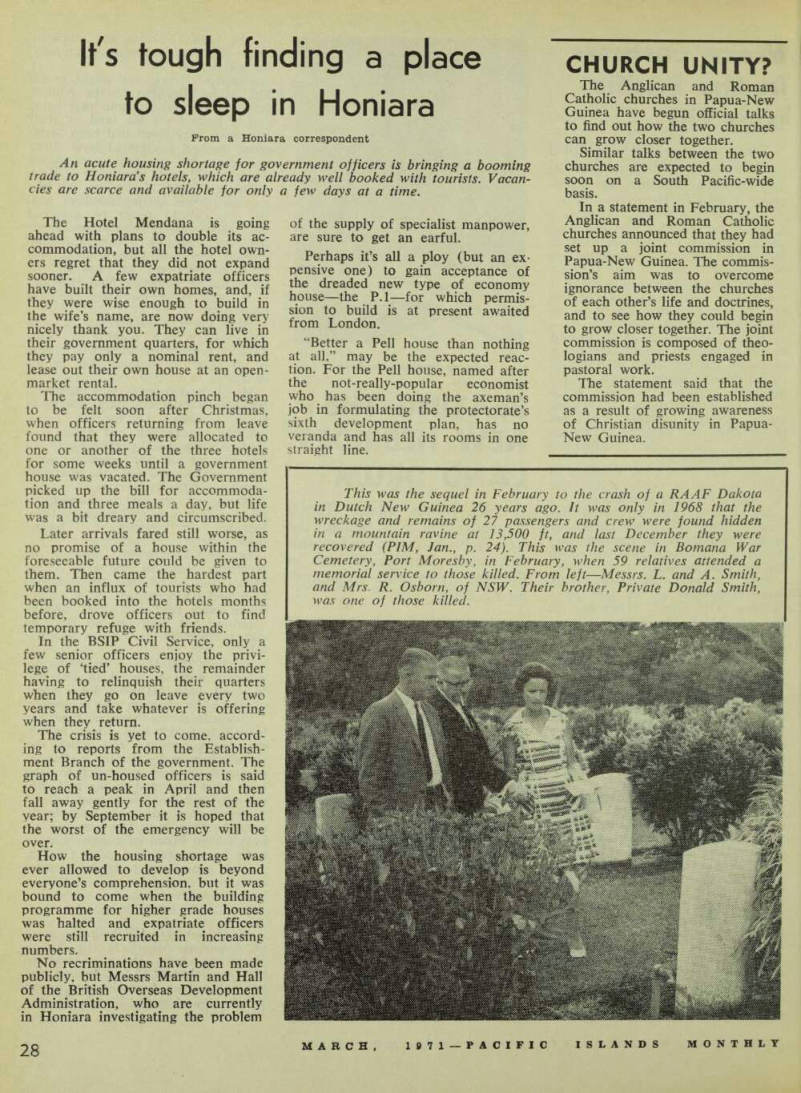
This was the sequel in February to the crash of a RAAF Dakota in Dutch New Guinea 26 years ago. It was only in 1968 that the wreckage and remains of 27 passengers and crew were found hidden in a mountain ravine at 13,500 ft, and last December they were recovered (PIM, Jan., p. 24). This was the scene in Bomana War Cemetery, Port Moresby, in February, when 59 relatives attended a memorial service to those killed. From left — Messrs. L. and A. Smith, and Mrs. R. Osborn, of NSW. Their brother, Private Donald Smith, was one of those killed.