Beating The
p. 29 · Read in the full issue
New Hebrides
Land Drum
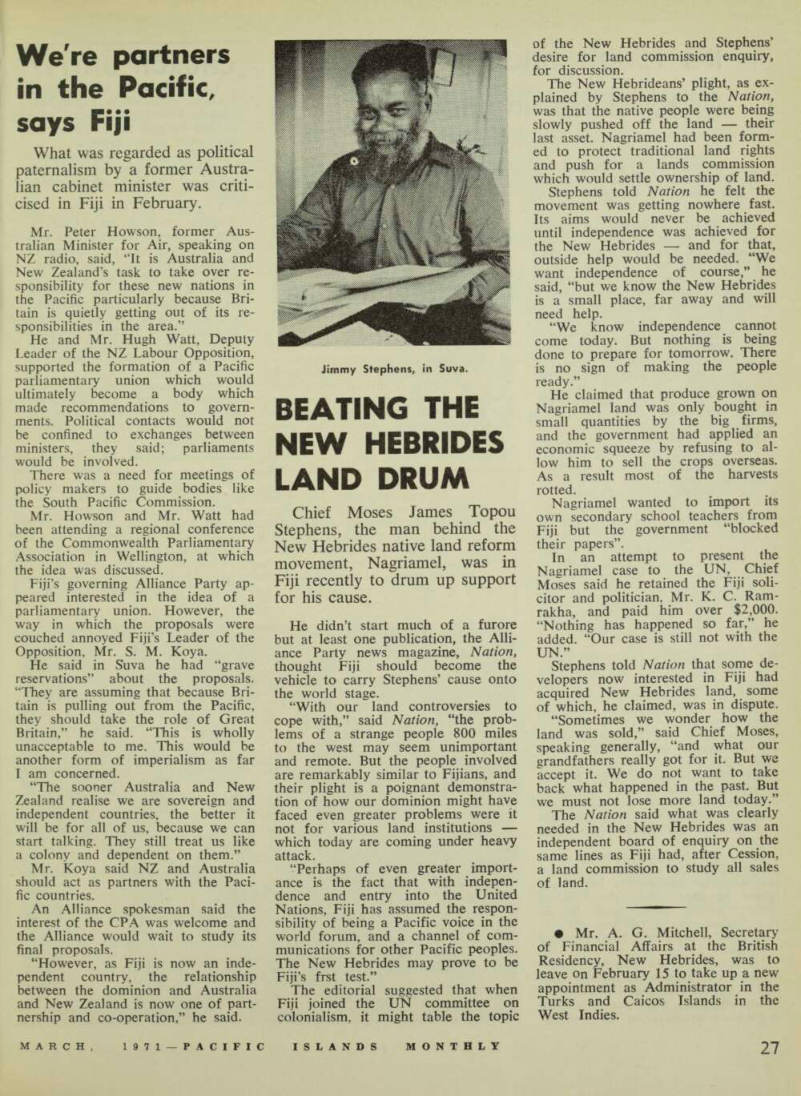
Chief Moses James Topou Stephens, the man behind the New Hebrides native land reform movement, Nagriamel, was in
Fiji recently to drum up support
for his cause.
He didn’t start much of a furore but at least one publication, the Alli ance Party news magazine, Nation, thought Fiji should become the vehicle to carry Stephens’ cause onto the world stage.
“With our land controversies to cope with,” said Nation, “the prob lems of a strange people 800 miles to the west may seem unimportant and remote. But the people involved are remarkably similar to Fijians, and their plight is a poignant demonstra tion of how our dominion might have faced even greater problems were it not for various land institutions which today are coming under heavy attack.
“Perhaps of even greater import ance is the fact that with indepen dence and entry into the United Nations, Fiji has assumed the respon sibility of being a Pacific voice in the world forum, and a channel of com munications for other Pacific peoples.
The New Hebrides may prove to be Fiji’s frst test.”
The editorial suggested that when Fiji joined the UN committee on colonialism, it might table the topic
of the New Hebrides and Stephens’ desire for land commission enquiry, for discussion.
The New Hebrideans’ plight, as ex plained by Stephens to the Nation, was that the native people were being slowly pushed off the land — their last asset. Nagriamel had been form ed to protect traditional land rights and push for a lands commission which would settle ownership of land.
Stephens told Nation he felt the movement was getting nowhere fast.
Its aims would never be achieved until independence was achieved for the New Hebrides — and for that, outside help would be needed. “We want independence of course,” he said, “but we know the New Hebrides is a small place, far away and will need help.
“We know independence cannot come today. But nothing is being done to prepare for tomorrow. There is no sign of making the people ready.”
He claimed that produce grown on Nagriamel land was only bought in small quantities by the big firms, and the government had applied an economic squeeze by refusing to al low him to sell the crops overseas.
As a result most of the harvests rotted.
Nagriamel wanted to import its own secondary school teachers from Fiji but the government “blocked their papers”.
In an attempt to present the Nagriamel case to the UN, Chief Moses said he retained the Fiji soli citor and politician, Mr. K. C. Ram rakha, and paid him over $2,000.
“Nothing has happened so far,” he added. “Our case is still not with the UN.”
Stephens told Nation that some de velopers now interested in Fiji had acquired New Hebrides land, some of which, he claimed, was in dispute.
“Sometimes we wonder how the land was sold,” said Chief Moses, speaking generally, “and what our grandfathers really got for it. But we accept it. We do not want to take back what happened in the past. But we must not lose more land today.”
The Nation said what was clearly needed in the New Hebrides was an independent board of enquiry on the same lines as Fiji had, after Cession, a land commission to study all sales of land. • Mr. A. G. Mitchell, Secretary of Financial Affairs at the British Residency, New Hebrides, was to leave on February 15 to take up a new appointment as Administrator in the Turks and Caicos Islands in the West Indies.
Jimmy Stephens, in Suva.