Business and Development
pp. 103-107 · Read in the full issue
A Temporary Reprieve For The
Gilbert And Ellice Islands
When Ocean Island phosphate deposits are exhausted, the GEIC will lose about $2,500,000 a year—about 54 per cent, of recurrent revenue—not to mention the wages earned by several hundred of the colony’s people employed in the industry. But recent revised estimates of the island’s phosphate reserves suggest that mining could continue for eight or nine years; or two years longer than had been expected.
To maintain the present extraction rate of 550,000 to 600,000 tons a year for the full eight years, the British Phosphate Commissioners will need to procure mining leases over all remaining phosphate land at Ocean Island.
Negotiations have been in progress for some time now between the BPC and Banaban landowners over the conversion of building leases to mining leases, and over a small area which was missed in early surveys and must, therefore, be the subject of a separate leasing agreement.
The price paid for Ocean Island phosphate is still tied to the price paid by the BPC at Nauru. The Nauruans have sold phosphate to Japan at $l4 and $l5 a ton but the BPC price for Nauruan phosphate remains at $12.30, suggesting that the “world price” for phosphate is rather higher than that which the partner governments, with their ef fective monopoly of the markets in Australia and New Zealand, are pre pared to pay.
As a result of discussions held between the three partner govern ments—UK, Australia and NZ—at Suva in March, last year, the Ocean Island price has now been raised to $12.30 a ton as from July 1 last.
Whether the phosphate deposits last until 1976 or 1979, the domin ant fact of the GEIC’s economic life remains: When the phosphate is fin ished, so is the major source of gov ernment revenue.
And, as Reuben Uatioa, the col ony’s Chief Elected Member, pointed out at the September South Pacific Conference in Suva, the average per capita income in the colony could by 1978 be down to half what it was in 1968, unless new sources of revenue are discovered.
The colony, with the assistance of aid funds, is now making every ef fort to develop and diversify its economy. At last, a Fisheries De partment has been established and 1971 will be a year of intensive re search to see if a large scale fishing industry can be established.
Coconut improvement and re planting schemes, and crop diversifi cation are receiving close attention from the Agriculture Department.
Attempts are being made to estab lish such import-replacement indus tries as the production of timber for local use.
If the targets in the colony’s de velopment plan can be achieved, and a large scale fishing industry can be
established, then the economic future of the GEIC might not be as dark as it has been pictured in the past.
But there will be problems to overcome because the plan does not take full account of the human factor and the difficulties that will be in volved in persuading the people who live on the outer islands to change, not simply their methods of coco nut cultivation, but their whole way of life.
As the colony has found to its cost in the past, it is not easy to translate ideas into action. All the people will need to become vitally concerned and involved in the vari ous projects.
But it is not reasonable to expect the people of the outer islands to be so involved when they have little real understanding of the problems that must be faced. Perhaps a partial solution could be found in a greater degree of decentralisation of gov ernment and services and more tour ing by senior officers from all gov ernment departments!
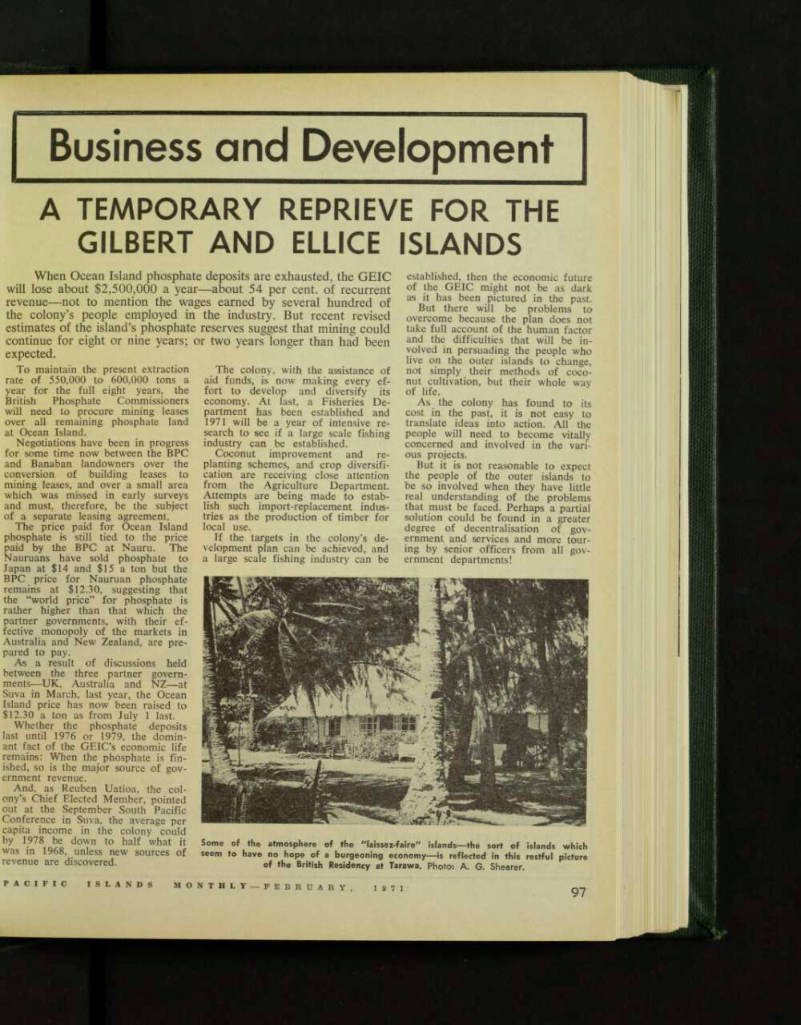
Some of the atmosphere of the "laissez-faire" islands—the sort of islands which seem to have no hope of a burgeoning economy—is reflected in this restful picture of the British Residency at Tarawa. Photo: A. G. Shearer.
Jap cars press
ahead in P-NG
PNG Motors, the public motor vehicle franchising company cover ing most major centres in Papua-New Guinea, is converting its sales drive to Japanese makes—and successfully.
In 1970 PNG took on the Subaru, made by Fuji Heavy Industries, with spectacular success, pushing the make into third best seller, and all done with one engine size in one basic body, with 2-door, 4-door, station wagon and sports sedan versions.
As well, PNG has taken over the Mazda distributorship from Rabaul based John Dowling, dropped prices around $2OO a car to meet Toyo Kogyo’s demands for volume sales, and virtually doubled sales in the first month.
The victim of all this Japanese business has been the Austin/Morris line of cars which have disappeared at least temporarily from PNG showrooms. The British/Australian makes have become uncompetitive in price and goodies to attract the buyers, and the situation is getting tougher all the time.
At the end of 1969, Austin/Morris between them were the second-most populous cars on territory roads.
Holden had the most.
The situation for “Australia’s own” car and the British makes, as well
as European makes such as Peugeot, has changed dramatically in the last few years. Holden still clings to a substantial share of the market, but the trend is apparently irretrievably to the Japanese.
In 1967, Japanese makes held 39 per cent, of the car and station wagon market; in 1968, 46 per cent.; in 1969, 53 per cent.; and in June- July-August, 1970, were comfortably holding 65 per cent. Now, that's progress.
Toyota and Nissan/Datsun are still top of the heap, but Subaru, Mitsubishi (Colt), and Mazda are baying ever louder and either of the last two could unseat one.
The Subaru campaign is now enter ing its second phase, with an alter native 1,300 cc engine available throughout the range, new colours, stereo tape players to complement the standard radio fitting, and AIR CONDITIONING. This is likely to bring on a bun-rush of optional air conditioning where it is a real boon on hot and dusty roads.
Aust. exporters
under fire
An Australian trade survey mission to Papua - New Guinea, concerned about Australia’s lessening share of the territory’s imports, has criticised the lack of “export consciousness”
among Australian exporters who send insufficient or delayed documents to their clients in New Guinea.
The mission Messrs. F. R. G.
Strickland, managing director, H.
Halford Pty. Ltd.; F. J. Watt, mana ging director, Tozer Kemsley and Milbourn (A’asia) Pty. Ltd.; R. R.
Clark, director, McPherson’s Ltd,; K. W. Wilkinson, assistant director, International Trade Relations Division, Department of Trade and Industry, Canberra, and R. D. Wright, assistant trade commissioner, Pacific Islands visited Lae and Port Moresby last August. The mission was part of a project initiated by the Export Development Council to study all aspects of Australia’s exports to the territory.
In its just-published report, the mission declares that Australia has great competitive strength in New Guinea, but is not fully exploiting it. because: ® Ships almost invariably arrive in Port Moresby or Lae ahead of docu ments and manifests, which means cargoes cannot be cleared. If cargoes are not cleared within four days of a vessel’s departure, storage and bond charges equivalent to those in Sydney are levied.
This factor, together with break ages and losses, inflates the price of Australian products in New Guinea, while eliminating the benefits of speed
and service from Australia. The mission blames the documentation delays on a “lack of export con sciousness” causing inadequate docu ments to be sent to the importer, and slowness of mail and clerical procedures.
The documentation problem could be very much eased if territory Customs introduced a single column invoice with value-for-duty based on f.0.b., and an effective “check-to arrive” system.
The present two column invoice requirement stems from a general adoption of Australian Customs pro cedures and systems, the mission said.
Although existing legislation allows import entries to be made before the arrival of a vessel, the system’s ad vantages are largely negated by the late arrival of shipping manifests. • There are serious problems in the loading and unloading of cargoes.
As no wharf reservations apply in the port of Sydney, shippers do not know until the last minute where the ship is to load. This results in congestion at the wharves and delays in the pre paration of manifests. In territory ports the absence of manifests rules out planned stacking or unloading.
This, combined with poor stevedoring and packaging, brought about dam age. • Many territory firms buy on a hand-to-mouth basis, using the faster shipping services. Consignments are consequently often spall, resulting in non-standard packaging being used to fill the odd orders.
Although the mission makes no formal recommendations, it suggests that Australian exporters should check with importers on the type of packing necessary. Some importers had told the mission they were even willing to pay a premium on pack aging if this could guarantee their cargoes arriving on time in good condition. Established firms should also keep their agency arrangements under review to ensure that all outlets are effectively covered.
"Encouraging"
manganese finds
Following encouraging manganese finds in north-east Viti Levu, the Australian-backed United Mining and Exploration company has plans for stepping up its prospecting operations in Fiji, In lanuary an Indian geologist was due to arrive in Fiji to take over as exploration manager of the company.
He is Mr. C. Agrawal, who will first turn his attention to Wainibuka in eastern Viti Levu.
The Fiji-registered company, which is associated with Mt. Coora Mining,
has licence to prospect 118,000 acres at Wainibuka, 6,100 acres in the Sivia area near Nadi, another 12,400 acres at Tubutau, and 35,000 acres at Mangondro.
According to one of its directors, Mr. Vishnu Deo, a Fiji-born accoun tant now living in Sydney, the out look is “very encouraging”.
“At Wainibuka, we have found six different spots where mineral outcrops exist,” he said in Suva recently.
“Further studies will have to be carried out to see whether heavy ex penditure on mining is warranted.
But I’m very encouraged by the pro gress so far.”
The associated company, Mt. Coora
Mining, has prospecting rights at Kilkivan, Marlborough and Charters Towers in Queensland.
MOP being worked
in BSIP
After a period of 40 years, BSIP’s rich Manning Strait pearling beds are being worked again. In the days when natural pearls and mother-of pearl shell were worth something, Captain Hamilton and his team of Tahitian divers, using “hard hat” equipment made a good living there.
Now a new company, the Solomon
Islands Mother of Pearl Company, has been formed.
It uses modern equipment and scientific farming techniques and has financial backing from a Thursday Island Group, represented in the Solomons solely by members of the Palmer family. Mr. Ernie Palmer, one-time recruiter for Lever Bros., is on the board of directors and handles the paperwork in Gizo. Two of his sons, Phil and Len, live on Aratoba Atoll between Wagina and Rob Roy Islands in the Strait.
From these headquarters the company’s two vessels, the T.I.
lugger Chiomi and the converted Moreton Bay prawn trawler Tafura, range over the Strait. Main harvest is still gold lip MOP shell which yields the occasional pearl but in these days of artificial pearl culture, they have to be really exceptional to be worth anything, The company is also perfecting a new technique for the formation of large artificial blister pearls by gluing plastic hemispheres onto the inside surface of young shell. It i s also experimenting with various kinds of spat collectors to collect pearl shell larvae during the breed
ing season and grow them to market able size.
Like Captain Hamilton, the Palmers find Polynesians make the best divers and most of theirs come from Ontong Java, in the Northern Solomons. They use Gilbertese boat crews from the nearby resettlement on Wagina. The divers do not use scuba equipment but “hookah” gear and an on-board compressor pumps air, via a rubber hose, to a regulator held directly in the mouth.
Despite all their modern equip ment, one of Phil Palmer’s treasured possessions is one of Captain Hamil ton’s old brass diving helmets he found abandoned on a nearby island.
It hangs in the Palmer’s living room, a reminder of days long past.
The Palmers may soon have neigh bours in Manning Strait. CRA Exploration Ltd. has just completed a survey for bauxite on Wagina and if the deposits prove as extensive as hoped, the island will have an air strip, port, and small European township. Employment would then be provided for the island’s resettled Gilbertese—over 2,000 of them, who form the largest colony of Gilbertese so far in the Solomons.
P-NG oil search
"precautions"
Announcing that 28 applications had been received for petroleum ex ploration permits in five offshore areas of Papua-New Guinea, Australian Minister for External Territories, Mr.
C. E. Barnes, said in January “every precaution” would be taken against harmful effects from oil exploration when exploration started.
The Petroleum (Submerged Lands) Act, under which the permits would be issued, made adequate pro vision for the application of any safeguards considered necessary, he said. The act enabled directions to be issued to ensure strict control over drilling operations and to prevent drilling in any particular area.
Any recommendations put forward by the current Great Barrier Reef Royal Commission, which had appli cation beyond the area of the reef, would be examined, and action would be taken where appropriate, to pro tect the interests of the people of
P-Ng.
Mr. Barnes said that interest in petroleum exploration in the terri tory was encouraging. In 1969, $10.7 million was spent on oil prospecting there and a similar amount was spent in 1970. Several wells were expected to be drilled in 1971.
He added the most sought after area for oil exploration when appli
cations were invited recently was near the Trobriand Islands, for which 17 applications had been made. Names of the successful applicants would be announced by the end of March.
Meanwhile in January, Oil Search Ltd. announced that Texaco Overseas Petroleum Co. and California Asiatic Oil had exercised their option with Australasian Petroleum Co. Ptv.
Ltd., for the drilling of an interestearning well on a structure in the western portion of APC’s Permit No. 27 in Papua. Preparations are already in progress and it’s anticipated that drilling will commence towards June.
Partners in APC are Oil Search Ltd., BP and Mobil.
D kir" 1 *1
P-Ng S Oil
i
war hots up
i . , The oil-fuel supply situation in Papua-New Guinea has suddenly come of age—all because of the old stimulus, competition.
The giant British Petroleum organisation is now selling well in P-NG, and Caltex has just announced plans for a further $2 million expansion—service stations and bulk fuel depots. Caltex has the tender for fuel supplies for the P-NG Electricity Commission throughout the territory and the coastal tanker, Pacific Voyager, carries Caltex to outer islands.
For years, Shell and Mobil had P-NG on their own, but late starters Caltex and BP are now really on the move ( PIM , Dec., p. 105). r\ • f* ■ .
repsi-Cola arrives
™ w , .
The Pert Moresby Freezing C°., n a fure and riistrihm. h pf *? mitmifacducts In PNr b Pepsi-Cola pro- Pens?ro^ G which -c repsi-cola, which is now repreemrV 6 into U p r Nr h a 3 f S direct entry into P-NG at a period when consiimption rs rising rapidly. in ivoz-bs son drink sales there il ei i e QM S 7fi a e 1 a f l sl ‘ B mi ) lion ’ and tW ° years later ’ they reached $3
siVeSp livL. i fn e ed
* ld .? al u OZ * b o°n tt ea i lOC a 27 oz family bottle at 20c and lit i\ nng ' P u i, ca “ a V 6c 7 „ HrinV pnLin bott 5 - s " St A 0? annK container sold m P-NG which na ?, a i?' S r\ al r!i! e fP rcw cap d u manager of the ot°Vi, M ? reSby f feezing C P’’ speakin g t me time of the launch, said that ont i n p 2 lltlcal and economic frJ 31 e d a y as t, poten ti a l ro«oI nCr aS Iu 8 ** pr . oduc tivity anc j ge ot the soft dnnk industry.