For British
p. 38 · Read in the full issue
New Aid Plan
Dependencies
From KEN McGREGOR, in London Britain is setting up a trouble shooting department in its For eign and Commonwealth Office to tackle common problems
affecting remaining British de
pendencies.
As yet unnamed, the department is a result, partly, of a recommendation of the fledgling Dependent Territories Administrative Staffing Unit of the FO. The DTAFU was itself only born last year, to recruit administra tive officers for territories.
An FO spokesman told PIM the new troubleshooting department would “strengthen the arm of depend ent territories and try to consolidate expertise in these matters”.
It would cover the three areas of dependencies: Gibraltar, St. Helena and the Falklands; the West Indies; and the Pacific and Indian Ocean Department (including the Gilbert and Ellice Islands, the New Hebrides and the Solomons).
Miss Eleanor Emery currently heads the third group, and will remain in this capacity.
I understand the new department will specialise in aid, finance, grant in-aid and personnel bugbears com mon to all dependencies. Its budget and administrator have not yet been determined.
The Marquis of Lothian, Under secretary, FO, told the House of Lords in January that the depart ment would “preserve the expertise
inherited from the old Colonial Office, which would otherwise disappear as a result of natural wastage”.
He said that in addition to develop ment aid and technical assistance Britain would continue to provide budgetary aid to dependent territories whose own revenues were insufficient to cover the day-to-day running costs of their administration, and economic and social services.
Neither Britain nor most of the territories concerned liked this form of aid which from Britain’s point of view represented an open-minded commitment. Britain intended to bring budgetary aid to an end wherever possible. This did not mean that Britain proposed to limit depen
dencies’ expenditure more rigorously.
On the contrary, the emphasis was on increasing their revenues and Britain would assist them to exploit their natural resources to that end.
Lord Shepherd (Labour) said the economic problem of the Solomon Islands was just as important to Britain as the problems of the English Highlands and Islands of Scotland.
He said political development in the colonial territories would “be marginal” in the next few years.
The Marquis’ remarks on aid are particularly relevant to the Gilbert and Ellice Islands, whose main source of revenue —royalties from phosphate —will dry up about 1976.
I understand a decision has already been made to continue grant-in-aid to the GEIC indefinitely, regardless of deficits after 1976 or independence in the late 1970’5.
Britain’s general rule is when col onies become independent, grant-in aid (to make up budget deficits) ceases. However, exceptions have already been made in at least two instances in Africa by the UK Treasury.
The GEIC will be another excep tion. (See also p. 97).
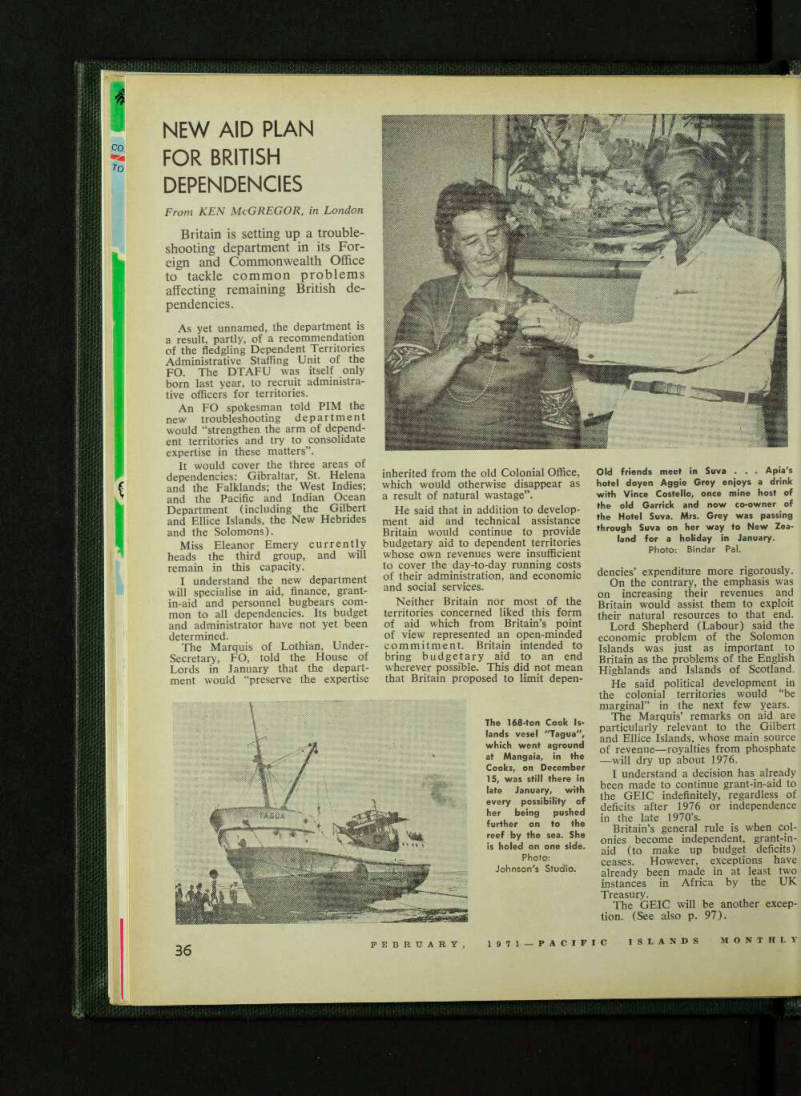
Old friends meet in Suva . . . Apia's hotel doyen Aggie Grey enjoys a drink with Vince Costello, once mine host of the old Garrick and now co-owner of the Hotel Suva. Mrs. Grey was passing through Suva on her way to New Zea land for a holiday in January.
Photo: Bindar Pal.
The 168-ton Cook Is lands vesel "Tagua", which went aground at Mangaia, in the Cooks, on December 15, was still there in late January, with every possibility of her being pushed further on to the reef by the sea. She is holed on one side.
Photo: Johnson's Studio.