big church talks
pp. 31-32 · Read in the full issue

Migration an issue at big church talks
From SUSAN YOUNG, in Honiara Delegates to the South Pacific Anglican Council left Honiara after a week oftalks in January, feeling that they had done something constructive This was in marked contrast to the council meeting last year, when members failed lamentably to come up with anv tresh ideas, or even a new statement of their work
SPAC is a fairly informal associa tion of the Dioceses of Melanesia, Polynesia, Papua-New Guinea and Carpentaria. It meets periodically to talk about and plan for the work of the church and to see how the dioceses may best help each other.
At Honiara, the representatives did not get much closer than last year to defining the precise nature and purpose of SPAC; but they did at least definitely decide that they wanted the organisation to continue working.
One of the most encouraging
features of the council, however was the outspoken part played by most ot the Pacific Islanders present. This effect seems to have been achieved chiefly by means of splitting the council into racial groups for the detailed discussions.
At first glance, such a procedure might seem anathema to any church organisation. In fact, freed from the diffidence which both brown and white often feel in each other’s com pany, the scheme resulted in some refreshingly uninhibited talking. It also resulted, during the council’s plenary sessions, in a genuine feeling of mutual respect and profound racial harmony.
This was evident in the statement which the delegates issued at the end of their meetings.
They felt it was of “the utmost importance” that church, government and commerce should increasingly give indigenous people opportunities for leadership and responsibility. But they said that it was also important
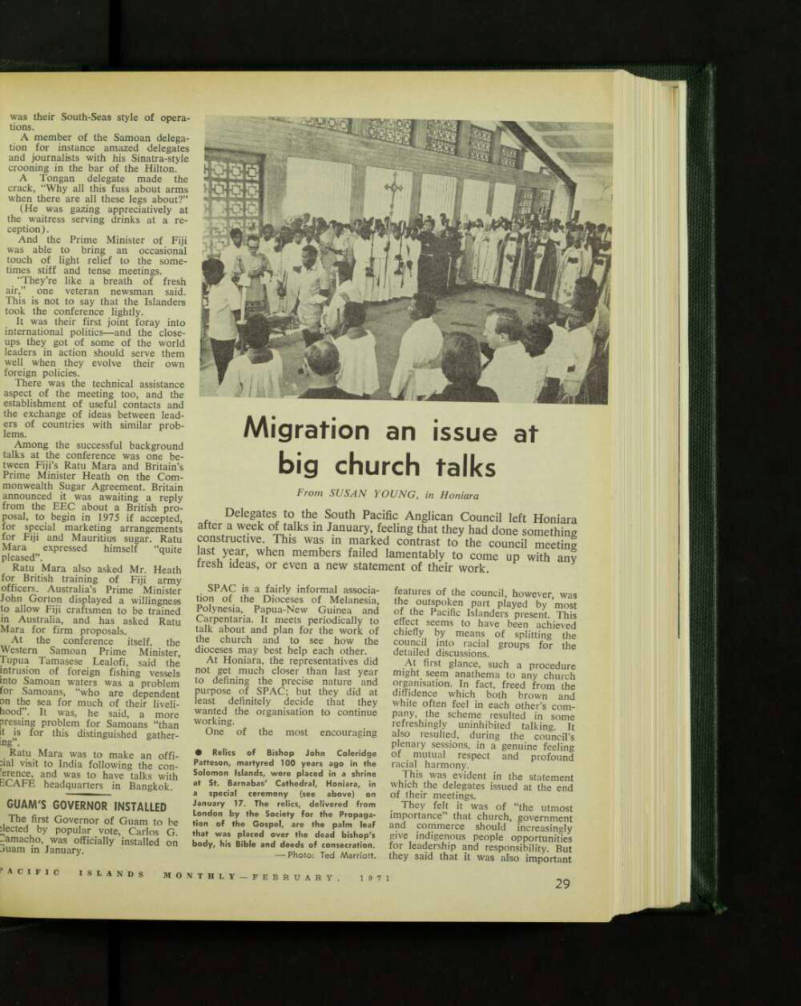
Relics of Bishop John Coleridge Patteson, martyred 100 years ago in the Solomon Islands, were placed in a shrine at St. Barnabas' Cathedral, Honiara, in a special ceremony (see above) on January 17. The relics, delivered from London by the Society for the Propaga tion of the Gospel, are the palm leaf that was placed over the dead bishop's body, his Bible and deeds of consecration.
Photo: Ted Marriott.
that expatriates should stand beside Islanders in this transition period— “lt is emphatically not a time for the expatriates to walk out, or to be pushed out.”
The delegates said that SPAC itself should express the local mind and that it should have an indigenous majority.
To this end, the council will next year hold a special consultation at which all the representatives will be Pacific Islanders. A few expatriates will be present, but only as consultants.
Amid a welter of domestic and wider topics, the council also took time to tackle the immigration issue.
Delegates said the council should “speak as one voice” to Australia and New Zealand, urging them to be “more humane” in their immigration laws and policies—especially towards Islanders wishing to enter those countries.
Delegates also expressed concern for people living in overcrowded areas of the South Pacific. They sug gested that a survey should be made, to determine the best areas for resettlement schemes. The delegates said that governments should, where necessary, amend their immigration laws to permit resettlement.
They went on to say that, where it was not already being done, Pacific churches and governments should be urged to pay local people with equal qualifications the same basic salaries as expatriates. They felt that such a policy would help to keep Pacific Islanders in their own countries, instead of going overseas in search of better jobs.