lump it now
pp. 97-100 · Read in the full issue
Like it or lump it now
From a Port Moresby correspondent The rift between Papua-New Guinea's Public Service Association and the government employer, the Public Service Board, had just reached the disastrous stage when there was a master stroke.
The focal point of the increasingly bitter war of words and actions— the board chairman, Mr. Gerald Unkles—was suddenly localised.
Into his place has stepped a board member, a former teacher and schools’ inspector, Serei Pitoi, 34, a Papuan who has the makings of a diplomat, and with whom the Public Service Association can start afresh.
The PSA said it was delighted. No wonder, after Mr. Unkles’ farewell blast at the Public Service during a management seminar at the Uni versity of Papua and New Guinea.
The board chairman, Mr. Unkles, said his two-years’ experience had shown him that the Public Service in the territory was “second-rate”.
He said public servants apparently joined in an unseemingly rush from Konedobu (headquarters in Port Moresby) before the 4.06 p.m, knock off time, and many were not on time in the morning.
He made other charges, of collusion among public servants to give each other plum jobs, and in general said that slack, un-dedicated, selfish, in efficient and wasteful attitudes pre vailed with great numbers of public servants.
One can’t blame his outburst entirely. He has been subjected to an unceasing uncomplimentary tirade from the PSA and public servants individually, as to his unco-operative, dictatorial attitudes and the board’s incompetence and inefficiency, plus a PSA Congress motion of no con fidence.
Mr. Unkles was undoubtedly right in what he said about a considerable number of Australian public servants.
But his brush was too broad.
At least one section of the district administration has now put in claims for four times as much overtime as it had previously. Some officers had put themselves out time after time, starting in the middle of the night if necessary, and acquiescing to depart mental pleas that there wasn’t enough money to pay overtime worked. The “gentleman’s agreement” has gone.
The way is open now for diplomacy on both sides with a board regime which is most unlikely to be removed.
It’s like it or lump it now for the PSA.
And that’s not a bad thing.
Pacific airline
changes soon
Air Pacific, small Suva based air line which has been in a poor financial position, has been rescued with new management, capital, bigger aircraft, and with a commercial arrangement with Fiji Airways. Mr. Robert Hunter, the American real estate developer, is not now managing Air Pacific.
Major shareholders of the re organised company will be Hawker de Havilland Australia (who have been involved for some time), Pacific Hotels and Development Ltd., and Glassgraft, a US company. Air Paci fic will apply for scheduled services
in Fiji, and a fortnightly service to Wallis and Futuna. It may get a share of the lucrative Nadi-Suva route held by Fiji Airways.
It also intends to change its name.
There is a good chance that Fiji Air ways may take the Air Pacific name, instead of the name of Pacific Islands Airways, which it has announced it will take. (There is already another Air Pacific in the Pacific—operating in the Marianas.) Fiji Airways itself is to expand, and announced in De cember it plans to buy the BAC 111.
New Hebrides Airways is also to expand following arrangements with UTA for a consortium, which will share extended local services.
Nickel miners
on the attack
New Caledonian “petit mineur”, Jean Claude Berton, turned on the full force of his charm in Sydney in December in an admitted attempt to bring home to sheltered Austra lians the full horror of France’s nickel policy in New Caledonia, and its effects on the territory’s inde pendent mine owners.
But from the lack of space his revelations provoked in the Sydney Press (he did better on radio), one might construe that Australians, far from upset at New Caledonia’s cut in nickel production, will be only too pleased to pursuade Japan, which at the moment buys 90 per cent, of its nickel from New Caledonia, to buy from them instead.
Mr. Berton—lamenting that he could provide no better facilities for the Press than free drinks at 11 a.m. in the lush Wentworth Hotel, be cause of the decree in New Caledonia that travellers can only take SA27O with them out of the country—was in a mood to unburden himself. He said many small miners were in danger of going bankrupt because of France’s sudden decision to slap on them a nickel quota of 4.3 million tons this year (ending March 31), when they had received orders to sell some six million tons to Japan (PIM, Dec., p. 101).
He explained he was in Sydney to bring home to Australians just how France treats New Caledonia. The French, he said, quite simply wanted to stifle New Caledonian miners, so that French-controlled companies could grab the lion’s share of the nickel and take all the profits out of the country.
With the eloquence of a de Gaulle, he declared: “Australians are absorbed in the development of their own country and forget, un fortunately, that New Caledonia is only 2i hours away by jet from Sydney. Australians also seem un aware that Caledonians feel they belong to the Pacific and not to Europe. A striking proof of our attitude was the Caledonians’ re fusal in 1940 to sell nickel to Japan, and our decision to continue the war alongside our Pacific allies after the surrender of France.”
Later, “We have tried without success to get Paris to listen to us.
But Paris is too far from the Pacific.
Paris does not hear our voice . . .
Paris is too busy with the discus sions on Algerian oil. Paris only knows words like ‘non’ and ‘pas possible’, and its representatives have stated that the Caledonian mine operators are but a few, so
why take them into account?”
Mr. Berton warned of social un rest from 600 to 700 workers ex pected to be laid off because mines were shutting down. He said New Caledonians had had about enough of French bureaucracy: French “nickel-plated dreams” had brought on nothing but inflation and a higher cost of living.
To questions, he said that although a lawyer in French Poly nesia had been deported for less, he did not mind speaking out; he was born in New Caledonia and that made the difference.
Trade and diplomatic
missions to Noumea
Mr. Alan Edwards, the new Consul for Australia in New Cale donia, arrived in Noumea in mid- November. Mr. Edwards, who is accompanied by his wife, served pre viously in Paris and Saigon. His predecessor in Noumea, Mr. David G. Wilson, returned to Canberra in October, at the end of his two-year term.
The new Australian Trade Com missioner for Pacific Islands, Mr.
Llewellyn J. Martin, has meanwhile passed briefly through Noumea from his Suva post. Mr. Martin was ex pected to make his first extensive
contacts in New Caledonia by January.
Between times, the first trade mis sion to the Pacific islands organised by the Government of New South Wales, visited Noumea in November.
The 11-man group departed from Sydney on November 1, spending three weeks in Papua-New Guinea, Solomon Islands, Fiji and New Cale donia.
New Zealand is also keen to con solidate its growing trade with New Caledonia. The beginning of Decem ber saw the visit to Noumea of New Zealand’s Trade Commissioner for the Pacific, Mr. Gordon M. McLaren, who is now posted in Suva.
At the same time, the newly arrived first Air New Zealand repre sentative in Noumea, Mr. Graeme Hankins, was officially named as New Zealand’s trade correspondent for the territory.
US unions interested
in New Caledonia
United States labour unions are moving fast to form new ties with overseas unions, and to strengthen existing ones, as US companies be come increasingly international in scope. Their aim is to improve working conditions in US operations overseas until they equal conditions in the US. Lower wages overseas are seen by the unions as a threat to US labour because they could mean less jobs available at home.
Meyer Bernstein, international affairs director of the United Steel workers of America, recently spent three days in New Caledonia arrang ing for his union to help a local fledgling nickel workers’ union. Two North American concerns with which the USW bargains, US-owned International Nickel of Canada, and Kaiser Aluminium and Chemical Corp. are both in on big expansion of Caledonia’s nickel industry.
So, when the Caledonian union negotiates a new labour contract in January, two French-speaking USW officials will provide the new union’s representatives with detailed infor mation on the two firm’s finances and labour contracts. The two will also help with bargaining demands.
Confusion over
Fiji sugar future
There’s a big question mark over the future of the Fiji sugar industry.
Who is going to run it when the CSR Co. Ltd. (or its subsidiary, South Pacific Sugar Mills Ltd.) with draws after the 1972 crush?
A select committee, appointed by the Fiji Legislative Council last June,
has been looking at the future of the industry, and in November came to Sydney to talk terms to the company.
The committee, in an interim report to the Fiji parliament in December, was vague, to say the least, about what is intended.
The committee commented, “Finally, we are considering the re quirements, legislative and admin istrative, to provide a satisfactory basis for future ownership and con trol. We shall report on these in our final report”.
There is no potential buyer of SPSM in sight—at least publicly. The CSR Co. and the Fiji Government have been negotiating a price the company should receive for Fiji assets, and Fiji’s Natural Resources Minister, Mr. Doug. Brown, who is also chairman of the select committee, says his government has “no intention of nationalising the sugar industry”.
The CSR Co. Ltd. has agreed in principle that arbitration should decide the price it should receive for its assets.
It turned out the views of the parties about the value of the CSR Co. assets in Fiji were as far apart as the poles. In their discussions in Sydney they were unable to get down to details because they couldn’t agree on the main issue—the price to be paid for the shares.
Then who is going to buy the shares if the government says it has no intention of nationalising the industry? There are only two parties in the discussions, and if the Fiji Government buys the shares this would be regarded as nationalisation.
A member of the select committee,
Mr. R. D. Patel, told the Fiji House of Representatives in December: “We did not seek to buy this industry.
It was the company which declared its intention of withdrawing from this industry”.
Mr. Patel then went on to give an assurance that Fiji would see to it the sugar industry would not be disrupted. No cane would be un harvested. Employees of SPSM would have security of service.
Mr. Brown, who said categorically that the government had no intention of nationalising the sugar industry, in moving that the select committee’s report be adopted, said, “It is in the best interests of Fiji for us to take over the sugar industry”.
Which seems to be a clear case of nationalisation, unless the govern ment is acting as intermediary for an unknown potential buyer.
Fiji's five year plan
promises much
Fiji’s new five-year development plan, starting this year, will cost the central government about SF7S million, local government bodies about $25 million and private in vestors around $264 million.
Two huge projects, the building of the $7 million Lautoka Hospital and reconstruction of the Suva-Nadi Road, account for a quarter of the entire public investment programme.
The plan proposes that $750,000 be spent in 1974 and 1975 on a new parliament building. Nearly $lB million will be spent on social services, more than $8 million on community services, and almost $l4 million for economic services (includ ing s7i million on fisheries, forestry, co-operatives and tourist develop ment).
Developments connected with the Public Works Department, transport and civil aviation, the Posts and Telegraphs Department and marine, are allotted $29,300,000.
In a foreword to the hefty volume containing the plan, Fiji’s Prime Minister, Ratu Sir Kamisese Mara, outlined its aims as: “To create more employment, to build a multi racial society, to integrate the widely dispersed islands of the group, to enable Fiji to play a positive role in the South Pacific region and to achieve progress within a framework of economic, social and political stability.”
Addressing the opening session of the new two-chamber parliament, the Governor-General, Sir Robert Foster, said more than 70 per cent, of the funds needed would have to be borrowed, compared with 50 per cent, during the fifth development plan.
About 53 per cent, of the total funds required would be raised from overseas sources, as against 42 per cent, during the last plan.
This trend could not be supported indefinitely, Sir Robert said, and future development plans would need to rely heavily on internal sources and other avenues of revenue.
“The plan is for social as well as economic development,” he said. “All parts of the social body must be nourished.”
One of the main aims of the new plan was to narrow the gap between rural and urban dwellers. Unbalanced development not only left rural dwellers—more than half the popu lation—without their share of pro gress, it also tended to accentuate the drift of the rural population to the towns, with all the problems of overcrowding, poor housing, etc.
For this reason, he said, the plan laid maximum stress on agriculture, forestry and fishing and rural development generally.
The plan sets a gross domestic product growth target of 6.7 per cent, per year over the next five years, meaning the gross domestic product, estimated to be about $l7B million in 1970, should increase to $246 million in 1975, as measured by present prices.
This 6.7 per cent, growth rate for the next five years compares with an achieved growth rate of approxi mately 5 per cent, during the last development plan period.
Sir Robert said that tourism—the most dynamic sector of the economy —was of major importance, perhaps second only to agriculture.
Tourism is not at present a major contributor to the national income, representing only about 3.4 per cent, of gross domestic product in 1970.
But as an earner of foreign ex change, it presents a very different picture. In 1965, gross receipts for tourism accounted for 13 per cent, of the total receipts from the sale of goods and services abroad. This had increased to about 30 per cent, in 1970. By 1975 it’s estimated that the figure will have risen to 51 per cent.
The development plan stresses the need for Fiji to retain its image as a “safe and desirable place” for foreign investment, since a very large proportion of private investment will come from foreign sources. Various incentives for investment in desired sectors are being reviewed to make them more effective.
The plan said that government also realised the need to encourage invest ment by facilitating the acquisition of by individuals, or companies seeking to establish new enterprises or expand old ones.
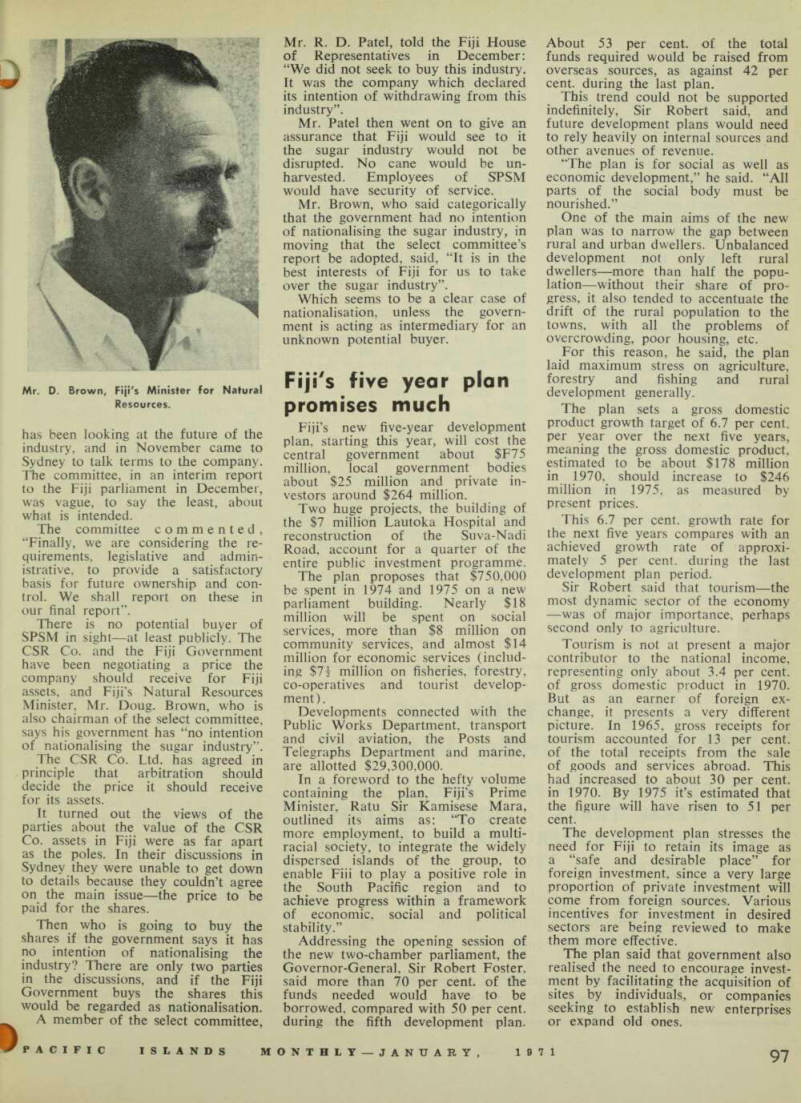
Mr. D. Brown, Fiji's Minister for Natural Resources.
P-NG debate
over spare parts
The failure of numerous native trucking enterprises due to lack of spare parts for the vehicles has be come a hot issue in recent months in Papua-New Guinea.
A House of Assembly motion in November brought the first meeting —just before Christmas—of motor traders, finance companies, and Ad ministration officials, to try to find a fair way of cooling a partially racial issue.
Papuan MHA, Paulus Arek, was one who blamed white garage owners for “tricking” native people out of their money for repairs which take months to complete.
The House motion (it’s just a motion at this stage) called on the Administration “to examine the possibility” of legislating to suspend hire-purchase payments when a vehicle can’t be used because spare parts are not available, or in surance claims are delayed for the same reason.
Finance companies said that if this became law they would simply withdraw finance for vehicles when ever there was danger of this hap pening (the danger is very largely with native buyers, or rather hirers).
If they did continue finance, motor traders would have to bear the losses under a “full recourse” agreement, and they in turn would accept only cash business from native people wanting vehicles.
Some traders have been dishonest or negligent in selling vehicles they could not afford to keep spares for,
but traders aren’t entirely at fault.
Genuine stories are legion of native buyers bringing on premature breakdowns through ignoring ser vicing requirements; the distances and terrible roads between vehicle fran chise holders, in the Highlands par ticularly, makes it quite often impracticable to effect repairs at a village; and no trader can carry every spare in the fluctuating vehicle market in the territory today.
Truck distributors are still very scattered, and breakdowns in remote places cost frightening amounts in mechanics’ time.
The situation is worrying for the traders, as for the hirers and buyers.
Ignoring companies, individual native people buy twice as many trucks as whites at present.
In the not too distant future, native people will be virtually the entire market. They’ll also be largely semi-literate or illiterate for decades, and some way of protecting them and also honest traders is sorely needed.
London bid
for BNG?
UK finance house, Jessel, is con sidering a takeover bid for the 49year-old highly-profitable British New Guinea Development Com pany, Papuan copra and rubber pro ducer, PIM man Ken McGregor re ported from London in December.
Jessel, with its Stgs/- shares sell ing on the London Stock Exchange for about 31/-, has a paid-up capital of about £lO million, but its assets are worth several times this figure.
BNG’s 2/- shares, unlisted in Aus
tralia, but listed in London, have recently been selling for about 3/4 and giving a dividend of nearly 12 per cent.
BNG is one of four overseas plan tation groups Jessel is considering bidding for. It wants to diversify and invest outside the slow moving UK economy. The overall deal would cost Jessel £ll million but terms it would offer BNG aren’t known. BNG shareholders are widely spread, with many smallholders in the UK. Burns Philp and W. R.
Carpenter have small holdings.
Tonga ends stage one
of oil search
The first phase of Tonga’s search for commercial oil deposits ended in late December with the departure from Tongan waters of 237 ton American survey vessel Polaris. Good weather and excellent staff work enabled her to complete a 6,000 sq. mile survey between Tongatapu and Vavau, in less than 30 days.
Polaris, fitted with gravity and magnetometer equipment, is one of the most modern units afloat, and is owned and operated by Geophysical Surveys International, Houston, a division of Texas Instruments.
During a brief ceremony aboard, Capt. K. M. Simpson told King Taufa’ahau the cost of gathering and processing this kind of technical data was between $2OO and $3OO per kilometre.
Shell manager, Alan Jackson, on behalf of the consortium searching for oil said the data collected will first be computerised by GSI, then a final interpretation will be made by Shell experts at the Hague. The information will be passed to each participant—Shell, 8.P., Aquitaine, Gulf, Republic and Ampol—who are free to make their own interpreta tion.
The search for Tongan oil began with the trilateration survey last August by another overseas vessel, Atlantic Shore, to set up the radio location grid system which will pin point all subsequent off-shore activity.
Between September and November, Dr. C. J. Mulder from Shell mounted a widespread geological survey during which he collected for laboratory tests, hundreds of rock samples from the main island groups and re-interpreted a wide range of aerial photographs.
This consolidation of offshore and geological evidence will take several months to process. Only when the results have been integrated and evaluated can a decision be reached by the oil participants as to future action.