Book Reviews
pp. 79-81 · Read in the full issue
Just how much bully was there in Hayes?
William Henry Hayes was born in an American village in 1827; he became a Pacific sea-rover about 1850; and between 1850 and 1877, when he was murdered by his sea-cook aboard his 23-tons schooner out in the Central Pacific, he acquired great notoriety as Captain Bully Hayes, buccaneer and swindler extraordinary.
Yet Bully Hayes was never con victed of a major crime. He showed remarkable cleverness, and often a deplorable sense of raw humour, in swindling his creditors; but, as far as my records go—and I accumula ted a trunk-load of them—he never was actually gaoled for petty crime, as he might have been.
He was a big, hearty, jolly man, famous as a bare-fists fighter; and, throughout the Pacific Islands, from San Francisco to Melbourne, and from Auckland to Singapore, there were scores of men who—while acknowledging his rascality—spoke of him in terms of friendship and admiration.
However, in the half-century which followed his death, he was the victim of scores of newspaper scavengers, who debited his record with almost every imaginable sea-crime. Rape, barratry, blackbirding, bigamy—you name it and, according to the scribblers of that period, Bully had done it.
I know, because in the thirties I collected all this as part of the material for a book on Bully Hayes —which I never got around to writing.
I established Pacific Islands Monthly, and Pacific Publications Ltd., in 1930; and, from the immense material then available in the Islands, I decided there were several books just yelling to be written—the true stories of Pitcairn Island, Bully Hayes, Queen Emma, Abbe Rougier, the Marquis de Rays’ swindle, among them. Nordhoff and Hall did the Pitcairn story, and made a fortune out of it. I wrote the Emma book, which was a quick sell-out. I had intended to write the true story of
Bully Hayes, but I was swamped by editorship, administration and Anno Domini, so I gave away my great mass of Hayes material to a Sydney writer—who unfortunately has done nothing with it.
That, in a historical sense, was unfortunate. It included the Moore Collection. In the thirties, I paid George Tyrrell, of George Street, £5O for the Moore Collection; and that in its turn included a mass of longhand records assembled by (I think) a Captain Griffiths, of Nelson, NZ, who had decided somewhere in the 1890’s to write the true story of Hayes, Moore was a retired Navy officer.
He . must have spent years gathering ? n j arra| tgmg his Hayes material, and had partly written his book. But he dropped tt all in 1914 when, I Presume he wa called U P f ° r nav y d and hls effects eventually were s *; . .. r „ . . ~. examination of all this stuff convinced me that it contained a great deal of unpublished history of Hayes, and of Pacific Islands events around the middle of last century .
Two or three books about Hayes bad been published in the early part of this century. They were cheap pot-boilers, worthless as history, devoted mainly to painting Bully Hayes as an unmitigated scoundrel, Now, at long last, comes a new book— Captain Bully Hayes, Black birder and Bigamist, by Frank Clune.
It’s a very readable and useful compilation, and it does put the story of Hayes into clearer and truer focus than anything hitherto published. But it has its shortcomings. There is not much that is new in it, so that the full story of Hayes now probably will never be told.
Clune has gone over most of the stuff that had been published in the last 60 or 70 years, and has shown skill and good judgment in putting the innumerable stories of Bully’s exploits into effective chronological order. This must have been a colossal task, because the literary scavengers of the past had just grabbed at incidents from here and there, without regard for truth or continuity.
As put together by Clune, from a mass of often contradictory material, this history of Bully Hayes is readable, lively and colourful; and Clune is fair enough to say that, while he has done his best to find the truth, as between “the venom of his enemies and the admiration of his supporters”, his book must not be regarded as reliable history. But Clune has done history a service by emphasing his conclusion that Bully Hayes was not as bad as he has been painted.
Within the book is evidence of one outstanding accomplishment by
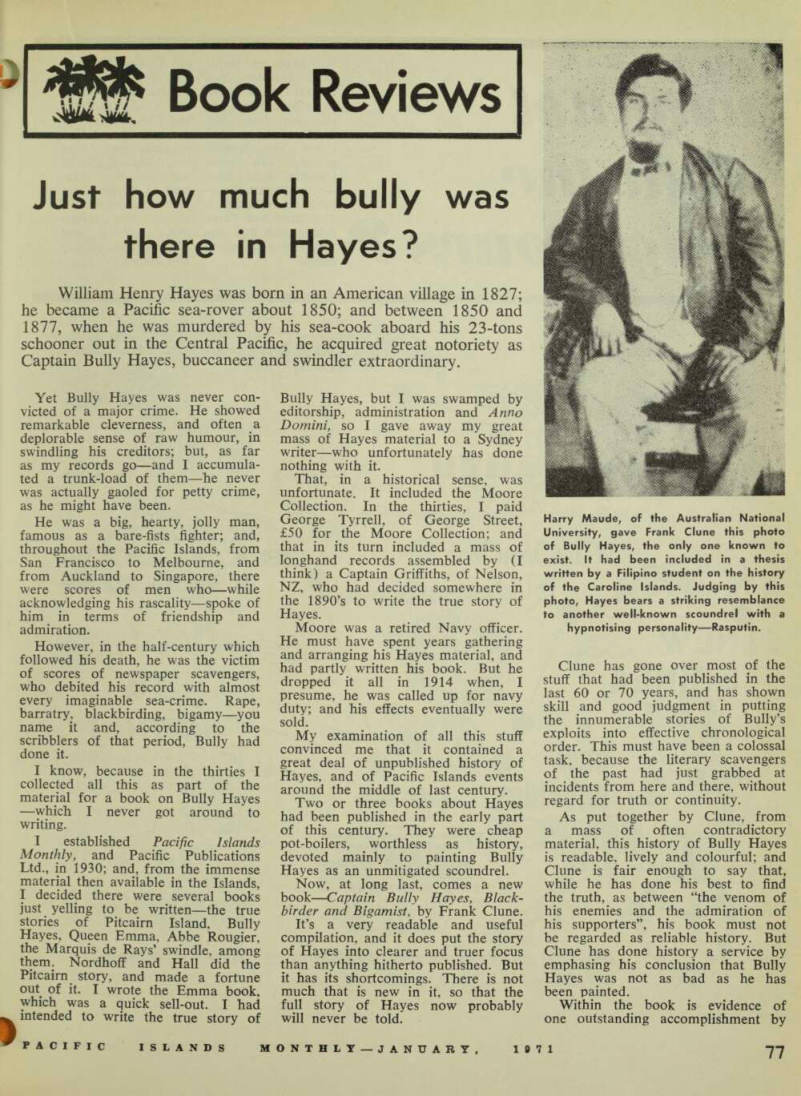
Harry Maude, of the Australian National University, gave Frank Clune this photo of Bully Hayes, the only one known to exist. It had been included in a thesis written by a Filipino student on the history of the Caroline Islands. Judging by this photo, Hayes bears a striking resemblance to another well-known scoundrel with a hypnotising personality—Rasputin.
the author: reproduction of the only known photograph of Hayes. Thirty years ago, I searched the Pacific in vain for something like this. PlM’s old friend, H. E. Maude, of the Australian National University, found this photograph for Clune in a history of the Caroline Islands written by a Filipino student. It’s a pity that this unique picture is not on the front cover of the book, instead of the imaginative drawing (by Norman Lindsay, no less) taken from the cover of a rubbishy book (by Louis Becke) about Hayes that was published more than 50 years ago.
Frank Clune, author of this new book, is himself a literary pheno menon.
About 35 years ago he began writing dinky little books about travel, which were not highly re garded by reviewers, but which com manded readership. Thenceforth, he never stopped travelling and writing; his style improved and his public grew; and now, including this new one on Hayes, he has no less than 64 books to his credit.
He’s a jolly, friendly man in his seventies who has demonstrated how his kind of writing can be made to pay. The last two chapters of this Hayes book have nothing to do with Hayes, but are typically Clune. They describe how Clune wandered at large in New Hebrides and New Cale donia, making friends and influencing
people.
R. W. Robson.
(Captain Bully Hayes, Black
Birder And Bigamist. Angus And
Robertson. $4.95).