* Footnotes
pp. 48-49 · Read in the full issue
TTiE Minister for External Territories has come A and gone. As no reporters accompanied him on his tour of Papua, and as he refused to hold a news conference before he left, it is difficult to find out just what happened. Even members of the House of Assembly were inadequately briefed; I was one of several who did not even receive a copy of his itinerary. But from the sparse accounts available it would appear that he has chided those of whose behaviour he disap proves in his usual benign avuncular manner.
From the meagre radio news items and Press pars one gets the impression that he has done a certain amount of talking, but very little listening except to kiaps and to those Papuans, no doubt carefully selected, who were invited to meet him
at residency receptions.
From Balimo, in the Western District, it was reported that he had addressed local government councillors, but neither from Balimo nor from
anywhere else has there been any word of meetings at which Papuans were invited to place their views before the minister.
The pattern seems to have been all too frequent one of one-way communication from which we have suffered so much in the past.
If this impression is unfair to Mr.
Barnes, he has only himself to blame for making his trip such a hush-hush affair.
The mere fact that the Minister spent the whole of a 10-day visit
to the territory in touring Papua was in itself remarkable. Normally VlP’s, whether from Can berra or from the United Nations, hurry through Port Moresby with averted eyes on their way to New Guinea.
Mr. Barnes’ unusual behaviour has naturally given rise to speculation. By the time these words appear in print we may know all, but in the meantime it seems not unreasonable to guess that Mr. Barnes’ foray into Papua may have been prompted by the growingly vocal unease among Papuans about their future in a united Pagini.
There are two reasons for this unease. First, since the amalgamation of the two territories in 1946, the lion’s share of developmental expendi ture has gone into the more economically pro-
They Want A
Place In The Sun
For Papua
mising New Guinea territory, leaving the greater part of Papua as a depressed area. Second, if this economic imbalance is allowed to continue this side of independence, there is little hope of its being corrected after independence, when Papuan members will be, as indeed they are now, in a permanent minority in the national parlia ment. If development funds are not made available for Papua while they are still being allo cated by Australia, there is only a very slender hope that they ever will be.
It is no doubt with these thoughts in mind
that Mr. Ebia Olewale, member for South Fly, is currently canvass ing the idea of a “Papua Action” group to press for a place for Papua in the economic sun. It is hardly surprising that this move should be made by the member for South Fly. If Signor Luigi Maria D’Albertis were to revisit Mr. Glewale‘s electorate, he would find that it had changed very little since he terrorised its inhabitants with rockets and fire crackers in 1876.
Mr. Barnes’ reaction to this situation appears to have been to point out, in those tones of sweet reasonableness that become him so well, that development in New Guinea will also benefit Papua. He could hardly have taken a worse line.
This is exactly what Papuans are afraid of. Not unnaturally they shy away from a role in which they will be the perpetual poor relations of the New Guineans, reminded at frequent intervals, as they undoubtedly would be, of their dependent
position.
The amalgamation of Papua and New Guinea in 1946 was an Australian political decision, just as their separation between 1919 and 1942 had been an Australian political decision. The terri tories were amalgamated without any attempt
With Percy Chatterton
in Port Moresby
having been made to find out whether in fact was what either Papuans or New Guineans ®anted, and, during the last few years, it has become increasingly evident that many Papuans dislike the thought of being carried on the backs of New Guineans quite as much as many New Guineans dislike the thought of having to carry them.
There is only one way in which this tension can be relieved and successful Paginian unity achieved, and that is by pumping into Papua such a measure of developmental expenditure as will enable Papuans to hold up their heads and say to New Guineans, “There are not as many of us as there are of you, but man for man we are pulling our weight in the national economy.”
Until the same kind of money has been spent on development in Papua as has been spent during the last 20 years on development in New Guinea, Papuans will not be able to do this.
TT was probably just an accident that Mr.
Barnes’ visit coincided with an outburst of mutual recrimination between the Public Service Association and the Public Service Board, probably unequalled in virulence since the days of the 1906 Royal Commission; but the Minister was not slow to seize on the opportunity to chide both public servants and politicians.
Public servants were warned that they must not become involved in politics. A worthy senti ment, but one with rather a hollow ring while 10 senior public servants sit in the House of Assembly, where they introduce Public Service prepared legislation, lobby to secure its passage, and even on occasion launch a personal attack on an elected member whose views they may dis like. Compared with these activities, one feels that the indiscretion of base-grade clerks who get around at weekends in Pangu Party T-shirts is not so very damaging to the Public Service image.
We politicians are also chided. We must not interfere with the Public Service. This dictum also rings a bit hollow when one remembers that the P-NG Public Service is under the control of an Australian politician—none other than Mr.
Bames himself. The fact that nowadays he dele gates some of his powers to a Public Service Board whose members he nominates does not materially alter this situation.
If by “non-interference” Mr. Barnes means non-interference with the day-to-day running of the Public Service, fair enough. But it has to be remembered that it is the Paginian politicians who, when Budget time comes round, have to find the money needed to pay for the Public Service, and may have to endanger their chances
of re-election by levying unpopular taxes to help pay for it. When this happens, it is they who lose votes, not Mr. Barnes.
Under these circumstances it does not seem unreasonable to suggest that the House of Assembly should have at least as much say in the shape, size and cost of the P-NG Public Service as the Minister for External Territories has.
Yet what are the facts? For several years now, local politicians have been urging the need for a Department of Local Government. Their pleas have been rejected. We have been told that a new department costs a lot of money and is difficult to staff. Yet during this same period two new departments which we haven’t asked for have been set up—the Department of Social Development and Home Affairs, and the Depart ment of Transport.
The establishment of the former was ap parently the result of a bit of intra-service jockeying for position. The latter came in by the back door. First, a Co-ordinator of Transport was appointed, and he had, of course, to have a few typists and clerks to assist him, and no doubt a tea-boy (euphemistically described as a “cleaner”) as well.
Soon this modest establishment was expanded into a “Directorate of Transport” within the De partment of the Administrator. Finally we found ourselves saddled with a full-blown Department of Transport, with all its burgeoning opportunities for empire building. But we’re still waiting for the one we asked for.
Can a country whose Public Service is shaped and controlled from outside its borders be said to be self-governing, or even to be substantially on the road to self-government?
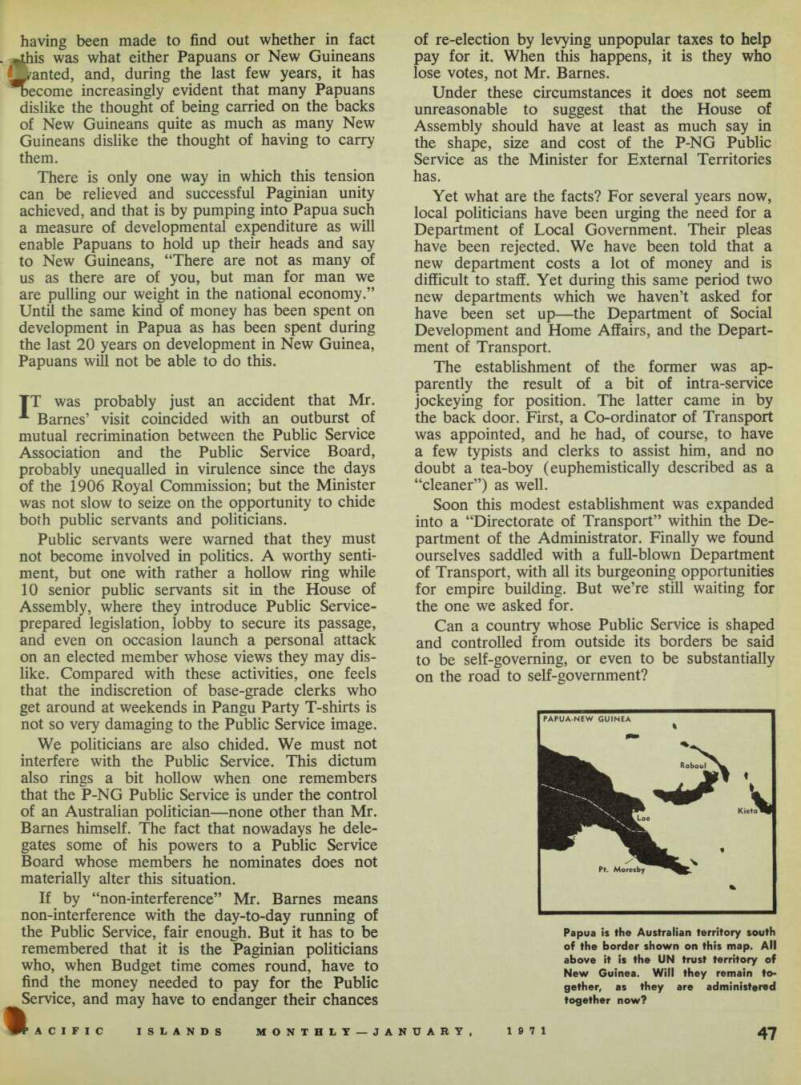
Papua is the Australian territory south of the border shown on this map. All above it is the UN trust territory of New Guinea. Will they remain to gether, as they are administered together now?