Solomons Talk Of 1975 As The
p. 27 · Read in the full issue
Target For Independence
Prom a Honiara correspondent Patterns are beginning to develop in the Governing Council of the British Solomon Islands Protectorate —the elected legislature which was established here in 1970 as an alternative to the Westminster system of parliament. They have begun to show following the second meeting of the council, which ended in December.
To start with, the Govco moves slowly, not achieving as much as might be expected. One of the reasons may lie in the fact that the Secre tariat, which is the government administration centre, has not been geared to working with committees.
Some changes have now been made since the second meeting, and next April, when the third meeting is held, we should see whether they speed up matters.
Under the constitution, matters are dealt with in private committees before the session starts. At the session the decisions of the com mittees, as shown in the committee’s minutes, are put forward for ratifica tion by the council. In theory this means that when the council deals with committee decisions, it should be a fairly quick process. What in fact seems to be happening is that the issues are being thrashed out afresh at the council. It may be that those council members not on the committee concerned do not find its decisions adequately minuted.
There are no political parties as such, though the council is divided into elected and official members and these are, of course, the two main factions. However, a third group which sometimes splits the elected members is now apparent. This com prises those four (out of 17) elected members who are chairmen of the various committees.
The chairmen are appointed by the High Commissioner and consider themselves answerable to him. In an issue where there is conflict between elected and official members, com mittee chairmen tend to veer to the officials, and this, of course, reduces the elected members’ majority.
The fact that Govco is slow doesn’t mean that there is nothing happening.
A highlight in December was the motion by Peter Thompson on inde pendence. Criticising the lack of con fidence by some of the other mem bers, he proposed a definite timetable for independence, with 1975 as the target.
The motion was carried, although some elected members who expressed reservation about being ready in time ■were dealt with scathingly by Peter
Thompson, who accused them of being out of touch with their people and having no faith in their abilities.
Whether 1975 is in fact to be the date, will depend on the rate of
localisation, the progress of rural development, and the economy generally. Above all, the Governing Council will have to start doing more than talk.
The two newcomers to the council made their presence felt in Decem ber. John Smith, the Financial Sec retary, despite his holding budget, soon showed that he was the most progressive of the official members, especially in the debates on localisa tion, independence and rural develop ment. Mr. Joe Bryan (South East Guadalcanal), claimed that rural development stopped where the road ended, and that thereafter there were just the bush knife and the pointed stick. He advocated more training farms, the cleaning up of rivers to stop flooding, as well as the intro duction of prawn farming. Consider ing that copra is still the main ex port and that copra production is still just over 20,000 tons per year, the same as 50 years ago, rural development is an important subject.
Solomon Mamalone spoke convin cingly on the need for rural develop ment, but it was in the debate on localisation when he came into his own, relating his experience as a former public servant and the dif ficulties he had encountered. Peter Thompson claimed that there should be by now at least one local district commissioner and one local head of department. All the elected members agreed not enough was being done to localise most departments.
The Annual Abstract of Statistics just published shows that, whilst since 1966 the number of Solomon Islanders in government service has increased from 1,130 to 1,660, the number of posts has also been in creased, with the actual result now that there are five more expatriates in government service than in 1966.
It is perhaps significant that a week after the session, Fred Osifelo, who has shown himself to be a skil led administrator in the Lands Department, was appointed Deputy Commissioner of Lands and Surveys.
The elected members will no doubt be more voluble if by the next meeting some definite steps towards localisation have not been taken.
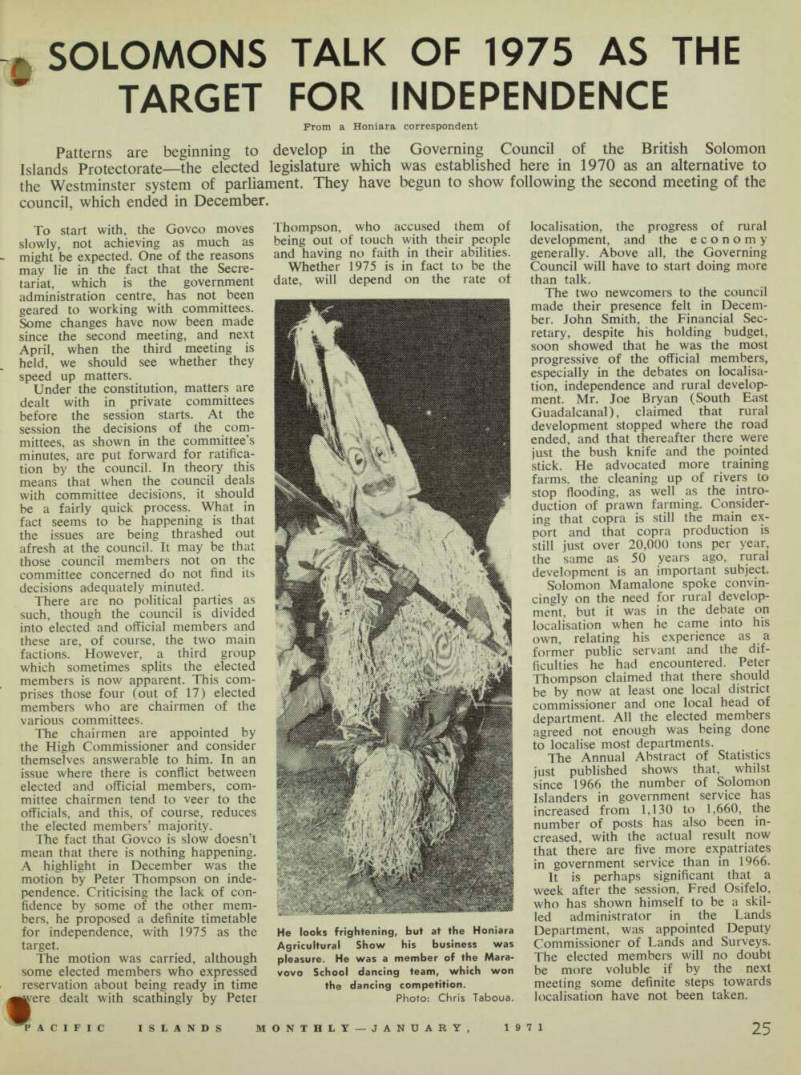
He looks frightening, but at the Honiara Agricultural Show his business was pleasure. He was a member of the Mara vovo School dancing team, which won the dancing competition.
Photo: Chris Taboua.