Pacific Islands Monthly
pp. 24-26 · Read in the full issue
Islands parliaments are on the move
It Won't Be Plain Sailing Into
The Pacific's New Year
From a Tarawa correspondent It ended both with a bang and a whimper—the final meeting of the Gilbert and Ellice Islands Colony’s House of Representatives in December. There was conflict over localisation and the lack of effective communication between the government and parliament, but there was also an air of anti climax.
The House of Representatives has now been dissolved.
The Gilbert and Ellice Islands Colony expects in February to hold general elections which will give it a revised Legislative Council and a Ministerial Member system of gov ernment.
A Leader of Government Business, elected from among the elected mem bers by themselves, will be chosen at a short meeting of the new Legislative Council, probably in March, and the GEIC will get down to serious political business by about May (see PIM, Dec., p. 29).
As the final meeting in December drew to a close, the elected members looked to the future, and to their new powers—providing they were re elected.
Little interest was shown in “government” business. Draft legisla tion was debated in a desultory manner, if at all. Supplementary budget provisions, including $93,000 for the Prince of Wales’ visit last October and $20,000 for the Resident Commissioner’s new office, were passed without a murmur.
The 1971 estimates occasioned little comment and capital expenditure of more than $1.2 million was approved, with only a solitary query.
In the GEIC the budget debate has not yet become a forum for general discussion of government policies and expenditure. The elected members have preferred to initiate debate on matters of concern by means of questions and motions. It was clear, too, in December that the elected members were concerned with their own position in the House and with their effect on government.
This issue was raised by Babera Kirata (Onotoa) during the adjourn ment debate. It was his intention, he said, to express the dissatisfaction of all elected members, and many members of the public, over the poor communication which existed between the government and the House of Representatives.
He argued that the government gave low priority to matters brought before the House by elected mem bers. The people believed, Babera declared, that “we cannot do our job, and ... are useless in this House”, and “They regard us as
nothing more than government rub ber-stamps”.
As could be expected, the speech drew support from his elected col leagues and caused some agitation amongst the officials. In reply, the Assistant Resident Commissioner, Mr. Derek Cudmore, said the criticism was unjustified. And the elected members had not, he said, made full use of the information given them in the House.
The whole debate, however, begged a much more important question. If the elected members believed their criticism to be fair, and the govern ment did not believe it so, then surely a basic communication problem must exist?
But localisation, perhaps, generated more heat than any other single issue during the meeting. Reuben Uatioa (Urban Tarawa), the Chief Elected Member, started the ball rolling with a series of specific questions designed to elicit basic information from the government.
Replies revealed that seven positions had been localised in the past two years and in the same period, 37 new posts, filled by expatriates, had been created. (The colony now employs about 120 expatriate officers).
Naboua Ratieta (Marakei), implied that some of the seven posts had not been “localised” but simply re presented an expanded establishment.
It was left to the president of the House, Sir John Field, to clarify the government’s position. If the establish ment was expanded, and local officers appointed to positions that could be filled by expatriates, he said, then localisation had taken place. . . .
Having obtained the desired^
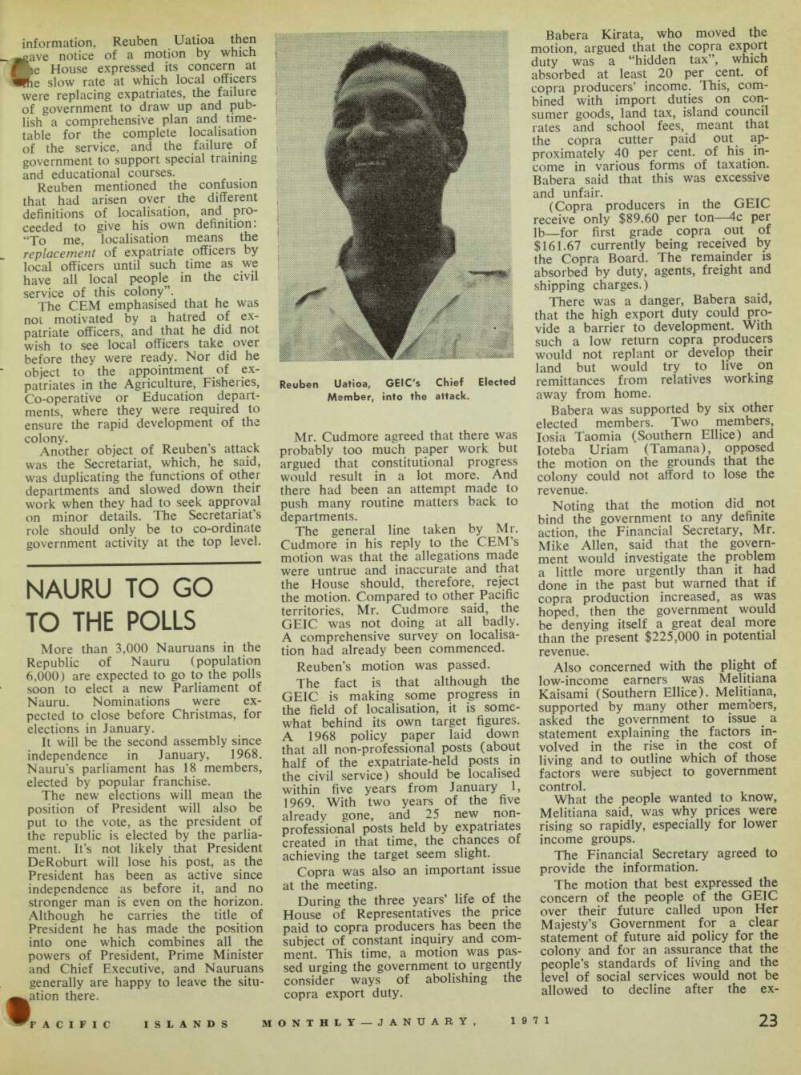
The Western Pacific High Commis sion, with headquarters at Honiara, in the Solomons, embraces the Gilbert and Ellice Islands, the British Solomons and the New Hebrides. Now the GEIC is to be come separate.
information, Reuben Uatioa then Kave notice of a motion by which fte House expressed its concern at le slow rate at which local officers were replacing expatriates, the failure of government to draw up and pub lish a comprehensive plan and time table for the complete localisation of the service, and the failure of government to support special training and educational courses.
Reuben mentioned the confusion that had arisen over the different definitions of localisation, and pro ceeded to give his own definition: “To me, localisation means the replacement of expatriate officers by local officers until such time as we have all local people in the civil service of this colony”.
The CEM emphasised that he was not motivated by a hatred of ex patriate officers, and that he did not wish to see local officers take over before they were ready. Nor did he object to the appointment of ex patriates in the Agriculture, Fisheries, Co-operative or Education depart ments, where they were required to ensure the rapid development of the colony.
Another object of Reubens attack was the Secretariat, which, he said, was duplicating the functions of other departments and slowed down their work when they had to seek approval on minor details. The Secretariat’s role should only be to co-ordinate government activity at the top level.
Mr. Cudmore agreed that there was probably too much paper work but argued that constitutional progress would result in a lot more. And there had been an attempt made to push many routine matters back to departments.
The general line taken by Mr.
Cudmore in his reply to the CEM’s motion was that the allegations made were untrue and inaccurate and that the House should, therefore, reject the motion. Compared to other Pacific territories, Mr. Cudmore said, the GEIC was not doing at all badly.
A comprehensive survey on localisa tion had already been commenced.
Reuben’s motion was passed.
The fact is that although the GEIC is making some progress in the field of localisation, it is some what behind its own target figures.
A 1968 policy paper laid down that all non-professional posts (about half of the expatriate-held posts in the civil service) should be localised within five years from January 1, 1969. With two years of the five already gone, and 25 new non professional posts held by expatriates created in that time, the chances of achieving the target seem slight.
Copra was also an important issue at the meeting.
During the three years’ life of the House of Representatives the price paid to copra producers has been the subject of constant inquiry and com ment. This time, a motion was pas sed urging the government to urgently consider ways of abolishing the copra export duty.
Babera Kirata, who moved the motion, argued that the copra export duty was a “hidden tax”, which absorbed at least 20 per cent, of copra producers’ income. This, com bined with import duties on con sumer goods, land tax, island council rates and school fees, meant that the copra cutter paid out ap proximately 40 per cent, of his in come in various forms of taxation.
Babera said that this was excessive and unfair. (Copra producers in the GEIC receive only $89.60 per ton—4c per lb—for first grade copra out of $161.67 currently being received by the Copra Board. The remainder is absorbed by duty, agents, freight and shipping charges.) There was a danger, Babera said, that the high export duty could pro vide a barrier to development. With such a low return copra producers would not replant or develop their land but would try to live on remittances from relatives working away from home.
Babera was supported by six other elected members. Two members, losia Taomia (Southern Ellice) and loteba Uriam (Tamana), opposed the motion on the grounds that the colony could not afford to lose the revenue.
Noting that the motion did not bind the government to any definite action, the Financial Secretary, Mr.
Mike Allen, said that the govern ment would investigate the problem a little more urgently than it had done in the past but warned that if copra production increased, as was hoped, then the government would be denying itself a great deal more than the present $225,000 in potential revenue.
Also concerned with the plight of low-income earners was Melitiana Kaisami (Southern Ellice). Melitiana, supported by many other members, asked the government to issue a statement explaining the factors in volved in the rise in the cost of living and to outline which of those factors were subject to government control.
What the people wanted to know, Melitiana said, was why prices were rising so rapidly, especially for lower income groups.
The Financial Secretary agreed to provide the information.
The motion that best expressed the concern of the people of the GEIC over their future called upon Her Majesty’s Government for a clear statement of future aid policy for the colony and for an assurance that the people’s standards of living and the level of social services would not be allowed to decline after the ex
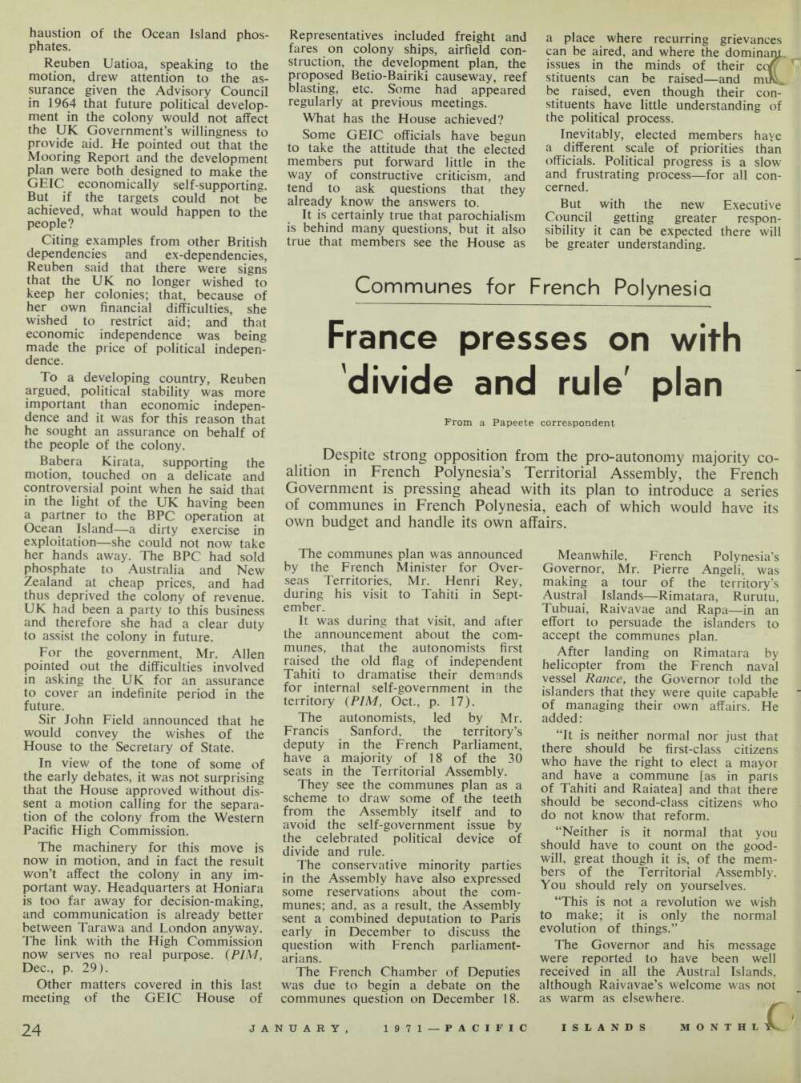
Reuben Uatioa, GEIC's Chief Elected Member, into the attack.
haustion of the Ocean Island phos phates.
Reuben Uatioa, speaking to the motion, drew attention to the as surance given the Advisory Council in 1964 that future political develop ment in the colony would not affect the UK Government’s willingness to provide aid. He pointed out that the Mooring Report and the development plan were both designed to make the GEIC economically self-supporting.
But if the targets could not be achieved, what would happen to the people?
Citing examples from other British dependencies and ex-dependencies, Reuben said that there were signs that the UK no longer wished to keep her colonies; that, because of her own financial difficulties, she wished to restrict aid; and that economic independence was being made the price of political indepen dence.
To a developing country, Reuben argued, political stability was more important than economic indepen dence and it was for this reason that he sought an assurance on behalf of the people of the colony.
Babera Kirata, supporting the motion, touched on a delicate and controversial point when he said that in the light of the UK having been a partner to the BPC operation at Ocean Island—a dirty exercise in exploitation—she could not now take her hands away. The BPC had sold phosphate to Australia and New Zealand at cheap prices, and had thus deprived the colony of revenue.
UK had been a party to this business and therefore she had a clear duty to assist the colony in future.
For the government, Mr. Allen pointed out the difficulties involved in asking the UK for an assurance to cover an indefinite period in the future.
Sir John Field announced that he would convey the wishes of the House to the Secretary of State.
In view of the tone of some of the early debates, it was not surprising that the House approved without dis sent a motion calling for the separa tion of the colony from the Western Pacific High Commission.
The machinery for this move is now in motion, and in fact the result won’t affect the colony in any im portant way. Headquarters at Honiara is too far away for decision-making, and communication is already better between Tarawa and London anyway.
The link with the High Commission now serves no real purpose. (PIM, Dec., p. 29).
Other matters covered in this last meeting of the GEIC House of
Representatives included freight and fares on colony ships, airfield con struction, the development plan, the proposed Betio-Bairiki causeway, reef blasting, etc. Some had appeared regularly at previous meetings.
What has the House achieved?
Some GEIC officials have begun to take the attitude that the elected members put forward little in the way of constructive criticism, and tend to ask questions that they already know the answers to.
It is certainly true that parochialism is behind many questions, but it also true that members see the House as
a place where recurring grievances can be aired, and where the dominant. issues in the minds of their cc/T stituents can be raised—and mirsL be raised, even though their con stituents have little understanding of the political process.
Inevitably, elected members have a different scale of priorities than officials. Political progress is a slow and frustrating process—for all con cerned.
But with the new Executive Council getting greater respon sibility it can be expected there will be greater understanding.