No.1 Income Earner
pp. 123-127 · Read in the full issue

Tourist Monster Grows In Fiji
"In A Year Or Two"
From SUE WENDT, in Suva Unless Fiji strikes oil or a bonanza of minerals (survey results are not negative, say the experts cautiously), tourism will be No. 1 evenue-earner in a year or two.
The statistics are impressive; more han SF3O million from tourism this . . . 3,000 more hotel rooms luring the next five years . . . capital ;xpenditure of $4O million to $5O mil ion .. . 25 per cent, growth rate . . . 100,000 visitors annually by 1976.
Not the miracle solution to all sconomic problems perhaps and :ertain to bring new problems in ts wake; nevertheless, tourism is irmly entrenched as part of the Fiji vay of life.
The task for independent Fiji is o help the monster grow, while pre senting it from taking over.
Incumbent upon both tourism con :erns and government is the task >f educating Fijians about the
ndustry’s benefits.
They see only the worst effects of ourism—the corruption of tradition ind culture, taxi drivers who grossly >vercharge, entertainment groups in :orporating plastic flowers and even insel into their costumes. The touts oo are a menace, and the leering ind loud remarks from some curio senders makes a visit to the markets in experience few female visitors vould care to repeat.
On the reverse side, the behaviour ind too-revealing garb of some sisitors, particularly cruise ship pas ;engers, seriously offends many lf tourism brings such people, they must sometimes think, vhy have it at all?
At the 10th annual tourism con sention at Korolevu recently, a Fijian ichoolteacher, Adi Davila Vunivalu, irged the 300 delegates to do so inc hing constructive about teaching Fijians about tourism.
“You talk about the beauty of my country, but what about the Fijian people?” she asked, during a sponta neous, emotional little speech.
“The bulk of the Fijian people are ieft in the dark about this great ;ourism that is coming to us”.
Adi Davila said she told her schoolchildren that tourism brought
money—but that was all they knew.
“I plead with you to find a way to educate the Fiijan people about this thing that is going to mean life or death to them in years to come.”
Nothing much was done about Adi Davila’s plea at the convention, but the issue was raised at a Fiji Visitors Bureau board meeting later in the month.
One speaker, Mr, R. W. Warner, suggested that a substantial amount of money be put aside by the board, for the provision of material for schools. The children after all, he said, were the citizens of tomorrow.
And in many cases, they took educa tion home to their parents.
No doubt this matter of education was noted by other South Pacific delegates attending the convention.
The Samoas, Tonga, the New Hebrides and Papua-New Guinea were all represented, and they too may soon be facing both problems and benefits of large-scale tourism.
It’s to be hoped that they also took note of a warning from guest speaker Marvin Plake, executive director of the Pacific Area Travel Association.
Tourism, said Mr. Plake (who can always be relied upon to burst bub bles of complacency), was beginning to become Fiji’s master. It was ter ribly late for orderly, proper develop ment of the industry, A master plan, which might cost anywhere from $5,000 to $500,000, was long over due. (At a different point of the conference Mr. Stinson, Fiji Minister for Tourism, said the master plan was two years off. See p. 125).
“A master plan would identify the so-called ideal tourist areas, where high rise hotels and shopping areas might go in Suva for example, suit able places for the development of public beaches and other places, roads from point to point,” Mr.
Plake said.
“The next step would be the
adoption of uniform building codes and zoning codes. This would enable potential investors from overseas to get a good understanding of what can be expected and not to force the investor to come hat in hand, haggling as you would to some bazaar over the cost of a trinket.
“New incentive laws must be adopted. In this regard Fiji has done very well. In fact from where I sit you’ve got the horse hitched to the back of the wagon. It came before your master plan, your building codes and your land use laws. But at least you know where the beast is and you can reach him!”
One of the most lively debates came on the subject of tipping. The question of whether visitors should or shouldn’t tip wasn’t resolved—it never is—but it had plenty of delegates on their feet.
General manager of the Fiji Visitors Bureau, Mr. Rory Scott, maintained that since people tipped because they were ashamed not to do so, it should be possible to reverse the situation.
He described a notice he’d seen in a New Hebrides’ hotel, saying: “Tipping is contrary to the laws of hospitality.” This had the effect of discouraging people from dispensing gratuities.
“Let’s not say any more that tip ping is voluntary. Tipping is a tyranny,” he declared. “There’s a duty on both management and hotel staff to ensure in Fiji that we really mean it when we say hands are not really out. I wonder whether it has not gone past that stage already.”
Hotel managers were dismayed by a suggestion from Mr. Scott that it would be up to hotels to compensate their staff if tipping was banned or discouraged.
“We can control tipping so that it is soft-sell, but I cannot believe that we have to pad the wages struc ture,” said Mr. Colin Thompson, managing director of Travelodge Fiji Ltd. “We would have to put it on the tariff and we want to avoid this at a time when Fiji is on the bottom rung of a tourist explosion.”
Mr. Paddy Doyle, manager of The Fijian hotel, was, naturally enough, one of those in favour of tipping.
“But I agree that the largesse should be distributed so that the chef and the fellow who cleans the toilet get their fair share,” he added.
Paddy Doyle also waxed eloquent on, not the Suva-Nadi road, his favourite topic, but water. He said the government five-year-plan made no provision for adequate water
upply to his and other Coral Coast lotels. Unless something was done ibout the water shortage, hotels vould not be able to go ahead with danned extensions. Last year at one joint the shortage was so bad that, :xcept for drinking and cooking sup dies, his hotel was running on sea vater.
Mr. Freddie Caine, manager of fubakula Beach Motel, said the vater supply along the Coral Coast vas not only inadequate but un lealthy. “The only two doctors in he area are called out at all hours >f the morning by people with tomach trouble,” he said. “The government must take action, or no me will come.”
Delegates got REALLY worked ip over the question of port facilities —or lack of.
They berated the government for ts failure to provide comfort for he many thousands of cruise ship >assengers. The ports provided no oilets, shade or refreshments. Dis smbarking passengers had to stand iround for hours in seatless sheds, rhousands of people waiting to go >n shore excursions were frequently leaked with rain. The whole situation vas pathetic.
In view of the fact that cruise passengers leave so much money in
Fiji, the criticisms seemed fair enough, Mr. Terry O’Neil, for the Ministry of Communications, Works and Tourism, answered that it looked as though nothing would be done for the next five years about passenger facilities, as the government would give priority to developing cargo space.
Last year ports in Fiji lost $400,000 and the problem would have to be looked at in this light. But there was a scheme to improve facilities at Savusavu.
And so the Fiji tourist bonanza grows, and with it, the problems.
Independence will
help tourism
Does a Fiji independent,
attract or deter visitors? This is a question that’s been on the minds of tourist promoters for some time. One man who firmly believes Fiji has even more appeal now than in its “colonial”
days (that is, before October
10!) is Fiji’s Minister for Tourism, Mr. Charles Stinson.
Mr. Stinson says Fiji will now attract interest and development activity on a scale it has never before experienced. He has outlined his government’s plans in catering for growth that will come in the next five years, with the building of another 3,000 hotel rooms at a cost of between $4O and $5O million.
Speaking at the Korolevu tourism convention he said the government would spend some $F3i million oft improving tourist facilities and pro moting tourism from 1971-75. This sum would be the government’s direct contribution during development plan six.
In addition, there would be sub stantial assistance to the industry in the form of taxation relief under the Hotels Aids Ordinance. For the first time, specific funds would be set aside for projects such as the creation of beauty spots, scenic lookouts, parking areas and access to beaches.
A separate section, with its own secretariat, would be created within his ministry to deal specifically with transport, civil aviation and tourism.
He revealed that $125,000 has been set aside for the establishment of a building for the School of Hotel and Catering Services, long-awaited by the industry. Building should start in
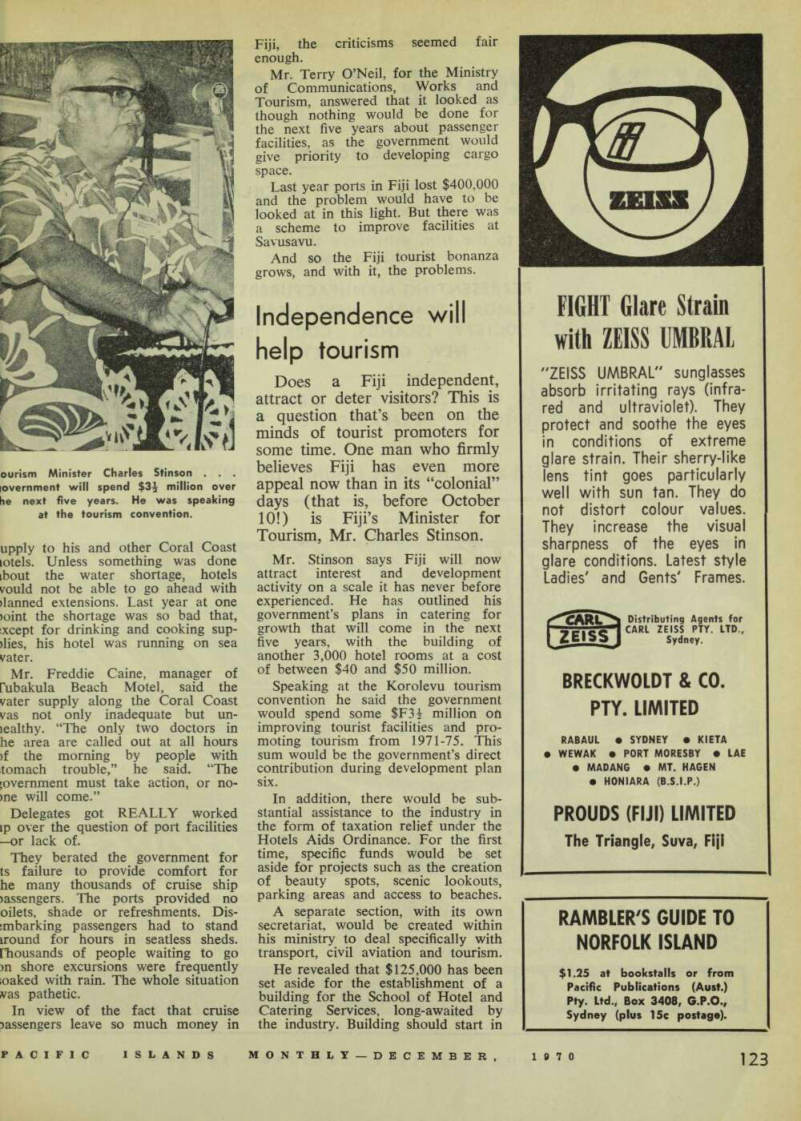
Tourism Minister Charles Stinson . . . dovernment will spend million over the next five years. He was speaking at the tourism convention.
anuary and the school should be perating in the second half of next ear.
Fiji would also be getting its master lan for tourism, he said —but not ur a couple of years at least. The reject would begin with a major irvey, leading to a master plan set ng out priorities for development, icluding a land use plan.
The draft terms of reference for ic survey included recommendations >r achieving the government’s policy f spreading the benefits of tourism lore widely.
The government expected to have bout 10 experts —planners, econo
lists and engineers—recruited from
arious tourist consultant orgamsa ons. The United Nations Develop lent Programme was prepared in rinciple to consider assistance in nancing the study. The World Bank willing to offer assistance in :ting executing agency.
’olynesian craft
:entre in Suva
Both Polynesian and Fijian crafts len will benefit from a new busi ess venture launched by the wife f Fiji’s Prime Minister, Adi Lady ,ala Mara, and the wife of the radewinds Flotel managing director, Irs. Anna Philp.
Adi Lady Lala and Mrs. Philp are lareholders in Polynesia Craft Centre Co. Ltd., a new company diich is to lease the workroom and lop currently being built opposite le Tradewinds, in Suva, The centre, esigned by Colin Philp, resembles le design of the hotel, with the mphasis on local stone and timbers.
Lau-born Mrs. Philp told PIM, We are doing this in order to help ur people. We will sell goods from le small producers, because they are le ones who really need help in uilding up a business.
“There are outlets here for Fijian lade goods, but few for the very ne products of Polynesia.”
Mrs. Philp, who will run the craft entre, has already ordered samples f handcrafts from out of the way laces like Niue, the Tokelaus, the 'ooks, Gilberts, as well as Samoa nd Tonga. She is planning too to lant a Polynesian garden, with mini lantations of local vegetables and lants.
“I’ve already collected small plants rom Lau and Bau of the flower ailed lagakali, which is used in weet-smelling oil,” she said. “It is ery difficult to grow and fairly hard o find these days.”