Pacific Shipping
pp. 93-99 · Read in the full issue

Fishing self-sufficiency "in three years"
From PETER T. LOVE , in Apia
Western Samoans are reviving the old sailing and fishing skills that once earned their home the title of the “Navigator Islands”.
Under the encouragement of the head of the fisheries department, Bill Travis, whose headquarters is in Apia, they are embarking on a fisheries programme which, Travis hopes, will make them self sufficient in fish in three years.
Back in the 18th century, Samoa was virtually the hub of an extensive navigational network. Twin-hulled catamarans could cany over a hundred seamen, and were able to travel for hundreds of miles out to sea in every direction. These early Samoan boats were “pre-fabricated” and could be disassembled in sections, stored away, and put back together in a very short time.
The Samoans were also adept at fishing. In the early days they had no difficulty in providing fish in abundance for their respective com munities.
The arrival of the missionaries in the mid-19th century changed this.
Boat-building and fishing went pretty much by the wayside while church related activities took precedence.
By 1900 there was virtually a halt in all boat-building in Western Samoa.
After over a hundred years of de cline in the fishing abilities of a great sea-going culture, the Western Samoans are once again returning to the sea for livelihood. Why?
The main reason is the new im petus provided by the government fisheries in Western Samoa. Bill Travis, who heads the fisheries de partment and initiated the programme six months ago, explains that about 10 per cent, of Western Samoan ex penditure is on imported canned fish —which is generally of poor quality.
Currency is badly needed in Western Samoa for medicines, school equipment, and other necessities which are currently being ignored.
There are plenty of edible fish avail able off the coasts, and if local villagers are given the correct in centives, they can again make a living
from the sea. In that way, in due time expenditure for imported canned fish can be done away with entirely, In 1926 when the population of Western Samoa was approximately 23,000, limited fishing inside the reef and net casting were sufficient for providing a livelihood. However, in 1970, the population has increased to 160,000, and is one of the fastest growing in the Pacific. Tests have shown that more protein energy is being expended searching for food on the reef than is being gained from the reefs available edible food supply.
Travis, an expert in nativesubsistence fisheries, as well as an author, a pearl diver and turtle specialist, wanted the project maintained on village level, with local people providing the incentive.
Because of the variety of fish to
be caught, a boat which could pro vide a variety of fishing techniques was needed. The vessel which seemed the most feasible and economical was a 20-25 ft, twin hulled catamaran.
The local villagers already seemed to know how to build the crafts from their ancestors, and since they en thusiastically received the idea (especially on Savai’i) Travis sug gested they form themselves into guilds. Each guild then built boats to the specifications, then elected two members to be trained as mechanics at the Technical Training Institute in Apia; they were instructed in running outboard motors, maintenance of equipment, etc.
Outboard motors and fishing equip ment were then distributed to the guilds. Demonstration units were sent to each village for two-week periods to teach the villagers how to tie knots, make splices and nets, and generally how to make up the gear.
Local items rather than imported ones were used wherever possible.
The villagers were taught several types of fishing, including deep line, traps and trolling. Many alternatives were provided in case one method of fishing failed.
“People are only keen if they con tribute,” states Travis. This is prob ably the overriding philosophy behind the fishing project. The villagers have to pay back the equipment loaned to them by the government; for instance, repayment for fishing gear begins after two months at 10 per cent, of the villagers’ catch value.
The goal, says Travis, is “to build up complete import-substitution fisheries within the next three years”.
This may be a big goal to shoot for, but with men like Travis combining with the villagers’ enthusiasm, it’s not too much to expect.
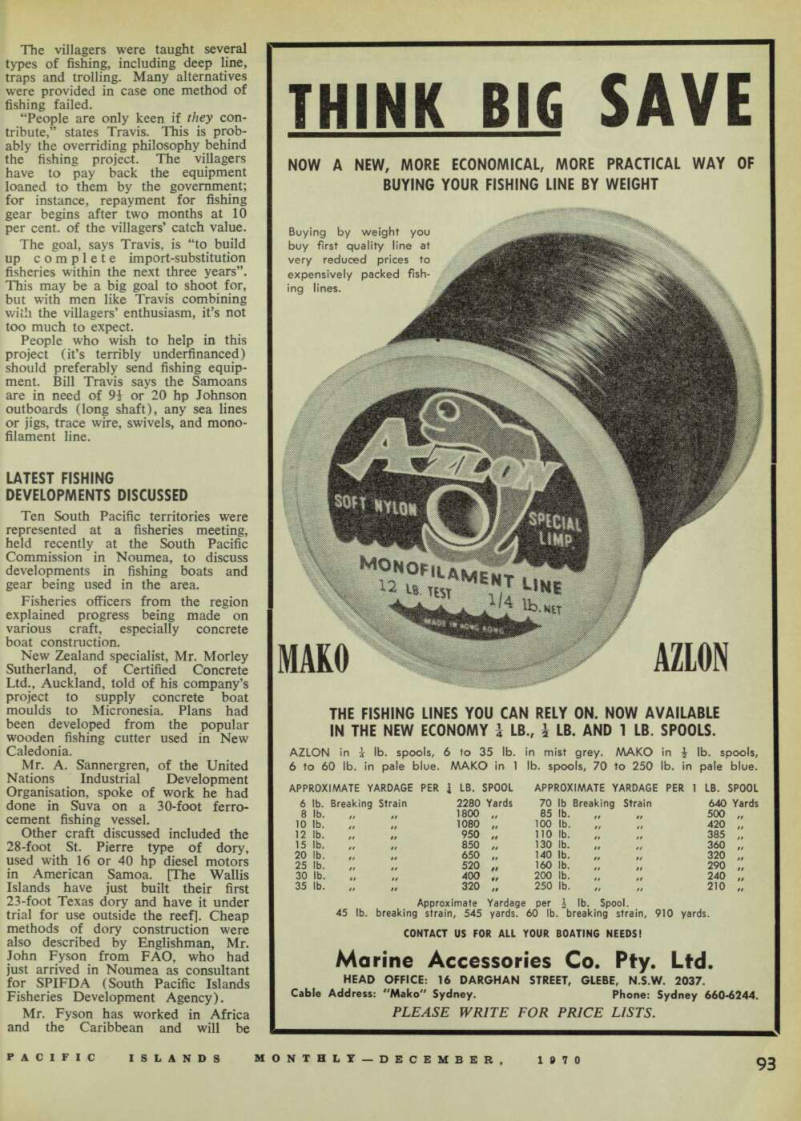
People who wish to help in this project (it’s terribly underfinanced) should preferably send fishing equip ment. Bill Travis says the Samoans are in need of 9i or 20 hp Johnson outboards (long shaft), any sea lines or jigs, trace wire, swivels, and mono filament line.
Latest Fishing
Developments Discussed
Ten South Pacific territories were represented at a fisheries meeting, held recently at the South Pacific Commission in Noumea, to discuss developments in fishing boats and gear being used in the area.
Fisheries officers from the region explained progress being made on various craft, especially concrete boat construction.
New Zealand specialist, Mr. Morley Sutherland, of Certified Concrete Ltd., Auckland, told of his company’s project to supply concrete boat moulds to Micronesia. Plans had been developed from the popular wooden fishing cutter used in New Caledonia.
Mr. A. Sannergren, of the United Nations Industrial Development Organisation, spoke of work he had done in Suva on a 30-foot ferro cement fishing vessel.
Other craft discussed included the 28-foot St. Pierre type of dory, used with 16 or 40 hp diesel motors in American Samoa. [The Wallis Islands have just built their first 2 3-foot Texas dory and have it under trial for use outside the reef]. Cheap methods of dory construction were also described by Englishman, Mr.
John Fyson from FAO, who had just arrived in Noumea as consultant for SPIFDA (South Pacific Islands Fisheries Development Agency).
Mr. Fyson has worked in Africa and the Caribbean and will be
available from Noumea to visit ter ritories interested in receiving advice for fishing vessel construction.
Another boat discussed—one which is being revived to popularity; —is the Western Samoan alia, described by the islands’ fisheries officer, Mr. Bill Travis (mentioned on p. 91). The twin-hulled alia, of traditional materials, was recommended for its multi-purpose usage, stability and low cost. A 30-foot twin-hulled vessel of this type, carrying a two ton payload and having a cruising speed of 9\ knots, was quoted as costing village craftsmen $3BO, including $3OO for the engine.
Mr. Travis claimed that such a craft, carrying a crew of seven, had proved particularly capable for many offshore fishing operations in all but the most severe weather.
The Tahitian bonitier tuna fishing boat also aroused considerable interest, and delegates recommended that SPIFDA consultant, Mr. Tyson, should study the possibility of having this boat improved and/or adopted for use in other territories. The use of live bait and pearl shell lures in tuna fishing was also discussed.
The operation of island fishermen’s associations was also considered, with US Peace Corps worker, Mr. A.
Banner, describing the activities of the Kia Island Fishermen’s Associa tion in Fiji.
Finally, an extensive report on this meeting is being sent to South Pacific governments.
"Thallo" In But
"Slidre Timur" Maybe Out
The Cook Islands were having ship ping troubles in November. The Seamen’s Union in New Zealand was alleged by Premier Albert Henry, of the Cooks, to have placed a ban on a ship he had chartered for three months, at $5OO a day, to carry building materials from NZ ports to Rarotonga.
On the bright side of the picture, however, was the earlier arrival of the Thallo (October 21) on charter for 12 months, to assist the Moana Roa ( PIM , Nov., p. 91).
Mr. Henry was in Auckland when his agent reported to him that a ban had been placed on the chartered Slidre Timur. He understood the union wanted another ship, the Lusan, to pick up the building materials.
Unless the Slidre Timur had some thing to do, the charter was going to cost $40,000. Delay in delivery of the materials could mean that hotels to service passengers arriving at Rarotonga’s airport, due to open in 1972, would not be ready in time.
The Thallo will be operated by a new company, the Cook Islands Ship ping Co., which is a partnership of Silk and Boyd Ltd., and Julian Hold ings Ltd., of New Zealand. She re ceived a big and warm welcome when she tied up at Rarotonga.
Serious Shipping
Delays In Moresby
Delays in getting their ships along side the wharf at Port Moresby is costing shipowners a fortune, accord ing to Captain Harry Mansson, a director of the Australia-West Pacific Line. Two AWP ships were held up in a queue early in November for
about 10 days, at a cost of $2,000 a day.
About 100 ft of the wharf at Port Moresby is under repair following an accident on August 14 when the Austasia Line’s Malaysia ran into it.
Normally the 700 ft wharf caters for two overseas ships at the same time, with one overhanging.
The two AWP ships affected were the Delos and Samos. The Delos arrived at Port Moresby early in November, to find a Bank Line ship and a Japanese ship ahead of it. The Delos was able to berth after four or five days, but then had to leave the wharf for a passenger liner.
When the Delos was able to get
back alongside to complete discharge, the Samos arrived, and while she was waiting for the Delos to leave, three more ships joined the queue. The Delos finally sailed on November 12, and the Samos on November 15.
Burns Philp were affected in two ways by the November delays to AWP. As AWP agents they were naturally concerned that their principals had to wait so long to start discharging, and a lot of their cargo, which included food and building materials for their own enterprises, was held up.
Captain Mansson considers that the P-NG Administration has its priorities wrong in relation to wharf building. The Administration spent a lot of money on a new wharf at Rabaul, which was “very good”, but the need was greater in Port Moresby.
Money spent on the Madang wharf could have been better applied to Port Moresby, he said.
Apart from the delays caused by the damaged wharf, shipowners also suffer delays at Port Moresby because of the narrow “T”-link from the wharf to the shore, and shortage of shed space.
Captain Mansson said that Captain G. Hawley, chairman of the P-NG Harbours Board, three years ago had suggested a scheme which would have overcome a lot of problems. This was to extend the wharf by 300 ft, reclaim land between the wharf and the shore, and build further storage sheds.
The extended wharf would cater for more ships, the reclaimed land would provide much easier access to sheds than the present T-link, and more sheds would allow cargo to be stored under cover. The work would be done in stages.
Captain Mansson said he was told the wharf extension would cost about $500,000, which was not a great deal in today’s context.
However, the Administration had spent money on expensive surveys, money which should have been diverted to improving current facilities.
Captain Mansson said that a reservation scheme at Port Moresby would probably help to overcome future delays as far as the Samos was concerned. If it was proved a ship had a certain delivery capacity a berth reservation could be made 15 days in advance, and on arrival the berth would be assured.
Unfortunately, the scheme could not be applied to the Samos on its November trip, as it was her first voyage, and she had to show her capacity. In future, with delivery capacity proved, a berth might be reserved for her.
The Delos does not have the re-
quired delivery capacity. Thus, she will always have to take her place in the queue till better facilities are available.
New Pacific Shipping
Services Aplenty
• The Orient Overseas Line, of Hong Kong, in mid-November intro duced a combined container and general cargo service from Australian east coast ports to the US west coast.
The first service, with Hong Kong Truth, was out of Brisbane, Port Kembla and Melbourne for Los Angeles, San Francisco and Van couver.
Future services from Australia will include Sydney. Port Kembla will not be on the regular schedule.
The other ships on the service will be the Hong Kong Beauty, scheduled to leave Australia mid-December, and Hong Kong Surety, scheduled to leave Australia mid-January.
The ships are equipped to carry about 250 containers. • The Swire group has launched a new Fiji-New Caledonia-Australia service with the China Navigation’s Taiyuan under charter, operating out of Suva every 21 days. The new service is in line with group policy of encouraging Australian export trade to the area.
The Taiyuan, a cargo-passenger ship, caters for 86 passengers. The Suva to Suva voyage includes five days in port—Suva, Lautoka, Noumea and Sydney.
On a proving cargo-passenger service to the Pacific from Sydney, the Taiyuan carried a full load of passengers, and on the second trip was 80 per cent. full.
If the success of the proving voyage continues, China Navigation will seriously consider putting a second ship on the run.
The service is under the control
of a newly registered Fiji company, Fiji-Australia Line Ltd., which is based in Suva. • The Pacific Islands Transport Line has increased its cargo carrying capacity in its US Pacific Coast- Pacific Islands service with the ad dition of the Thorsisle, 9,350 tons.
The Thorsisle will supplement exist ing services operated with the Thor 1 and the Thorsgaard.
The Thorsisle ( cx-Bonanza ) has a speed of 17 knots, and in addition to cargo capacity (including large refrigeration chambers) has accom modation for 12 passengers.
She is not the first ship to bear the name Thorsisle to operate in the Pacific trade. Pacific Islands Trans port were agents for another Thor sisle, which was withdrawn from the service in August, 1966. • The Oregon Pacific Line in mid-November inaugurated a three monthly general cargo service be tween Auckland and Chile direct, with the Ganja, 8,742 tons.
''West Star" Begins
South Pacific Cruises
Suva, Nukualofa, Apia, Pago Pago, Papeete, Moorea and Bora Bora are among the ports of call for a series of tourist cruises now being operated by a Seattle-based company, Westours Inc,, through a subsidiary, West Line.
The tourists travel in a Liberia registered liner, the West Star, 5,500 tons, which has accommodation for 240 passengers, and has 90 crew members. The programme, which began in November, and which will continue till March 24, will offer 42 different types of cruises. Captain is Adolfo Castillo Duenas.
A sister ship, the Pacific Star (ex- Polar Star ) will operate a series of cruises to some of the lesser known islands of French Polynesia.
MV "Thallo", on her inaugural visit to Rarotonga. See story p. 95.—Photo: John son's Studios.