Caves, Bones And Customs
pp. 61-63 · Read in the full issue

In The Trobriands
By D. K. Holdsworth
The main island of the Trobriand group, Kiriwina, was once a coral atoll. It was raised above sea level and the atoll formed the present island; the old lagoon is now a central swamp and the old reef is now a ring of hills which rise to about 150 feet. Caves were formed by a solution of the coral calcium carbonate at the water table and many still contain pools of fresh, clear water.
All the caves of the Trobriand Islands, in fact, are soon to be declared a national park to protect them for future generations.
Stalactites and stalagmites have long since decorated the interiors and to all intents and purposes the caves are identical to limestone caves. Bats frequent many of the larger ones and their excrement, guano, can be pro fuse.
Only one cave is decorative enough to be considered a potential tourist cave; it is far from the hotel and the long walk through the bush and the hazardous path over irregular sharp edged coral boulders would deter all but the bravest tourist.
Many caves are associated with myths and legends, and many, with fresh water near the entrances, are used as emergency water sources for the Trobriand villagers. The women and girls often walk three to five miles carrying a large assortment of claypots, bottles and pans to collect the water.
However in many villages the Ad ministration is now drilling to reach the water table —usually 30-50 ft below the surface—and connecting permanent hand pumps. So the long trek to the caves may soon subside, "in many caves we discovered human bones. It was not clear whether the bones were from the victims of inter-village wars or repre sented sacred burial.
Skulls, pelvises and limb bones predominate, the rib and smaller bones were conspicuously rare. Large
• Opposite page, the sacred cave of Selai, near Labai. According to legend, the mother of all the Trobriand Islanders lived here.
clam shells and occasional pieces of pottery were noted.
Austen (1939) reports of a Tro briand tradition to bury the dead and to later exhume them to transfer the bones, in pots or on a clam shell, into the caves. One clam shell we discovered in a cave contained the bones of a small child.
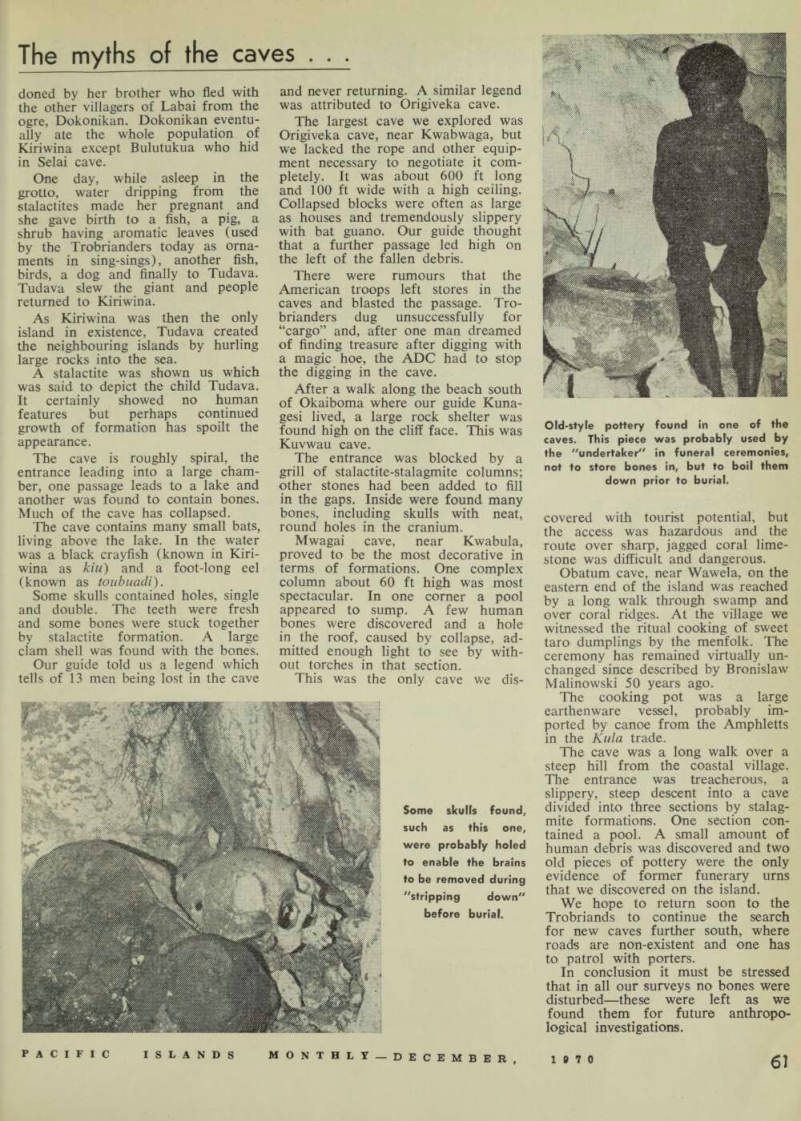
Some skulls had smooth, round holes in the crown and a few had two holes about two inches apart.
Our first impression was that they were formed by a blow from a nailed club or star club but the absence of radiating fractures did not support this theory.
Surgical trepanning seemed unlikely since there were no signs of healing in any. The most likely explanation seems to indicate drilling after death.
A probable explanation is that in the old days the custom was to bury the dead until the flesh decomposed and then dig up the bones and inter them (sometimes in a pot) in a cave.
If the deceased was important many men would gather to mourn him.
The task was considered to be both an honour and a duty.
As long as the ceremony lasted, close relatives of the dead person had to feed the mourners and re ward them with pemkwala —presents of pigs and other valuables. The giving of pemkwala was an honour but it could prove embarrassing if the ceremony lasted too long.
Instead of removing flesh by slow decomposition following burial the mourners rapidly stripped an im portant person with knives or axes, the bones then boiled and smoked.
Boiling pots were stored in the caves and there is the possibility that the
pots found in caves were not funeral urns but undertaker’s tools. The biggest obstacle to the rapid reduc tion of the body to bones is presented by the brain and it is probable that circular holes were drilled in the skull to enable the brains to be removed.
Our guides stated that the bones were of men “long before”. It was not apparent whether they meant long before their grandparents were bom or whether they were of a race of people overthrown by an invasion of the present Trobriand people.
They maintained the bones were those of giants, but they appeared to be of a similar size to those of the present Kiriwinians. The teeth ap peared well preserved and still white and did not appear to be more than 100 years old.
Here are the caves in detail: Selai cave, near Labai, is sacred to the Trobriand people and we be lieve that only about half-a-dozen Europeans had visited the cave before we did. A previous ADC told the people of Labai to charge Europeans £5 or £lO each to be shown the cave.
This had quite a discouraging effect on tourism.
The myth surrounding the cave concerns Tudava, a culture-hero who taught the Trobrianders the tech niques and magic of gardening. He distributed his knowledge according to the reception he received in each place, and this is why some lands only grow coconuts while others are rich in yams and other food crops.
His mother, Bulutukua, was aban-
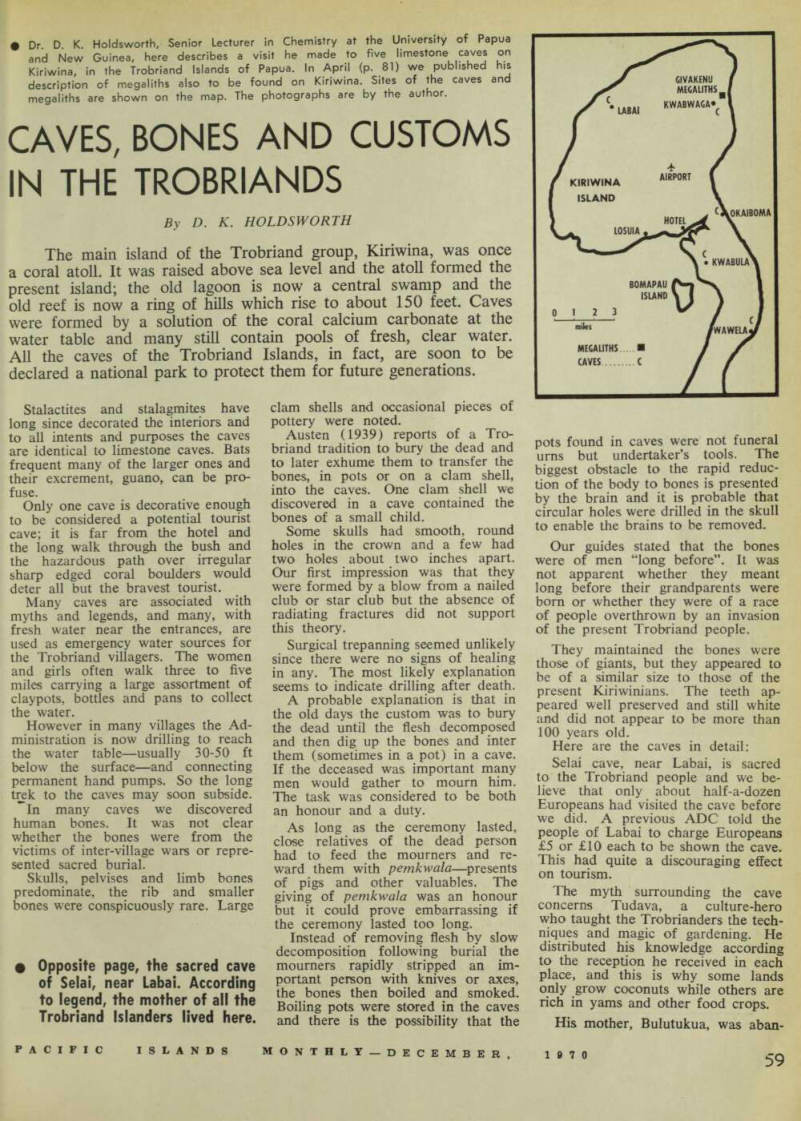
Dr. D. K. Holdsworth, Senior Lecturer in Chemistry at the University of Papua and New Guinea, here describes a visit he made to five limestone caves on Kiriwina, in the Trobriand Islands of Papua. In April (p. 81) we published his description of megaliths also to be found on Kiriwina. Sites of the caves and megaliths are shown on the map. The photographs are by the author.
The myths of the caves . . .
doned by her brother who fled with the other villagers of Labai from the ogre, Dokonikan. Dokonikan eventu ally ate the whole population of Kiriwina except Bulutukua who hid in Selai cave.
One day, while asleep in the grotto, water dripping from the stalactites made her pregnant and she gave birth to a fish, a pig, a shrub having aromatic leaves (used by the Trobrianders today as orna ments in sing-sings), another fish, birds, a dog and finally to Tudava.
Tudava slew the giant and people returned to Kiriwina.
As Kiriwina was then the only island in existence, Tudava created the neighbouring islands by hurling large rocks into the sea.
A stalactite was shown us which was said to depict the child Tudava.
It certainly showed no human features but perhaps continued growth of formation has spoilt the appearance.
The cave is roughly spiral, the entrance leading into a large cham ber, one passage leads to a lake and another was found to contain bones.
Much of the cave has collapsed.
The cave contains many small bats, living above the lake. In the water was a black crayfish (known in Kiri wina as kiu ) and a foot-long eel (known as toubuadi ).
Some skulls contained holes, single and double. The teeth were fresh and some bones were stuck together by stalactite formation. A large clam shell was found with the bones.
Our guide told us a legend which tells of 13 men being lost in the cave
and never returning. A similar legend was attributed to Origiveka cave.
The largest cave we explored was Origiveka cave, near Kwabwaga, but we lacked the rope and other equip ment necessary to negotiate it com pletely. It was about 600 ft long and 100 ft wide with a high ceiling.
Collapsed blocks were often as large as houses and tremendously slippery with bat guano. Our guide thought that a further passage led high on the left of the fallen debris.
There were rumours that the American troops left stores in the caves and blasted the passage. Tro brianders dug unsuccessfully for “cargo” and, after one man dreamed of finding treasure after digging with a magic hoe, the ADC had to stop the digging in the cave.
After a walk along the beach south of Okaiboma where our guide Kuna gesi lived, a large rock shelter was found high on the cliff face. This was Kuvwau cave.
The entrance was blocked by a grill of stalactite-stalagmite columns; other stones had been added to fill in the gaps. Inside were found many bones, including skulls with neat, round holes in the cranium.
Mwagai cave, near Kwabula, proved to be the most decorative in terms of formations. One complex column about 60 ft high was most spectacular. In one corner a pool appeared to sump. A few human bones were discovered and a hole in the roof, caused by collapse, ad mitted enough light to see by with out torches in that section.
This was the only cave we dis-
covered with tourist potential, but the access was hazardous and the route over sharp, jagged coral lime stone was difficult and dangerous.
Obatum cave, near Wawela, on the eastern end of the island was reached by a long walk through swamp and over coral ridges. At the village we witnessed the ritual cooking of sweet taro dumplings by the menfolk. The ceremony has remained virtually un changed since described by Bronislaw Malinowski 50 years ago.
The cooking pot was a large earthenware vessel, probably im ported by canoe from the Amphletts in the Kula trade.
The cave was a long walk over a steep hill from the coastal village.
The entrance was treacherous, a slippery, steep descent into a cave divided into three sections by stalag mite formations. One section con tained a pool. A small amount of human debris was discovered and two old pieces of pottery were the only evidence of former funerary urns that we discovered on the island.
We hope to return soon to the Trobriands to continue the search for new caves further south, where roads are non-existent and one has to patrol with porters.
In conclusion it must be stressed that in all our surveys no bones were disturbed—these were left as we found them for future anthropo logical investigations.
Some skulls found, such as this one, were probably holed to enable the brains to be removed during "stripping down" before burial.
Old-style pottery found in one of the caves. This piece was probably used by the "undertaker" in funeral ceremonies, not to store bones in, but to boil them down prior to burial.