Sudden silence
p. 57 · Read in the full issue
and then a roar . . .
• An earthquake with epicentre near Karkar Island, New Guinea, killed at least 10 New Guineans on October 31 in the Madang District, and caused damage worth hundreds of thousands of dollars.
The 'quake reached 8.5 on the Richter Scale —the highest reading since 8.1 at Rabaul in 1906.
Madang’s earthquake was a sobering reminder that New Guinea can still be a dangerous place to live.
The ’quake cut the multi-million dollar Seacom cable linking South- East Asia and Australia, and “lifted” parts of the ocean floor off Madang by up to a hundred feet. More than 500 water tanks were wrecked, and at the end of November, water sup plies were only just coming back to normal.
Here’s an account of what it was like from Madang’s John Graham: 3.45 A.M.—Slowly I came out of my deep sleep to the steady chop chop of an axe. The native boy next door must be going fishing and is preparing his early morning cuppa. 3.4 B.—Snatches from a pop-tune from the party just round the corner.
Must still be some beer in the keg and the regulars will not go home until it’s finished. 3.50.—1t’s just like a regular barn yard outside. The dog up the road is baying. There’s the flop-flop of the flying fox as it raids the papaw tree. The twitter of the night birds.
The distant roar as some party-owl races along Modilon Road well over the speed limit. 3.53.—The sudden silence is un canny. There is no movement. The birds have stopped twittering. The flying fox has stopped flapping. Even the dogs are silent. 3.55. —A deep rumble, not unlike thunder. Becoming louder. 3.56. —lt’s like riding a wild bronco! The bed is bouncing round the alcove! There’s a roar like an express train entering a tunnel. A crash as the electric stove comes hurtling across the room. The place is full of noise. 3.57. —Power off, lights out. The rumble fades in the distance. 3.59. Silence ... all I can hear is the sloshing of water in the tanks.
4.ol.—There’s a roar as the first car starts up and the town comes to life. The cry of a baby frightened in its sleep. The call of a neighbour to see if all is right. 4.03. —I grope for the torch. Damn.
I should have left it by the bed.
Blast! I stub my toe —the table must have moved. 4.04. —Glass all over the floor from the broken oven door. A few bottles have fallen over. 4.06.—A coconut from a tree 50 feet away has left a big dent in the shed roof. Tools are all over the floor. 4.08. —A very stiff whisky and to bed. 4.09. —The native boy starts chop ping wood again. 4.15.—1 drift back to sleep to the strains of The Yellow Submarine from the party up the road.
John Graham adds: In those first hours I doubt if many Madang people knew that they had just been through a record ’quake. Many actually slept through the lot. Dozens, like myself after a quick look round, were back to slumberland within minutes. Some were terrified and raced for open ground not to return until daylight.
Two lads from a building firm were fishing from the shoreline rocks: They said the ’quake seemed to be upon them in no time and they just had to sit there bouncing round in the coral. Thinking of tidal waves, it was
n()t long before they were scrambling to higher ground-in time to see a four-foot wave racing out of the calm sea to crash on the spot they had j ust vacated> They were left a s t un ned 13i lb cod—their only catch f° r tbe n i§ bt - Many were the stories that were passed round of personal losses. Of wedd i n g presents nursed half way round the world only to be dashed to pieces in that 90 seconds of terror.
Stories of Mrs . A losing eve rything while Mrs. B. next door did not even have a magazine displaced from the lounge room table, Many were the quick business deals, to lease new premises. It was to be “business as usual”. One airline employee announced he still had some seats on the 9.30 “earthquake special” going south, as he sat at his desk amid a pile of broken bricks, The Seacom Cable remained out for three weeks.
Most of the dead New Guineans were caught in falling houses or landslides not far from Madang, while three died when a big wave overturned their canoe at sea.
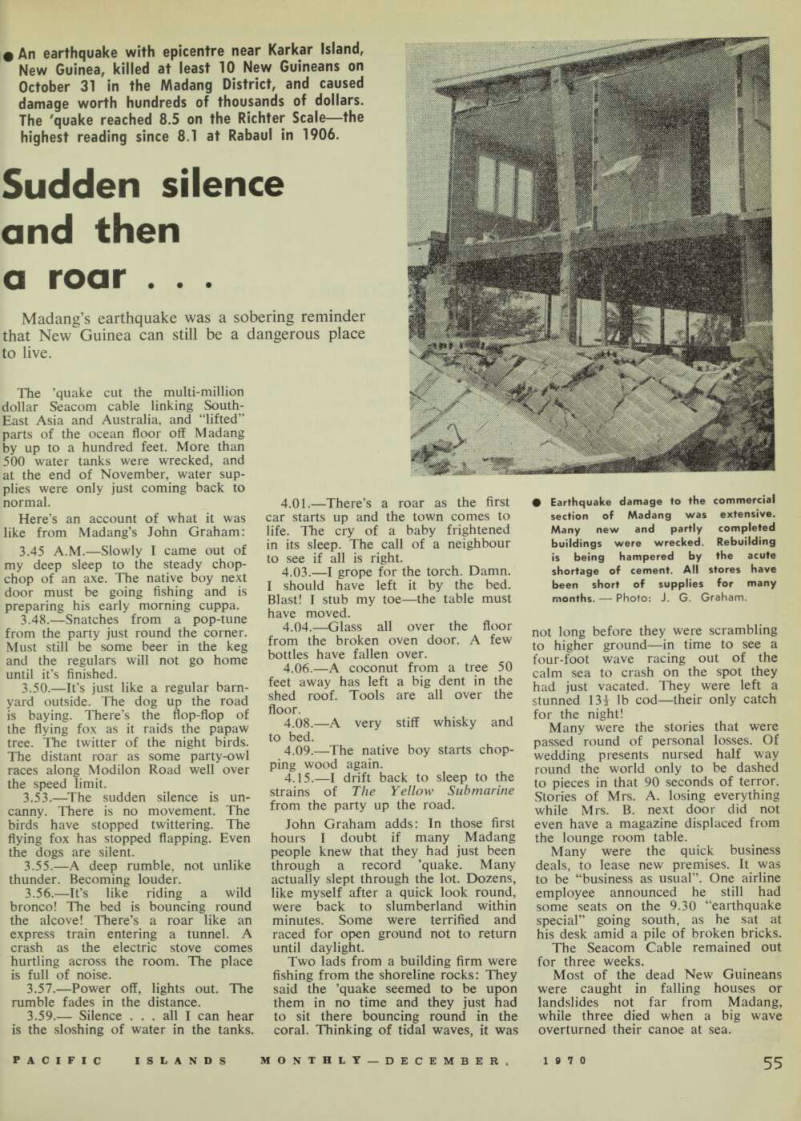
Earthquake damage to the commercial section of Madang was extensive.
Many new and partly completed buildings were wrecked. Rebuilding is being hampered by the acute shortage of cement. All stores have been short of supplies for many months. -Photo: J. G. Graham.