By raft across the Pacific
pp. 34-35 · Read in the full issue
Early one morning in November a searching aircraft from the Queensland coast circled a raft with four men aboard, and dropped an empty bottle with a slip of paper saying, “Welcome to Australia!” The trans-Pacific raft, La Balsa, had now been sighted. A day or two later, on November 6, it reached Australia—l6o days and 8,564 miles out of Ecuador.
It was a feat of endurance and courage, undertaken by the four men to satisfy themselves that a raft built as the early South American Indians built rafts (without metal) could cross the Pacific. The feat was acclaimed world wide. And the men—a likeable bunch of good-tempered fellows who survived the five months’ journey without a squabble—stand to make some money out of the venture. Newspaper rights to their story were promptly sold for $60,000 to Sydney newspaper publishers John Fairfax and Sons, and Captain Vital Alsar, 37, who organised and led the drift, will produce his own book.
For the first detailed report, Sydney Morning Herald writer and author, Gavin Souter (among his books is New Guinea: The Last Unknown), spent several days interviewing the four. His main informant was Captain Alsar.
Alsar, who once served as a lieutenant with the Spanish Legion, was born in a Spanish fishing town and was in spired to make his journey by the voyage of the Kon-Tiki. He was navigator and radio operator of La Balsa. The raft had no auxiliary motor. Alsar had been with Marc Modena on the Pacifica, a balsa raft which in 1966 drifted from Guayaquil, Ecuador, to the Galapagos before sinking. They had been aiming at Australia on that occasion.
Modena, 44, the eldest of the four on La Balsa, is a Frenchman, a former signaller in the French Navy, who manages a restaurant in Montreal. In 1956 he was one of the crew of a red cedar raft which crossed the Atlantic from Nova Scotia to England. The other two on La Balsa were Gabriel Salas, 27, a Chilean geologist, and Norman Tetreault, 26, the youngest, a French-Canadian industrial designer, who is also an amateur parachutist.
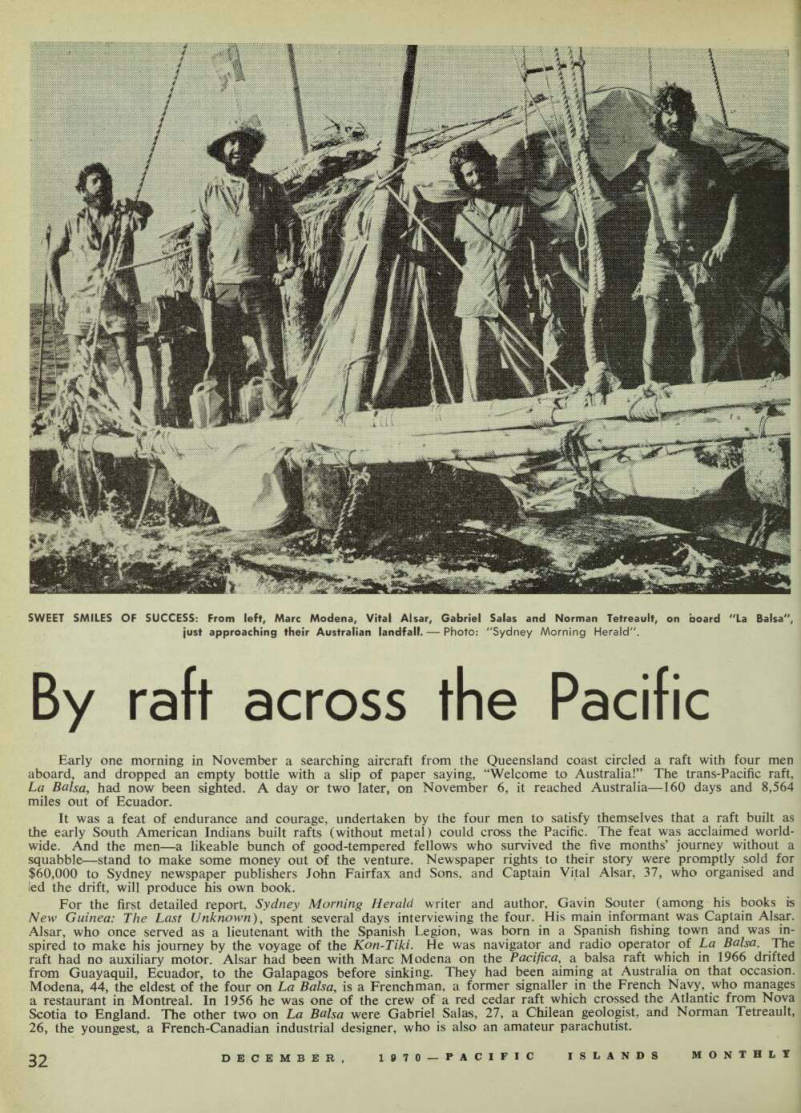
SWEET SMILES OF SUCCESS: From left, Marc Modena, Vital Alsar, Gabriel Salas and Norman Tetreault, on board "La Balsa", just approaching their Australian landfall. -Photo: "Sydney Morning Herald".
The story began in the town of Guayaquil in Ecuador, where the men assembled the raft. The right kind of balsa was found in the Andean foothills and four miles of local manila rope went into binding the seven 24 ft logs together, without any metal support.
Following traditional South American Indian design, a frond covered hut was built on deck to bouse the crew and supplies. The 28 ft mast was of bamboo and the 20 ft square sail made from local woven cotton. At weekends, the four dso hoisted a small piece of plastic covered canvas on which surrealist irtist Salvador Dali had painted an insignia for the voyage. The main sail lesign was painted by Vital himself.
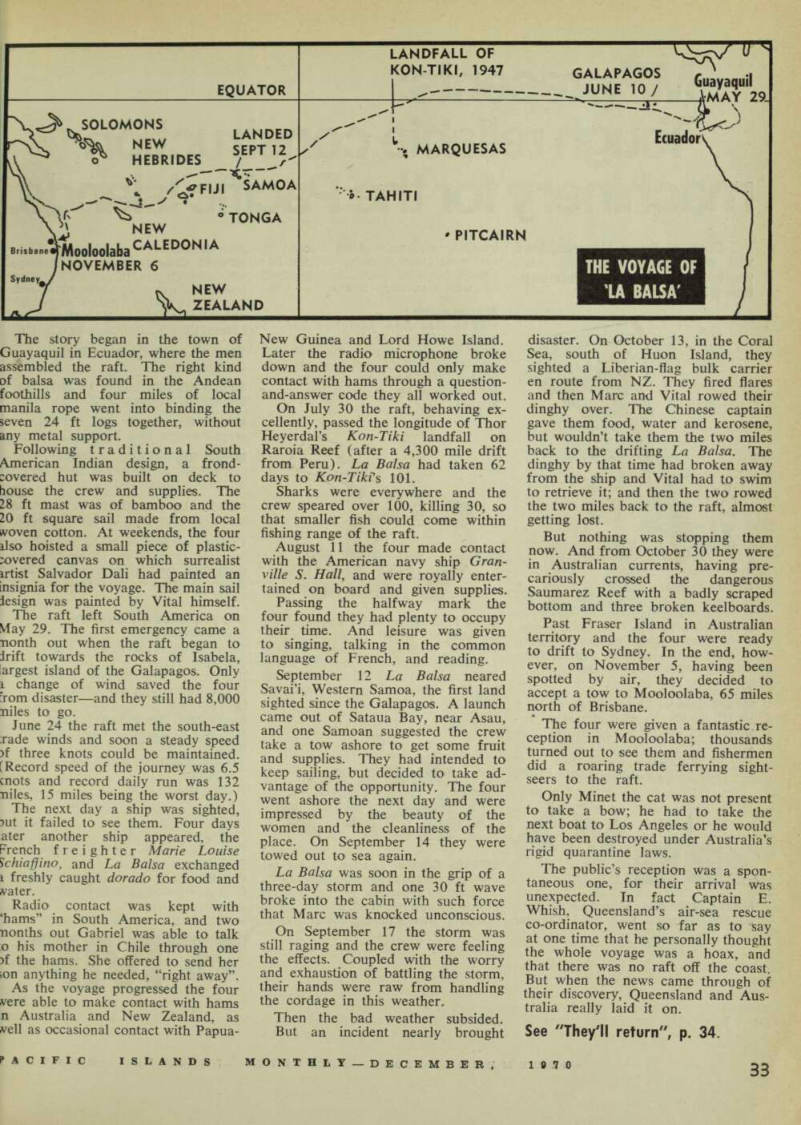
The raft left South America on May 29. The first emergency came a nonth out when the raft began to drift towards the rocks of Isabela, largest island of the Galapagos. Only i change of wind saved the four :rom disaster—and they still had 8,000 niles to go.
June 24 the raft met the south-east rade winds and soon a steady speed )f three knots could be maintained. [Record speed of the journey was 6.5 cnots and record daily run was 132 niles, 15 miles being the worst day.) The next day a ship was sighted, ?ut it failed to see them. Four days ater another ship appeared, the French freighter Marie Louise Schiaffino, and La Balsa exchanged i freshly caught dorado for food and water.
Radio contact was kept with ‘hams” in South America, and two nonths out Gabriel was able to talk o his mother in Chile through one )f the hams. She offered to send her ;on anything he needed, “right away”.
As the voyage progressed the four were able to make contact with hams n Australia and New Zealand, as well as occasional contact with Papua-
New Guinea and Lord Howe Island.
Later the radio microphone broke down and the four could only make contact with hams through a question and-answer code they all worked out.
On July 30 the raft, behaving ex cellently, passed the longitude of Thor Heyerdal’s Kon-Tiki landfall on Raroia Reef (after a 4,300 mile drift from Peru). La Balsa had taken 62 days to Kon-Tiki' s 101.
Sharks were everywhere and the crew speared over 100, killing 30, so that smaller fish could come within fishing range of the raft.
August 11 the four made contact with the American navy ship Gran ville S. Hall, and were royally enter tained on board and given supplies.
Passing the halfway mark the four found they had plenty to occupy their time. And leisure was given to singing, talking in the common language of French, and reading.
September 12 La Balsa neared Savai’i, Western Samoa, the first land sighted since the Galapagos. A launch came out of Sataua Bay, near Asau, and one Samoan suggested the crew take a tow ashore to get some fruit and supplies. They had intended to keep sailing, but decided to take ad vantage of the opportunity. The four went ashore the next day and were impressed by the beauty of the women and the cleanliness of the place. On September 14 they were towed out to sea again.
La Balsa was soon in the grip of a three-day storm and one 30 ft wave broke into the cabin with such force that Marc was knocked unconscious.
On September 17 the storm was still raging and the crew were feeling the effects. Coupled with the worry and exhaustion of battling the storm, their hands were raw from handling the cordage in this weather.
Then the bad weather subsided.
But an incident nearly brought
disaster. On October 13, in the Coral Sea, south of Huon Island, they sighted a Liberian-flag bulk carrier en route from NZ. They fired flares and then Marc and Vital rowed their dinghy over. The Chinese captain gave them food, water and kerosene, but wouldn’t take them the two miles back to the drifting La Balsa. The dinghy by that time had broken away from the ship and Vital had to swim to retrieve it; and then the two rowed the two miles back to the raft, almost getting lost.
But nothing was stopping them now. And from October 30 they were in Australian currents, having pre cariously crossed the dangerous Saumarez Reef with a badly scraped bottom and three broken keelboards.
Past Fraser Island in Australian territory and the four were ready to drift to Sydney. In the end, how ever, on November 5, having been spotted by air, they decided to accept a tow to Mooloolaba, 65 miles north of Brisbane.
The four were given a fantastic re ception in Mooloolaba; thousands turned out to see them and fishermen did a roaring trade ferrying sight seers to the raft.
Only Minet the cat was not present to take a bow; he had to take the next boat to Los Angeles or he would have been destroyed under Australia’s rigid quarantine laws.
The public’s reception was a spon taneous one, for their arrival was unexpected. In fact Captain E.
Whish, Queensland’s air-sea rescue co-ordinator, went so far as to say at one time that he personally thought the whole voyage was a hoax, and that there was no raft off the coast.
But when the news came through of their discovery, Queensland and Aus tralia really laid it on.
See "They'll return", p. 34.