Pacific Islands Monthly
pp. 27-29 · Read in the full issue
Despite The Politics, Life Can
Still Be Fun In Tahiti
By Judy Tudor
People who went to Tahiti in November expecting red, raw revolution to be breaking out all over ;he place must have been disappointed. Contrary to what one might have expected from newspaper reports, Mr. Sanford was not storming the local equivalent of the Bastille; nor were the Governor md other French officials being carted off to the guillotine in tumbrils.
Although, presumably, the pro agonists were still seething away ;omewhere behind their barricades, m the surface all was as usual, apart Torn the red-white-and-blue Polynesia 17 rancaise and vive la France stickers >f the opposition, which wants the 'tatus quo maintained; and the flag lisplay of the autonomists just out ;ide Papeete town centre.
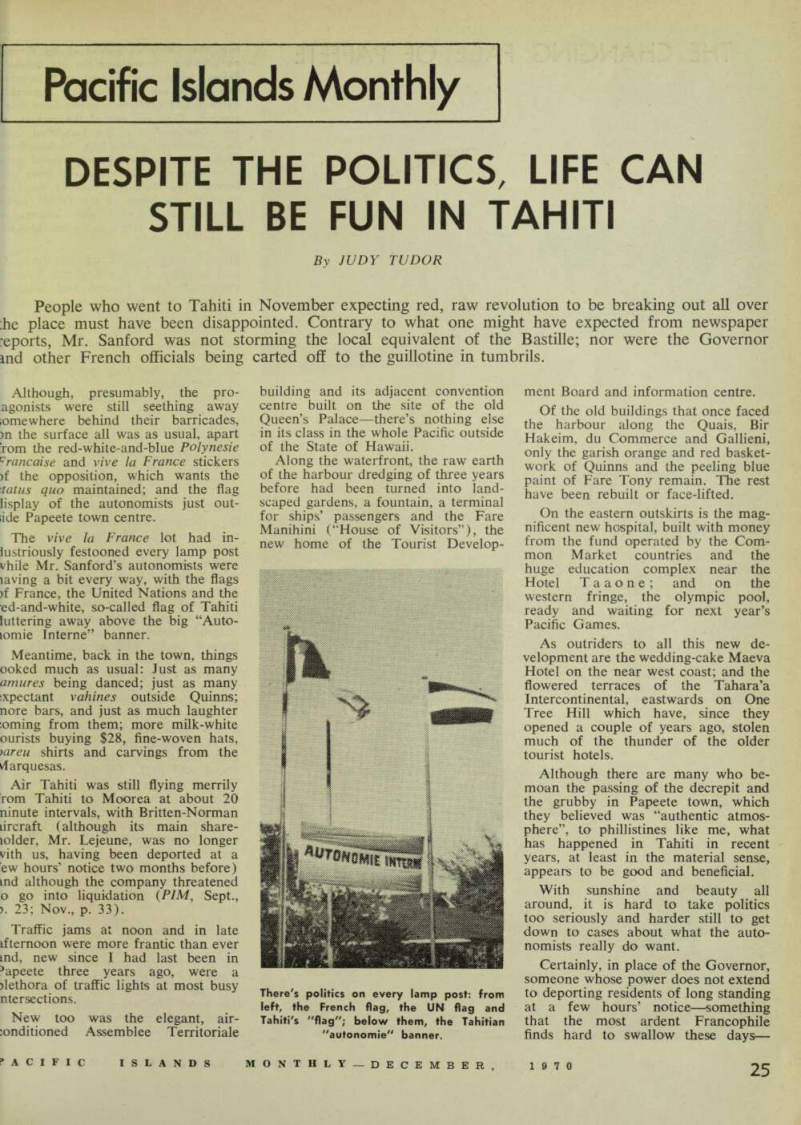
The vive la France lot had in lustriously festooned every lamp post vhile Mr. Sanford’s autonomists were laving a bit every way, with the flags if France, the United Nations and the ed-and-white, so-called flag of Tahiti luttering away above the big “Auto lomie Interne” banner.
Meantime, back in the town, things ooked much as usual: Just as many amures being danced; just as many :xpectant vahines outside Quinns; nore bars, and just as much laughter ;oming from them; more milk-white ourists buying $2B, fine-woven hats, yareu shirts and carvings from the Marquesas.
Air Tahiti was still flying merrily fom Tahiti to Moorea at about 20 ninute intervals, with Britten-Norman lircraft (although its main share lolder, Mr. Lejeune, was no longer vith us, having been deported at a ew hours’ notice two months before) ind although the company threatened o go into liquidation ( PIM , Sept., ). 23; Nov., p. 33).
Traffic jams at noon and in late iftemoon were more frantic than ever ind, new since I had last been in s apeete three years ago, were a jlethora of traffic lights at most busy ntersections.
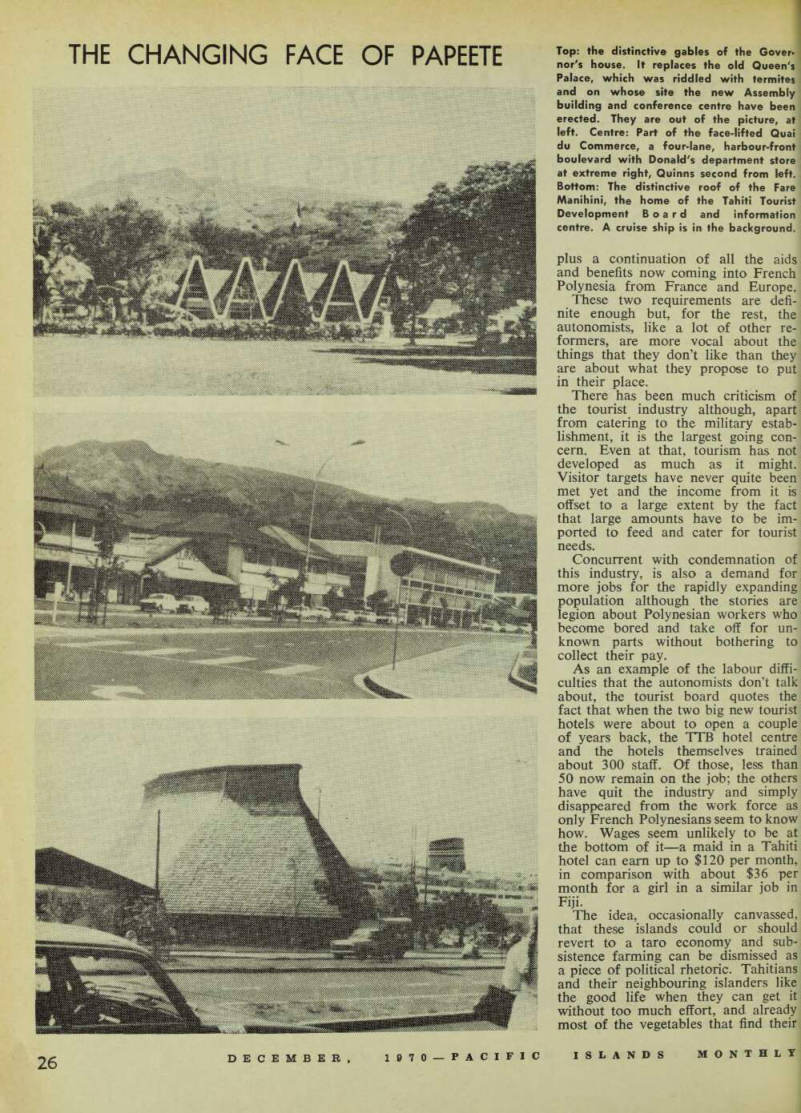
New too was the elegant, air :onditioned Assemblee Territoriale
building and its adjacent convention centre built on the site of the old Queen’s Palace—there’s nothing else in its class in the whole Pacific outside of the State of Hawaii.
Along the waterfront, the raw earth of the harbour dredging of three years before had been turned into land scaped gardens, a fountain, a terminal for ships’ passengers and the Fare Manihini (“House of Visitors”), the new home of the Tourist Develop-
ment Board and information centre.
Of the old buildings that once faced the harbour along the Quais, Bir Hakeim, du Commerce and Gallieni, only the garish orange and red basket work of Quinns and the peeling blue paint of Fare Tony remain. The rest have been rebuilt or face-lifted.
On the eastern outskirts is the mag nificent new hospital, built with money from the fund operated by the Com mon Market countries and the huge education complex near the Hotel Taao n e ; and on the western fringe, the Olympic pool, ready and waiting for next year’s Pacific Games.
As outriders to all this new de velopment are the wedding-cake Maeva Hotel on the near west coast; and the flowered terraces of the Tahara’a Intercontinental, eastwards on One Tree Hill which have, since they opened a couple of years ago, stolen much of the thunder of the older tourist hotels.
Although there are many who be moan the passing of the decrepit and the grubby in Papeete town, which they believed was “authentic atmos phere”, to phillistines like me, what has happened in Tahiti in recent years, at least in the material sense, appears to be good and beneficial.
With sunshine and beauty all around, it is hard to take politics too seriously and harder still to get down to cases about what the auto nomists really do want.
Certainly, in place of the Governor, someone whose power does not extend to deporting residents of long standing at a few hours’ notice—something that the most ardent Francophile finds hard to swallow these days—
There's politics on every lamp post: from left, the French flag, the UN flag and Tahiti's "flag"; below them, the Tahitian "autonomie" banner.
plus a continuation of all the aids and benefits now coming into French Polynesia from France and Europe.
These two requirements are defi nite enough but, for the rest, the autonomists, like a lot of other re formers, are more vocal about the things that they don’t like than they are about what they propose to put in their place.
There has been much criticism of the tourist industry although, apart from catering to the military estab lishment, it is the largest going con cern. Even at that, tourism has not developed as much as it might.
Visitor targets have never quite been met yet and the income from it is offset to a large extent by the fact that large amounts have to be im ported to feed and cater for tourist needs.
Concurrent with condemnation of this industry, is also a demand for more jobs for the rapidly expanding population although the stories are legion about Polynesian workers who become bored and take off for un known parts without bothering to collect their pay.
As an example of the labour diffi culties that the autonomists don’t talk about, the tourist board quotes the fact that when the two big new tourist hotels were about to open a couple of years back, the TTB hotel centre and the hotels themselves trained about 300 staff. Of those, less than 50 now remain on the job; the others have quit the industry and simply disappeared from the work force as only French Polynesians seem to know how. Wages seem unlikely to be at the bottom of it—a maid in a Tahiti hotel can earn up to $l2O per month, in comparison with about $36 per month for a girl in a similar job in Fiji.
The idea, occasionally canvassed, that these islands could or should revert to a taro economy and sub sistence farming can be dismissed as a piece of political rhetoric. Tahitians and their neighbouring islanders like the good life when they can get it without too much effort, and already most of the vegetables that find their
They insist their bombs are clean'
way into Papeete and other markets ire grown by Chinese who also have i dominant role in the territory’s jecond agricultural industry, the growing of vanilla. Copra production, now almost entirely from small holders, has been declining in recent pears.
Pet political hate, of course, is the activity of the Centre d’Experimenta ions du Pacifique (CEP) and its nuclear tests, although boom times :ame to French Polynesia with them.
Phe real boom was in the building jp period from 1963 to 1966/1967 when the first firings were made.
Since then it has been a waxing and waning affair, building up to a climax isually each mid-year when the tests ook place.
The last test was in August this pear and no one knows when, or f, there will be another but the nilitary establishment that has been milt in Papeete and its environs be cause of nuclear tests is considerable md in the last half-dozen years has men a predominant factor in the ocal economy.
In the climate of world bomb lysteria that has prevailed for the ast 25 years, protests over France’s ests were inevitable. Whenever they ook like detonating anything, screams >f anguish go up all over the Pacific rom Japan to New Zealand and, xaturally, local protestors have been juick to make political and emotional capital out of it. To such an extent hat, in the public relations sense, they argely nullify the efforts of the french to prove through the labora ory about 10 miles outside Papeete, hat their experiments are relatively larmless.
The establishment of the Departe nent de la Protection Sanitaire cost he equivalent of SUS 2 million, em >loys 11 European scientists and echnicians and 13 Polynesian assis ants, plus a lot of sophisticated, mtomatic equipment that feeds data nto computers 24 hours a day. Its indings over the last five years have convinced other scientists, United Nations authorities and the French hemselves. But it hasn’t convinced :ome local politicians who profess to mlieve that the findings are faked.
I spent two hours in the laboratory me Saturday in November, part of he time being lectured by the lirector, an ebullient Frenchman lamed Roger, rather like a jolly version of Yul Brunner, as to why French bombs are now clean. (They ire detonated in the atmosphere while suspended from a balloon and the
fallout is swooshed up to god-knows where and dissipated.) Being already convinced that all ban-the-bombers are nuts, I was easily persuaded by Mr. Roger that I’ve more to fear from an X-ray, or even the luminous dial of my watch, than from nuclear fallout in the Pacific.
And, if my French and the in terpreter’s English were equal to it, I think I was told that, if you feed a mouse in front of a TV screen it’s likely to die within a week from the effects of radiation. (The moral of that seems to be that, if you are very small, don’t go in for TV dinners.) The laboratory maintains 24 col lecting stations throughout French Polynesia and from these, samples of every kind of food eaten in those areas are taken regularly for testing.
At the laboratory great piles of taro, fish, coconut, fruits, shrimps, meat, milk and even dog (which some Poly nesians fancy) are chopped up, de hydrated in huge ovens, desiccated to ash in others, ground to a powder and reduced to fit into a container no larger than a small biscuit, fed into lead-lined contraptions and their elements broken down, tested, plotted, graphed and recorded in the memory bank of a computer. The small boxes are then stored in an air-conditioned room—thousands and thousands of them collected and dating from away
back before nuclear testing began in 1966.
Outside in a huge caravan, brought from the Sahara in 1966, entombed in a lead coffin for half an hour (but with music laid on), man also can be tested for his radio-active level and has shown that people from Europe normally have a level five times greater than that of anyone in the Pacific.
French hospitality didn’t, thank God, extend to an invitation to try it out. Instead we returned to the director’s office for some pleasant conversation and ice-cold champagne.
Good PR? Brain-washing? Possibly.
But after the minced dog, chopped fish and that musical lead coffin, very easy to take . . .
Although this and the military and para-military establishments that have developed since the tests began look permanent, the future is in some doubt. If testing ends and the military withdraw wholly or even in part, they will leave behind in French Poly nesia a vacuum that not even the tourist industry has a hope of filling.
So far, although the autonomists are fond of the “why don’t they’’ gambit, neither they nor anyone else has come up with any sure-fire, permanent solution to the territory’s economic problems and that, in the final analysis, is far more important to the individual inhabitant of these beautiful islands than what sort of relationship French Polynesia ulti mately has with metropolitan France.