Up Front
pp. 5-6 · Read in the full issue
with the Editor
Fred Hargesheimer is back on New Britain, this time with his wife Dorothy, and for a decent stretch of time. He and Dorothy are living for the next 12 months at the school that Fred built, returning o the United States in 1972.
They’ll build a house at Ewasse, md Fred hopes also to develop a jlantation, and teach maths at the Mrmen’s Memorial School, and Dorothy will assist the teachers with i library and other things.
Fred’s story has been told in PIM, n parts, as it has happened, over he years. A lot of people have no loubt seen at the same time stories n the newspapers about what Fred s doing in New Guinea—most of hem highly coloured reports, placing ill the stress on his wartime ex >eriences. They certainly make a ;ood story.
Fred Hargesheimer, in June, 1943, yas a major with the US Air Force, (iloting a plane which was shot lown over eastern New Britain. He »arachuted into dense rain forest, urvived for more than a month •n three chocolate bars, roots, iamboo shoots and snails until he yas found by natives, who took him o their village of Nantambu, nursed nm back to health, and hid him men Japanese patrols were out.
In November they guided him to ; secret camp set up by Australian .oastwatchers, from where, in Feb uary 1944, a US submarine took nm off. , Bac k in the States, where today -red Hargesheimer is a sales engineer /ith Univac, Fred didn’t forget. He aid his own expenses in 1960 to 0 back to Nantambu and say thank ou to the villagers who had saved iis life. It occurred to him while acre that the villagers needed more Tactical thanks than that and he leaded to build them a school. Back a the States he founded the Air men’s Nantambu Memorial Founda lon, and set out to raise money.
Iniong those whose help he enlisted 1 fnis part of the world was Air ice-Marshal Bill Townsend, whom e had first met in that New Britain angle camp.
It took Fred three years to raise
$3,000, and that was enough for him to start building the school—much of it with his own hands—in 1963.
It opened in 1964 at Ewasse, next door to Nantambu, with 85 children.
It has kept enlarging. Thanks to the help of Townsend the RAF Escaping Society built dormitories in 1966. A hospital was built in 1969.
School enrolment is now more than 200. It has a staff, a sawmill and other machinery to help it become self-sufficient in its building pro gramme. And it has two long govern ment leases on nearby land—one of 280 acres for cocoa, and one for 625 acres of virgin timberland.
The cocoa land is being cleared— it is one of the many jobs that Fred
is involved in—and the plan is that proceeds from cocoa sales should be made to cover the running expenses of the school and the hospital in about five years.
Thanks to the existence of the school, the area now has an airstrip and a regular air service from Rabaul. Such a trip used to take 16 hours by small ship or four days if you were going by dug-out canoe.
Until the plantations and the timber lease get going, the school still needs money, and Americans are
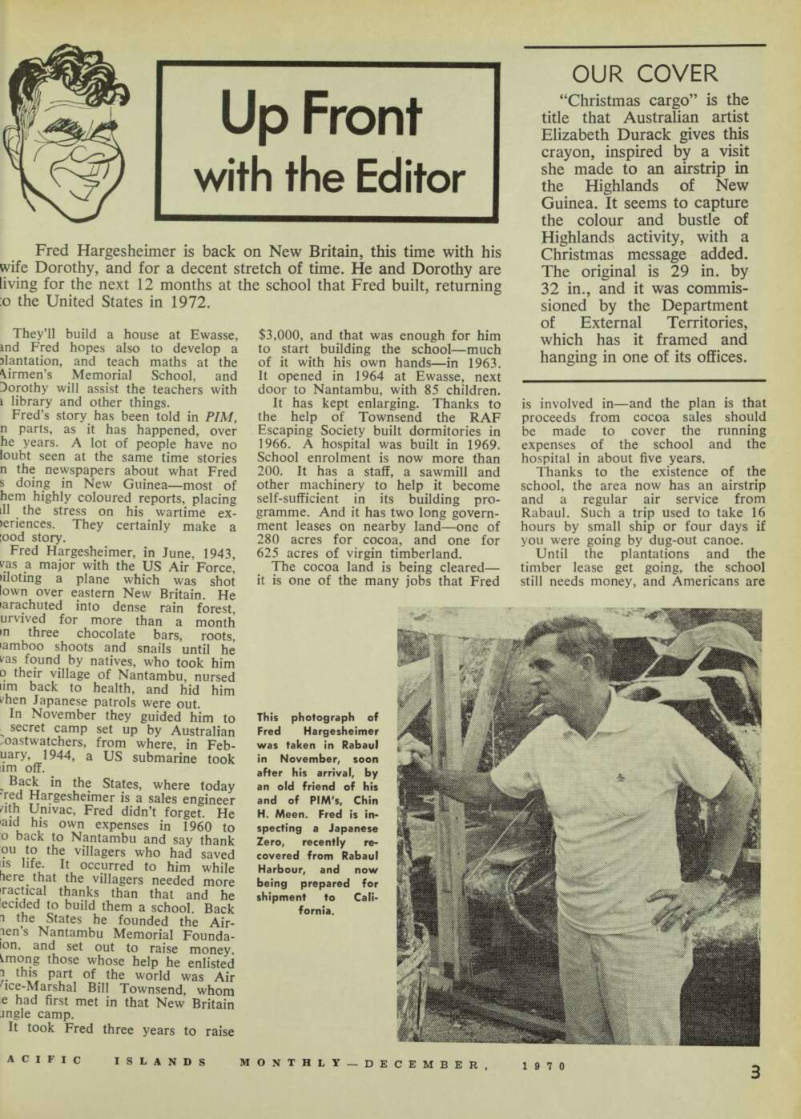
This photograph of Fred Hargesheimer was taken in Rabaul in November, soon after his arrival, by an old friend of his and of PIM's, Chin H. Meen. Fred is in specting a Japanese Zero, recently re covered from Rabaul Harbour, and now being prepared for shipment to Cali fornia.
still being encouraged to send their dollars to the foundation (which, in the States is a recognised, non-profit charity) to the First State Bank, White Bear Lake, Minnesota.
I’ve known Fred since his first visit to New Guinea in 1960. And later I met Dorothy. Like all of us, I was impressed with a man who decided to go back and say thanks.
After having met him, I felt in no doubt that he would get his school started. But having got it off the ground, would he continue his personal interest, or would he slowly be submerged under the pressure of his own substantial career?
Fred Hargesheimer did not allow himself to be submerged. He has the same enthusiasm for the task today as 10 years ago when he first went back to say thanks. He has in fact got two careers —his business career and his career with Airmen’s Memorial School. His enthusiasm has long since fully involved Dorothy and their three children. Dick, one of the two boys, has with his own hands helped his father build that school (they laid the first foundation).
Dorothy has been with him all the way, running a home on the one hand and being involved with the development at Ewasse on the other.
Here are two well-balanced people who are doing a job on the other side of the world simply because they decided it needed doing. And to do it they have had to overcome an extraordinary number of difficulties, many of them created by the distance between Minnesota and New Britain.
But they have kept the foundation running and expanding because they were prepared to spend their own time, and what little of their own money they had, on visits to the heart of it all.
I know of no greater story of dedication in the Pacific, and dedica tion which is performed cheerfully, than the story of Fred and Dorothy Hargesheimer. Thus I confess to being a little irritated at the super ficial newspaper about Fred’s original wartime experience, because that isn’t the point of the Harge sheimer story any more. When Fred was younger there was a war on, and everybody did what had to be done. Fred did more than many at that time, but it is the 25 years since, and especially the last 10 years developing the foundation, that have really shown what manner of man he is.
It’s in the long haul that Fred Hargesheimer triumphs, and he and Dorothy are Americans with a faith, humanity and perseverance that puts most of us in the shade.
Stuart Inder