Business and Development
pp. 108-114 · Read in the full issue
Help coming for Fiji's rural workers
From SUE WENDT, in Suva
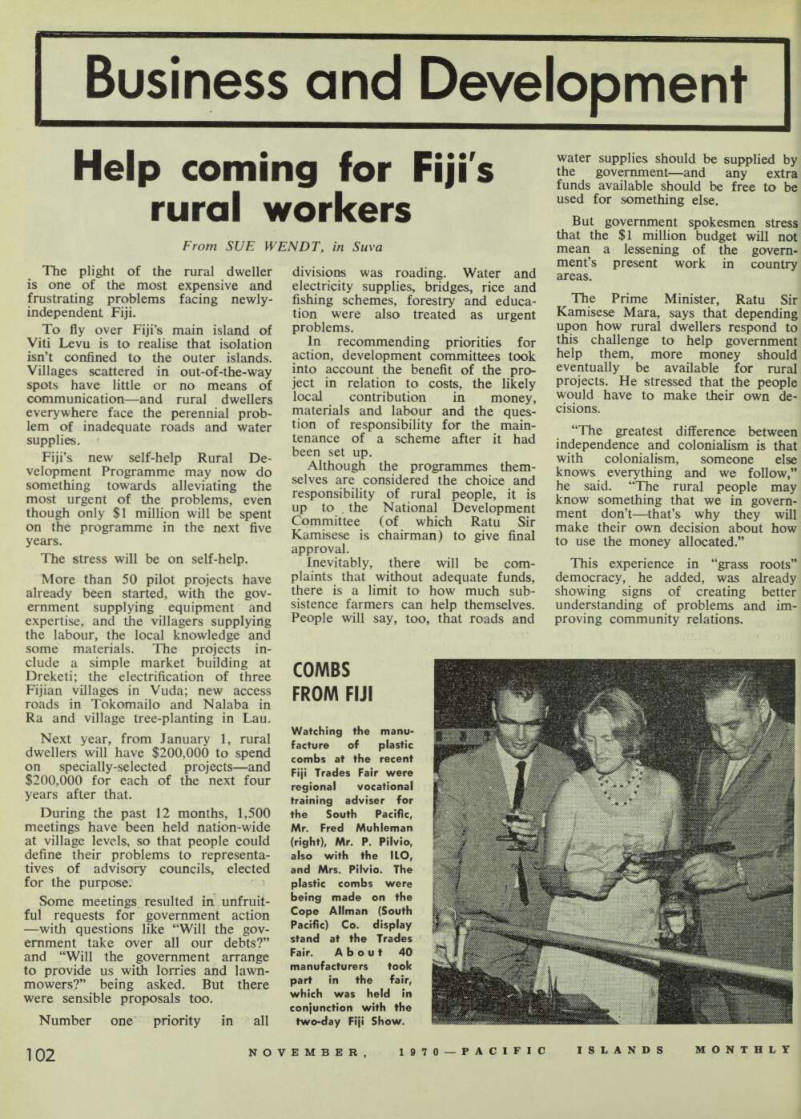
The plight of the rural dweller is one of the most expensive and frustrating problems facing newly independent Fiji.
To fly over Fiji’s main island of Viti Levu is to realise that isolation isn’t confined to the outer islands.
Villages scattered in out-of-the-way spots have little or no means of communication—and rural dwellers everywhere face the perennial prob lem of inadequate roads and water supplies.
Fiji’s new self-help Rural De velopment Programme may now do something towards alleviating the most urgent of the problems, even though only $1 million will be spent on the programme in the next five years.
The stress will be on self-help.
More than 50 pilot projects have already been started, with the gov ernment supplying equipment and expertise, and the villagers supplying the labour, the local knowledge and some materials. The projects in clude a simple market building at Dreketi; the electrification of three Fijian villages in Vuda; new access roads in Tokomailo and Nalaba in Ra and village tree-planting in Lau.
Next year, from January 1, rural dwellers will have $200,000 to spend on specially-selected projects—and $200,000 for each of the next four years after that.
During the past 12 months, 1,500 meetings have been held nation-wide at village levels, so that people could define their problems to representa tives of advisory councils, elected for the purpose.
Some meetings resulted in unfruit ful requests for government action —with questions like “Will the gov ernment take over all our debts?” and “Will the government arrange to provide us with lorries and lawn mowers?” being asked. But there were sensible proposals too.
Number one priority in all
divisions was roading. Water and electricity supplies, bridges, rice and fishing schemes, forestry and educa tion were also treated as urgent problems.
In recommending priorities for action, development committees took into account the benefit of the pro ject in relation to costs, the likely local contribution in money, materials and labour and the ques tion of responsibility for the main tenance of a scheme after it had been set up.
Although the programmes them selves are considered the choice and responsibility of rural people, it is up to . the National Development Committee (of which Ratu Sir Kamisese is chairman) to give final approval.
Inevitably, there will be com plaints that without adequate funds, there is a limit to how much sub sistence farmers can help themselves.
People will say, too, that roads and
water supplies should be supplied by the government—and any extra funds available should be free to be used for something else.
But government spokesmen stress that the $1 million budget will not mean a lessening of the govern ment’s present work in country areas.
The Prime Minister, Ratu Sir Kamisese Mara, says that depending upon how rural dwellers respond to this challenge to help government help them, more money should eventually be available for rural projects. He stressed that the people would have to make their own de cisions.
“The greatest difference between independence and colonialism is that with colonialism, someone else knows everything and we follow,” he said. “The rural people may know something that we in govern ment don’t—that’s why they will make their own decision about how to use the money allocated.”
This experience in “grass roots” democracy, he added, was already showing signs of creating better understanding of problems and im proving community relations.
Combs
From Fiji
Watching the manu facture of plastic combs at the recent Fiji Trades Fair were regional vocational training adviser for the South Pacific, Mr. Fred Muhleman (right), Mr. P. Pilvio, also with the ILO, and Mrs. Pilvio. The plastic combs were being made on the Cope Allman (South Pacific) Co. display stand at the Trades Fair. About 40 manufacturers took part in the fair, which was held in conjunction with the two-day Fiji Show.
New Caledonia has
"problems ahead"
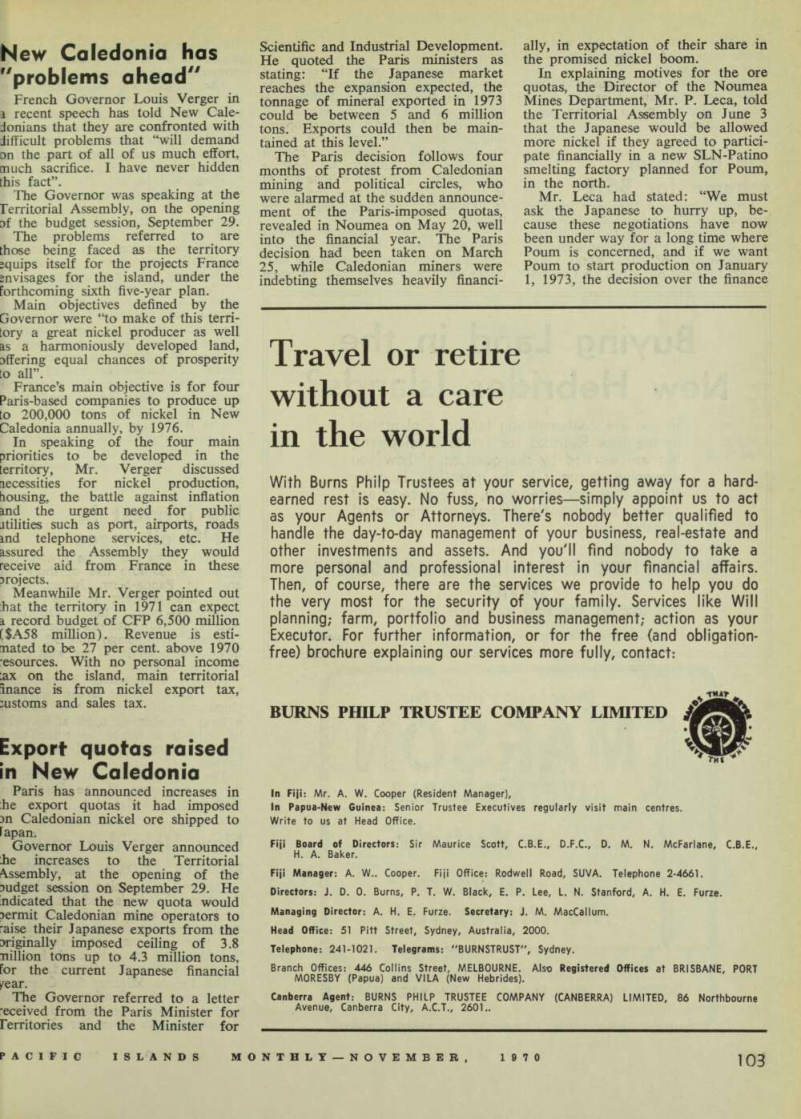
French Governor Louis Verger in a recent speech has told New Cale donians that they are confronted with difficult problems that “will demand on the part of all of us much effort, much sacrifice. I have never hidden this fact”.
The Governor was speaking at the lerritorial Assembly, on the opening of the budget session, September 29.
The problems referred to are those being faced as the territory equips itself for the projects France envisages for the island, under the forthcoming sixth five-year plan.
Main objectives defined by the Governor were “to make of this terri tory a great nickel producer as well as a harmoniously developed land, offering equal chances of prosperity to all”.
France’s main objective is for four Paris-based companies to produce up to 200,000 tons of nickel in New Caledonia annually, by 1976.
In speaking of the four main priorities to be developed in the territory, Mr. Verger discussed necessities for nickel production, housing, the battle against inflation and the urgent need for public atilities such as port, airports, roads and telephone services, etc. He assured the Assembly they would receive aid from France in these nrojects.
Meanwhile Mr. Verger pointed out hat the territory in 1971 can expect a record budget of CFP 6,500 million (SASB million). Revenue is esti mated to be 27 per cent, above 1970 •esources. With no personal income :ax on the island, main territorial inance is from nickel export tax, :ustoms and sales tax.
Export quotas raised
in New Caledonia
Paris has announced increases in he export quotas it had imposed >n Caledonian nickel ore shipped to lapan.
Governor Louis Verger announced he increases to the Territorial Assembly, at the opening of the budget session on September 29. He Indicated that the new quota would permit Caledonian mine operators to raise their Japanese exports from the M-iginally imposed ceiling of 3.8 million tons up to 4.3 million tons, for the current Japanese financial fear.
The Governor referred to a letter •eceived from the Paris Minister for Ferritories and the Minister for
Scientific and Industrial Development, He quoted the Paris ministers as stating: “If the Japanese market reaches the expansion expected, the tonnage of mineral exported in 1973 could be between 5 and 6 million tons. Exports could then be maintained at this level.”
The Paris decision follows four months of protest from Caledonian mining and political circles, who were alarmed at the sudden announcement of the Paris-imposed quotas, revealed in Noumea on May 20, well into the financial year. The Paris decision had been taken on March 25, while Caledonian miners were indebting themselves heavily financi-
ally, in expectation of their share in the promised nickel boom, In explaining motives for the ore quotas, the Director of the Noumea Mines Department, Mr, P. Leca, told the Territorial Assembly on June 3 that the Japanese would be allowed more nickel if they agreed to partici pate financially in a new SLN-Patino smelting factory planned for Poum, in the north.
Mr, Leca had stated: “We must ask the Japanese to hurry up, be cause these negotiations have now been under way for a long time where Poum is concerned, and if we want Poum to start production on January 1, 1973, the decision over the finance
must be taken fast. The only weapon at our disposal for the moment is to limit our exports”.
The use of this weapon never theless provoked strong protest from among the Caledonian mining com munity affected.
Big oil palm
scheme for BSIP
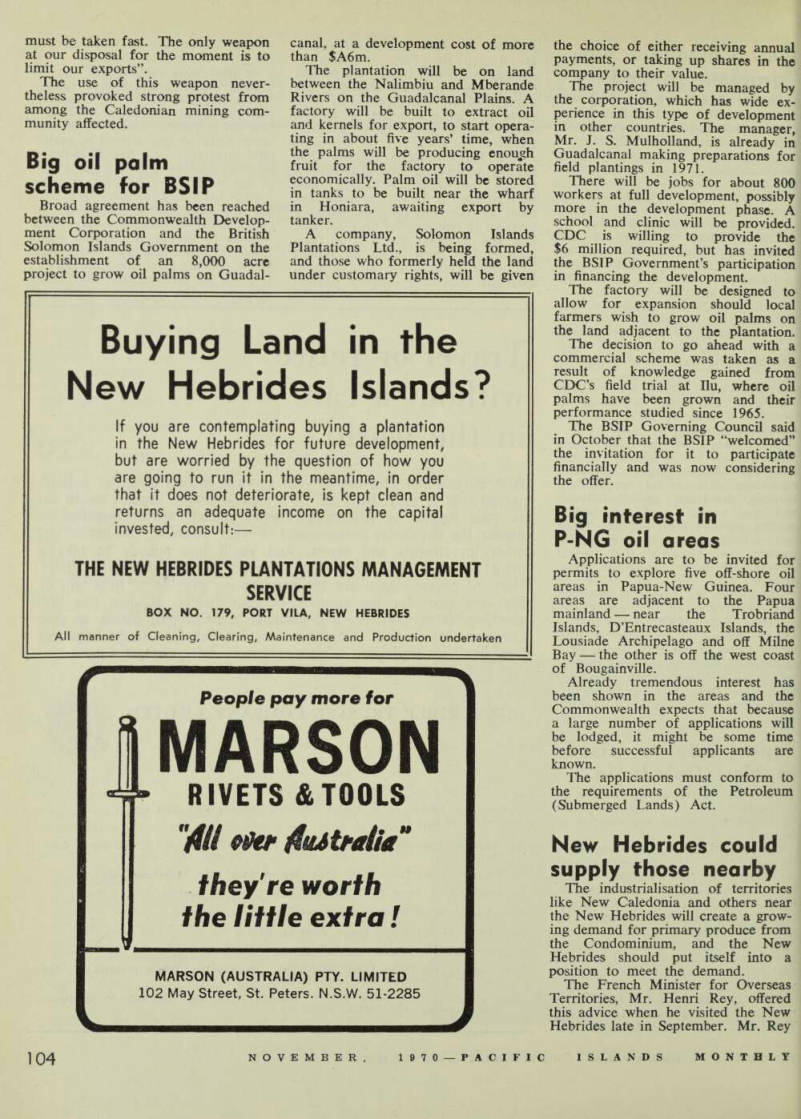
Broad agreement has been reached between the Commonwealth Develop ment Corporation and the British Solomon Islands Government on the establishment of an 8,000 acre project to grow oil palms on Guadal
canal, at a development cost of more than SA6m.
The plantation will be on land between the Nalimbiu and Mberande Rivers on the Guadalcanal Plains. A factory will be built to extract oil and kernels for export, to start opera ting in about five years’ time, when the palms will be producing enough fruit for the factory to operate economically. Palm oil will be stored in tanks to be built near the wharf in Honiara, awaiting export by tanker.
A company, Solomon Islands Plantations Ltd., is being formed, and those who formerly held the land under customary rights, will be given
the choice of either receiving annual payments, or taking up shares in the company to their value.
The project will be managed by the corporation, which has wide ex perience in this type of development in other countries. The manager, Mr. I. S. Mulholland, is already in Guadalcanal making preparations for field plantings in 1971.
There will be jobs for about 800 workers at full development, possibly more in the development phase. A school and clinic will be provided.
CDC is willing to provide the $6 million required, but has invited the BSIP Government’s participation in financing the development.
The factory will be designed to allow for expansion should local farmers wish to grow oil palms on the land adjacent to the plantation.
The decision to go ahead with a commercial scheme was taken as a result of knowledge gained from CDC’s field trial at Ilu, where oil palms have been grown and their performance studied since 1965.
The BSIP Governing Council said in October that the BSIP “welcomed” the invitation for it to participate financially and was now considering the offer.
Big interest in
P-NG oil areas
Applications are to be invited for permits to explore five off-shore oil areas in Papua-New Guinea. Four areas are adjacent to the Papua mainland near the Trobriand Islands, D’Entrecasteaux Islands, the Lousiade Archipelago and off Milne Bay the other is off the west coast of Bougainville.
Already tremendous interest has been shown in the areas and the Commonwealth expects that because a large number of applications will be lodged, it might be some time before successful applicants are known.
The applications must conform to the requirements of the Petroleum (Submerged Lands) Act.
New Hebrides could
supply those nearby
The industrialisation of territories like New Caledonia and others near the New Hebrides will create a grow ing demand for primary produce from the Condominium, and the New Hebrides should put itself into a position to meet the demand.
The French Minister for Overseas Territories, Mr. Henri Rey, offered this advice when he visited the New Hebrides late in September. Mr. Rey
uggested the New Hebrideans should ♦repare to meet an increased demand or their produce. In particular they hould pay attention to animal hus >andry.
While modem methods of trans >ort, processing and conservation vere under study, the people of the Condominium did not lack initiative.
Resolute men were available to or ganise production. The time was past or backward looking feuds; in the ♦resent day no country could allow tself the extravagance of keeping dive sterile land disputes, Mr. Rey laid.
October report
9n copra market
Reports from London indicate that ncreasing consumer demand and 'urther export sales from Europe to lie Middle East have kept prices ?f soft edible oils rising over the past few days, Mr. K. G. Oliver, general manager of the P-NG Copra Marketing Board, said in Port Moresby on October 21.
He said that additionally, reports ♦f considerable crop damage caused t>y a typhoon of some intensity (actually registered as one of the strongest) which hit the Philippines luring the past week brought re aewed firmness to the laurics market. Consumers bought Philip pine/Indonesian copra at up to 1U5212 for October shipment and paid up to SUS2I9 for November/ December shipment.
More activity also developed in the coconut oil market towards the week’s end with some worthwhile price gains registered.
Rabi sets up
investment co.
The Banabans of Rabi Island have formed a public company, Rabi Holdings Ltd., in preparation for the day when their Ocean Island phosphate royalties will stop.
The company, which has an office in Waimanu Road, Suva, has been registered with an authorised share capital of $2 million.
One of the directors explained in October that the company was intended to give Banabans services, employment and investment while they still had phosphate capital. This income would stop in four or five years.
In Suva, the company has bought three flats and an adjoining bulk store, which between them bring in an income of $3OO a month.
The company is also studying projects such as a sawmill, the ex
pansion of the Rabi copra industry and the building of shops. m _u c V*arpenrer mu KGS
Q rCCOrd profit
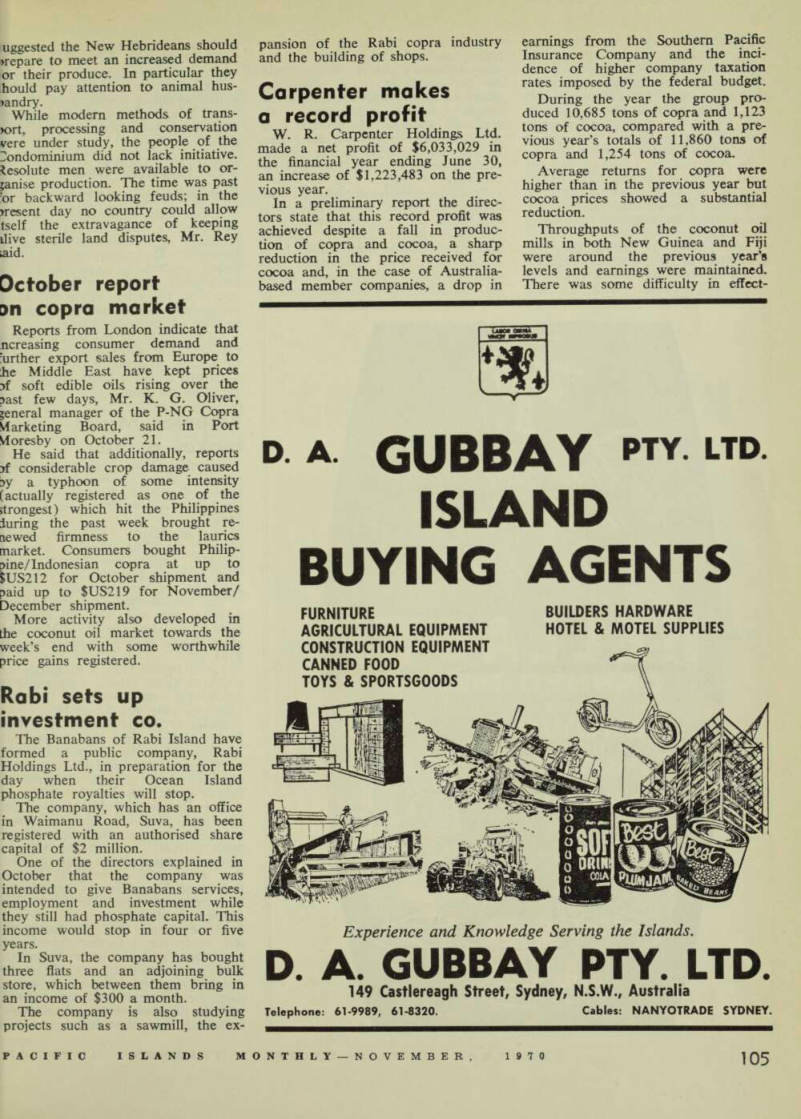
11/ D u rt u: ni „ IM W. R. Carpenter Holdings Ltd. made a net profit of *6,033,029 m the financial year ending June 30, an increase of $1,223,483 on the previous year.
In a preliminary report the directors state that this record profit was achieved despite a fall in production of copra and cocoa, a sharp reduction in the price received for cocoa and, in the case of Australiabased member companies, a drop in
earnings from the Southern Pacific Insurance Company and the inci dence of higher company taxation rates imposed by the federal budget.
During the year the group pro duced 10,685 tons of copra and 1,123 tons of cocoa, compared with a pre vious year ’ s tota j s 0 f n 860 tons of y and 1254 tons of cocoa . \ ’
Average returns for copra were higher than in the previous year but cocoa prices showed a substantial reduction.
Throughputs of the coconut oil mills in both New Guinea and Fiji were around the previous year’s levels and earnings were maintained, There was some difficulty in effect
ing sales in the second half of the y e ?£- Turnover of the group’s merchandismg subsidiaries in island areas increased overall by almost 10 per dent. The advance was marked in Fiji where the constantly-increasing flow of tourists plays a big part in maintaining retail sales buoyancy.
In Papua-New Guinea, development activity took the form of extensions of tea and coffee plantings, new and replacement plantings of cocoa, and development of copra plantations.
Tea production during the year amounted to 598,060 lb, a big increase on the small initial output of the previous year. With the first
factory in Kudjip estate now com pleted and the first stage of the second factory, on Kindeng estate, due for completion soon, production could be expected to continue to in crease at an accelerated pace, direc tors said, adding: “The tea has been widely sold on world markets where, because of its high quality, it has proved readily acceptable at en couraging prices.”
Production of desiccated coconut during the year amounted to 8,667,850 lb compared with 5,036,600 lb in 1968-69. Labour difficulties, intense competition from Ceylon and the Philippines, and prices which were frequently below cost of production, all combined to
constitute “a most difficult and un satisfactory year” for this new ven ture.
The directors have recommended a final ordinary dividend of 10 per cent., being 5 cents per stock unit on the ordinary capital of the com pany.
BP (South Sea)
increases profits
Burns Philp (South Sea) Co. Ltd. increased its net profit by $36,200, to $583,133 in the financial year to June 30. The company says con tinued growth of various Islands economies, together with improved operating efficiency within the com pany, had raised sales and profits, in spite of increased overheads.
To celebrate 50 years of existence the company proposes, in addition to a final dividend of 10 cents per stock unit to pay a bonus dividend of 10 cents per unit.
Emperor Mines
makes a loss
Emperor Mines Ltd., parent com pany of the Vatukoula, Fiji, gold mining operation, has announced a net loss of $F47,988 for the year to June 30.
Its subsidiary, Emperor Gold Mining Co. Ltd., had a loss of $56,558 during the same period.
This compared with a profit of $147,984 the previous year.
The loss resulted after taking into account help from the Fiji Govern ment amounting to $312,259 and after deferring expenditure of $383,925.
Tavua Power Ltd., a subsidiary of Emperor Gold Mining Co., made a profit for the year of $20,478 (previous year was $49,064).
Secretary of Emperor Mines, Mr.
E. H. Nutting, said that because of the group loss the directors did not recommend the declaration of a dividend. Last year a dividend of 2.5 c a share was issued.
The Emperor Gold Mining Co. has been limping along for some years—it has a constant fight to re main solvent. A three-year subsidy agreement between the company and the government—providing for a little over $2 million to be paid to the company from April, 1967 expired in March.
It’s expected that the company will apply for a further subsidy to keep the Vatukoula mine operating.
With so many thousands of people depending on the mine and its town ship, the government may find itself with the dilemma of deciding whether to subsidise or close-down.
Fiji to get brewery,
maybe tannery
Fiji is to get a second brewery and there are good prospects for the setting up of two new industries —a tannery and a footwear factory.
L. D. Nathan and Co. Ltd. and New Zealand Breweries Ltd. will jointly have a 51 per cent, interest in the brewery to be built in Lautoka. The interest will be held through Consolidated Hotels Ltd. whose chairman, Mr. L. D. Nathan, announced the decision in Auckland in October. L. D. Nathan and NZ Breweries jointly own Consolidated Hotels and its subsidiary, Waikato Breweries Ltd.
The other 49 per cent, of the Fiji company’s capital will be held by Fiji interests, including the Fiji Development Bank and the Native Land Trust Board.
Nominal capital of the Fiji com pany, South Seas Brewing Co., will be $750,000. New Zealand brewing skills “were in world class” and the directors were confident they could produce a beer widely acceptable throughout the South Pacific, Mr.
Nathan said.
Fiji’s beer consumption has been steadily rising and is currently over a million gallons a year; at present there is only one brewery, the Carlton in Suva. Consideration is also being given to the establishment of a rum distillery by an Australian company in Fiji.
Local businessmen, the Fiji Gov ernment and the UN, are involved in the proposals for a tannery and footwear factory. Several Fiji busi nessmen in the shoe trade have formed a company called Footwear South Pacific Ltd., and are being assisted by Mr. Ernest Knew, a tanning and footwear expert from the UN Industrial Development Organisa tion.
Mr. Knew considers there are good prospects for developing a tanning industry in Fiji and that local hides and skins would be used in the tannery. A pilot tannery and labora tory will be established if funds are forthcoming from UN agencies.
Striking plumbers
set up own shop
Over 30 plumbers of the Tonga Construction Company walked out on the new Viola Hospital job re cently—and started their own busi ness. This rarity in Tonga’s industrial activities occurred over a difference in payment of overtime.
A plumber spokesman said that for the previous month, shifts had done
overtime. But payment had been refused until the work accomplished had been evaluated. This made the men quit.
After negotiations it was agreed to pay the extra overtime, but the men involved had already left. They were told to re-apply but that the ringleaders would be delayed two weeks as punishment. None applied.
Instead they have set up their own plumbing business and a few jobs have come in . . . manufacturing guttering, buckets, tubs, tanks and general plumbing repairs. Business is slow but the men are confident that with their long experience on the major construction jobs like the new
wharf, post office, police headquarters and Dateline Hotel, they can make a go of it with their own private corn pany.
There are no trade unions in Tonga, c I r
31100? Cqd6 Tiiqis
• in ‘■MV3 Trial plantings of sugar cane in the Markham Valley area of the Morobe District of Papua-New Guinea are now being carried out by the Department of Agriculture, to find out whether it can be established as a commercial proposition in the
territory. No firm decision will be made on the trials until March 1972.
In 1964 DASF started planting various varieties of sugar from Queensland in the Markham Valley.
Later plantings gave some results parallel with sugar levels recorded in Queensland, indicating that harvesting could be carried out successfully in the valley over a period of five months from July each year.
Pinder variety was found most suitable for the Markham Valley and 15 acres of this were planted in March, Sugar cane from this block will be cut and planted on a 100 acre block near Chivasing; the final decision will depend on results from this 100 acre block.
P-NG concerned
over common market A five-man delegation representing political, business and government interests in Papua-New Guinea is visiting the UK and Europe to press the case for the territory’s right to special consideration if the UK joins the common market.
The delegation comprises Messrs.
A. Bilas, Ministerial Member for Trade and Industry; Roy Ashton, Ministerial Member for Public Works; B. E. Fairfax-Ross, chairman of the P-NG Copra Marketing Board; N. J. Thomson, head of Department of Trade and Industry, and J. Natera, economist with the Department of Agriculture, Stock and Fisheries.
Mr. Bilas told the P-NG House of Assembly before his departure: “The government has been working on this matter for some time and
believes that there could be serious effects on our exports if Britain enters the common market. Britain takes about 30 per cent, of our exports— it is a most important market for our copra and tea, and particularly for coconut oil and pyrethrum. It is also important for our coffee and cocoa.
“If Britain joins the common market, we will lose the preferences which she gives us, and import duties will have to be paid on most of our exports to Britain. But, many of our African competitors, because of their special relations with the common market, will not have to face this duty. This will clearly make our products much harder to sell. The Australian Government has already had long talks with the governments of Britain and the common market countries about this matter.”
NZ supplies a third
of Tonga's imports
New Zealand is now Tonga’s leading source of supply for many manufactured lines including stock foods, bags and containers, beer and cigarettes, building materials, general hardware, steel and refrigerators, meat, dairy products, electrical goods, clothing, confectionery, banana shocks and timber, Mr. Gordon McLaren, New Zealand Trade Commissioner for the Pacific, said recently in Tonga.
Trading figures for 1969 showed that NZ supplied 34.5 per cent, of Tonga’s total imports, valued at SNZI£ million, a 10 per cent, increase on 1968. In return NZ bought all Tonga’s banana crop, about half her desiccated coconut, and other fruit and vegetables valued at $1 million,
approximately one-third of Tonga’s total exports.
The close relationship in this two way trading, said Mr. McLaren, was the result of a policy of vigorous marketing, coupled with competitive prices and a regular shipping service.
Before long the Trade Commissioner’s office would be transferred from Auckland to Suva, to further facilitate inter-territorial trading and he looked forward to continued growth in this two-way trade with Tonga.
They're all on
to a winner
New Caledonia’s annual around island bicycle races are attracting growing commercial support. This year’s 12-day event (see p. 50) —the fourth—gave commerce a lot of mileage of its own, UTA achieved considerable pub licity for having flown out the two metropolitan French competitors. A bicycle manufacturer was proud to publicise the results of cyclists it had provided for. The Societe Le Nickel jersey and others were prominently displayed in TV coverage throughout the tour.
Nestles (Aust.) were again involved in the trial: A Nestles sweater was donned by the Caledonian winner of each lap. One of the company’s products, Milo, was offered as the officially designated tonic drink of the tour.
A Nestles representative, Mr. lan Buchanan, drove with Mr. Holland Cottin, Noumea representative of C.
Sullivan Export (Sydney), to cover part of the tour.
At the end of the race, all finishers received a Nestles certificate, while Roger Loquet, being the first Cale donian, won the Nestles trophy.
He was then invited to fly to Sydney, together with one other Caledonian cyclist, to be the com pany’s guest for a week. The Cale donians were expected to compete in track events in Australia.
After the tour, three young Cale donians were given racing bikes by three Noumea stores who had con ducted a contest for the purchasers of “lucky” Milo tins.
This was not the end of touring for the Nestles representative, how ever. lan Buchanan proceeded to the New Hebrides and was scheduled to join cargo superintendent Bill Treloar aboard the Bums Philp trade ship Konanda for a week’s voyage through the Banks and Torres Islands via Pentecost. They planned to arrange demonstrations on the use of Nestles products among the Melanesian plantations en route.