How to make your
pp. 65-68 · Read in the full issue
own money
Pictures and text by R. W. TAYLOR
Nature’s colourful treasures usually have had a monetary value! Pearls from the sea and diamonds, rubies, and other minerals and gem stones from the earth have roused the desire of man. Thus it is not so strange w o he fi re nd D i h ciLr m e h tal, P fnf Jl an a d r S ; ram of been develop currency have been developed The Samoans have the or fine mat; in Fiji, i is the tabua or whales tooth; while various types of shells and feathers have found similar importance in New Guinea.
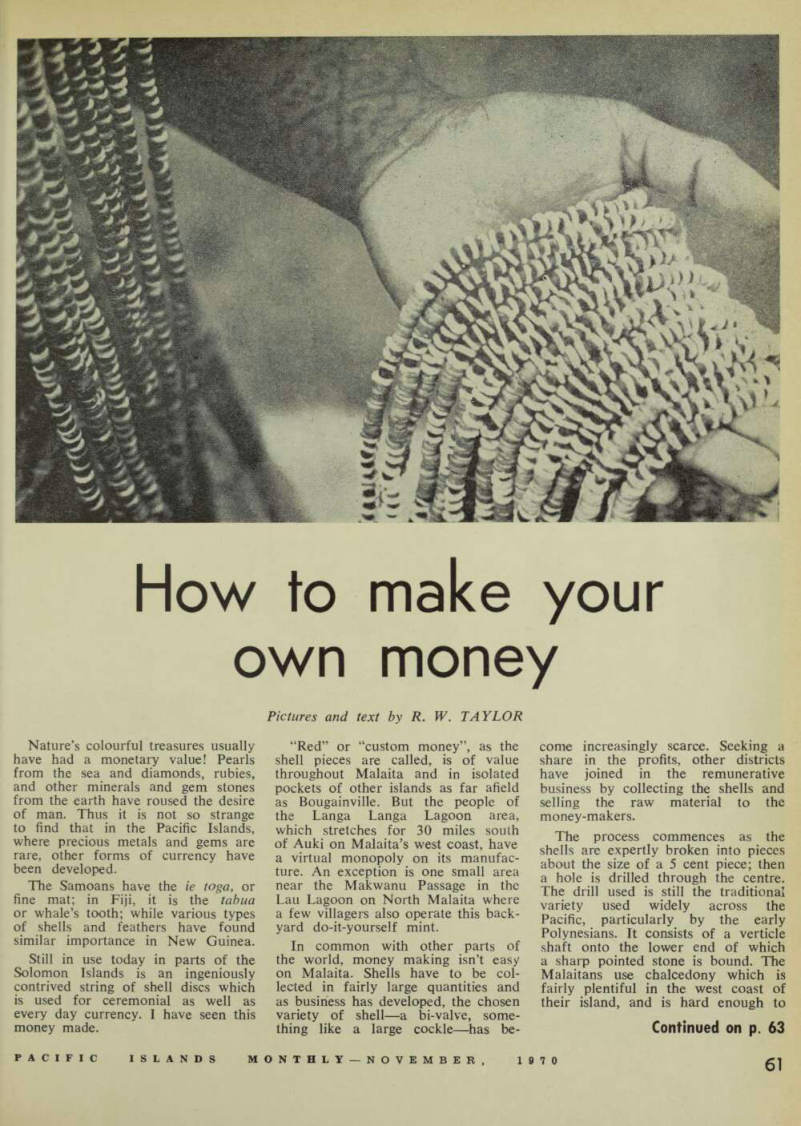
Still in use today in parts of the Solomon Islands is an ingeniously contrived string of shell discs which is used for ceremonial as well as every day currency. I have seen this money made.
“Red” or “custom money”, as the shell pieces are called, is of value throughout Malaita and in isolated pockets of other islands as far afield as Bougainville. But the people of the Langa Langa Lagoon area, .f°, r 30 t miles , s . oulh ° f ' ,° n Malalt f s wes V coast > have a virtual monopoly on its manufacture. An exception is one small area te toga, near the Makwanu Passage in the Lau Lagoon on North Malaita where a few villagers also operate this backyard do-it-yourself mint. j n com mon with other parts of the world, money making isn’t easy on Malaita. Shells have to be collected in fairly large quantities and as business has developed, the chosen variety of shell—a bi-valve, some thing like a large cockle—has be-
come increasingly scarce. Seeking a share in the profits, other districts have joined in the remunerative business by collecting the shells and selling the raw material to the money-makers.
The process commences as the shells are expertly broken into pieces about siz e of a 5 cent piece" then a hole is drilled through the centre.
The driU used is sti „ f he traditiona i variety used widely across the Pacifi particu ar i y by , he ear i y Polynesians. It consists of a verticle shaft onto the lower end of which a sharp pointed stone is bound. The Malaitans use chalcedony which is fairly plentiful in the west coast of their island, and is hard enough to
Continued on p. 63
retain a sharp working point for a reasonable time.
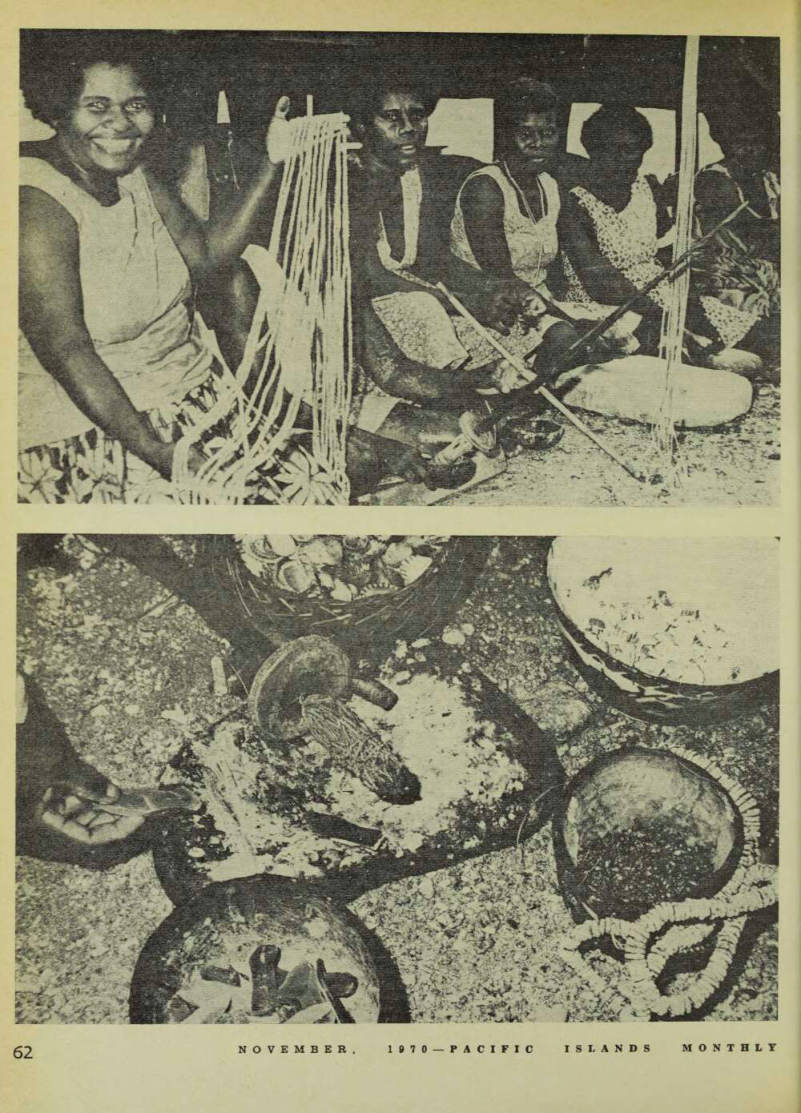
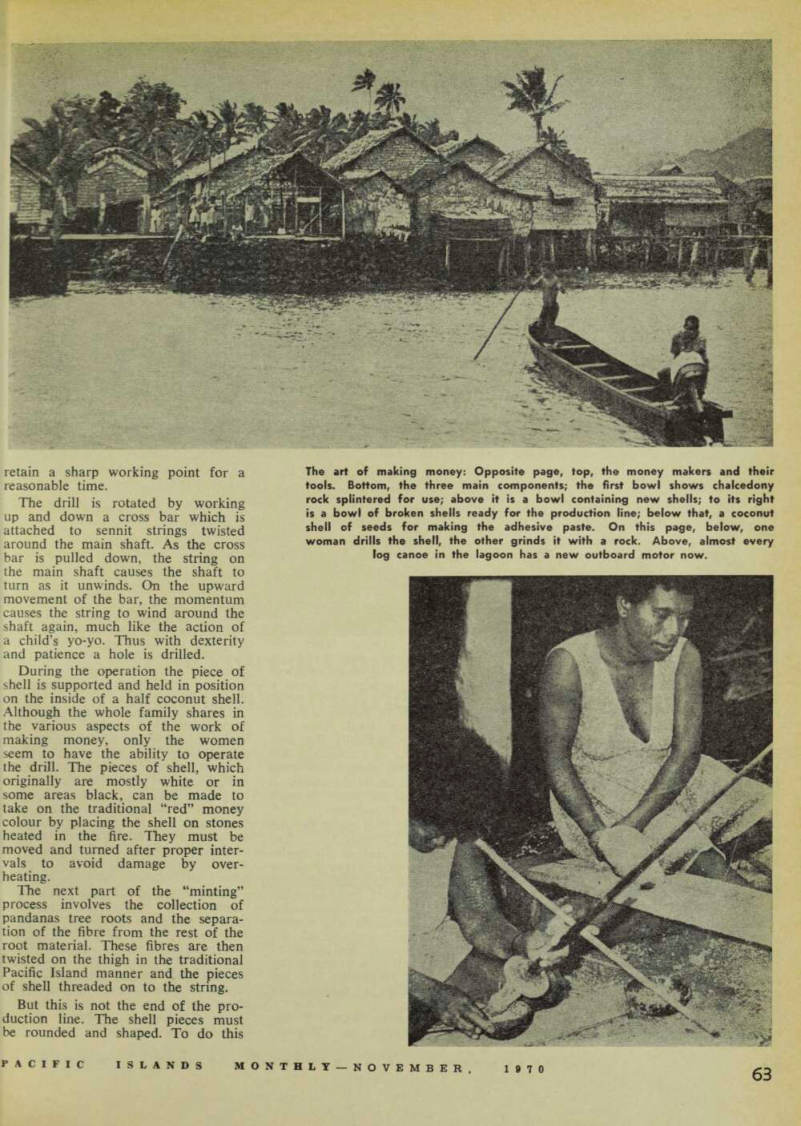
The drill is rotated by working up and down a cross bar which is attached to sennit strings twisted around the main shaft. As the cross bar is pulled down, the string on the main shaft causes the shaft to turn as it unwinds. On the upward movement of the bar, the momentum causes the string to wind around the shaft again, much like the action of a child’s yo-yo. Thus with dexterity and patience a hole is drilled.
During the operation the piece of shell is supported and held in position on the inside of a half coconut shell.
Although the whole family shares in the various aspects of the work of making money, only the women seem to have the ability to operate the drill. The pieces of shell, which originally are mostly white or in some areas black, can be made to take on the traditional “red” money colour by placing the shell on stones heated in the fire. They must be moved and turned after proper inter vals to avoid damage by over heating.
The next part of the “minting” process involves the collection of pandanas tree roots and the separa tion of the fibre from the rest of the root material. These fibres are then twisted on the thigh in the traditional Pacific Island manner and the pieces of shell threaded on to the string.
But this is not the end of the pro duction line. The shell pieces must be rounded and shaped. To do this
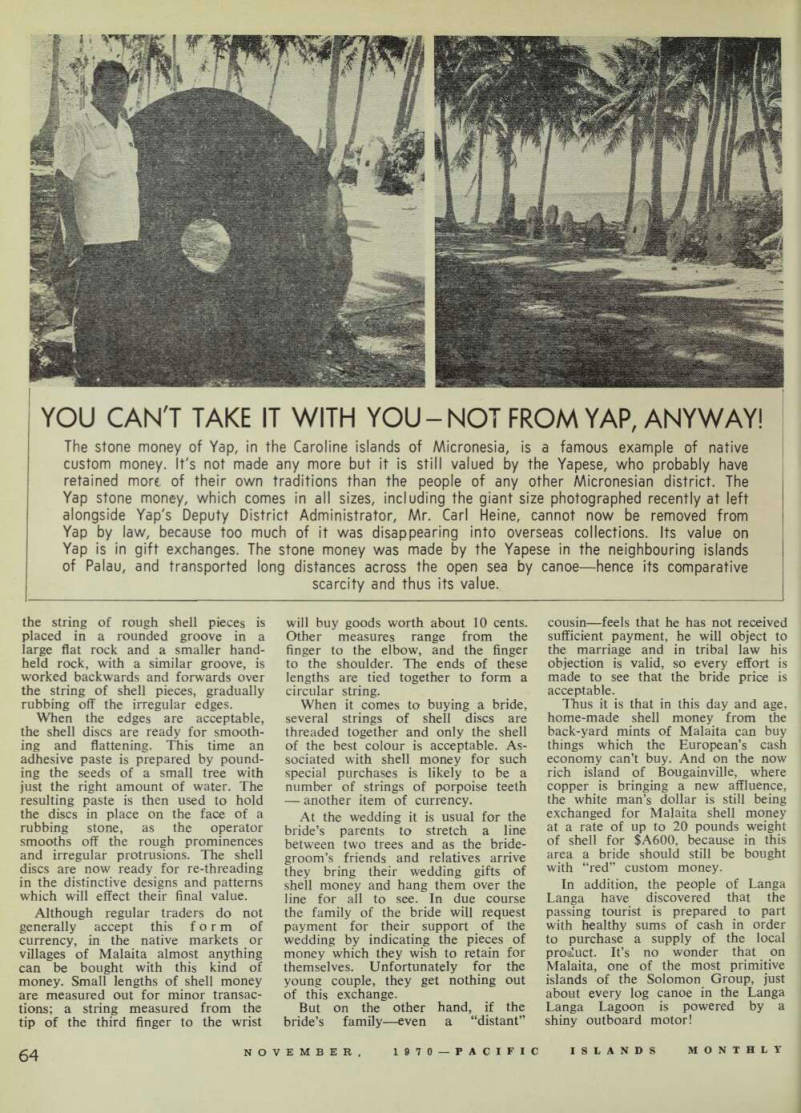
The art of making money: Opposite page, top, the money makers and tbeir tools. Bottom, the three main components; the first bowl shows chalcedony rock splintered for use; above it is a bowl containing new shells; to its right is a bowl of broken shells ready for the production tine; below that, a coconut shell of seeds for making the adhesive paste. On this page, below, one woman drills the shell, the other grinds it with a rock. Above, almost every log canoe in the lagoon has a new outboard motor now.
the string of rough shell pieces is placed in a rounded groove in a large flat rock and a smaller hand held rock, with a similar groove, is worked backwards and forwards over the string of shell pieces, gradually rubbing off the irregular edges.
When the edges are acceptable, the shell discs are ready for smooth ing and flattening. This time an adhesive paste is prepared by pound ing the seeds of a small tree with just the right amount of water. The resulting paste is then used to hold the discs in place on the face of a rubbing stone, as the operator smooths off the rough prominences and irregular protrusions. The shell discs are now ready for re-threading in the distinctive designs and patterns which will effect their final value.
Although regular traders do not generally accept this form of currency, in the native markets or villages of Malaita almost anything can be bought with this kind of money. Small lengths of shell money are measured out for minor transac tions; a string measured from the tip of the third finger to the wrist
will buy goods worth about 10 cents.
Other measures range from the finger to the elbow, and the finger to the shoulder. The ends of these lengths are tied together to form a circular string.
When it comes to buying a bride, several strings of shell discs are threaded together and only the shell of the best colour is acceptable. As sociated with shell money for such special purchases is likely to be a number of strings of porpoise teeth another item of currency.
At the wedding it is usual for the bride’s parents to stretch a line between two trees and as the bride groom’s friends and relatives arrive they bring their wedding gifts of shell money and hang them over the line for all to see. In due course the family of the bride will request payment for their support of the wedding by indicating the pieces of money which they wish to retain for themselves. Unfortunately for the young couple, they get nothing out of this exchange.
But on the other hand, if the bride’s family—even a “distant”
cousin—feels that he has not received sufficient payment, he will object to the marriage and in tribal law his objection is valid, so every effort is made to see that the bride price is acceptable.
Thus it is that in this day and age, home-made shell money from the back-yard mints of Malaita can buy things which the European’s cash economy can’t buy. And on the now rich island of Bougainville, where copper is bringing a new affluence, the white man’s dollar is still being exchanged for Malaita shell money at a rate of up to 20 pounds weight of shell for SA6OO, because in this area a bride should still be bought with “red” custom money.
In addition, the people of Langa Langa have discovered that the passing tourist is prepared to part with healthy sums of cash in order to purchase a supply of the local product. It’s no wonder that on Malaita, one of the most primitive islands of the Solomon Group, just about every log canoe in the Langa Langa Lagoon is powered by a shiny outboard motor!