don't change
pp. 55-56 · Read in the full issue
A Brett Milder
Profile
New Guinea Irishman whose values don't change
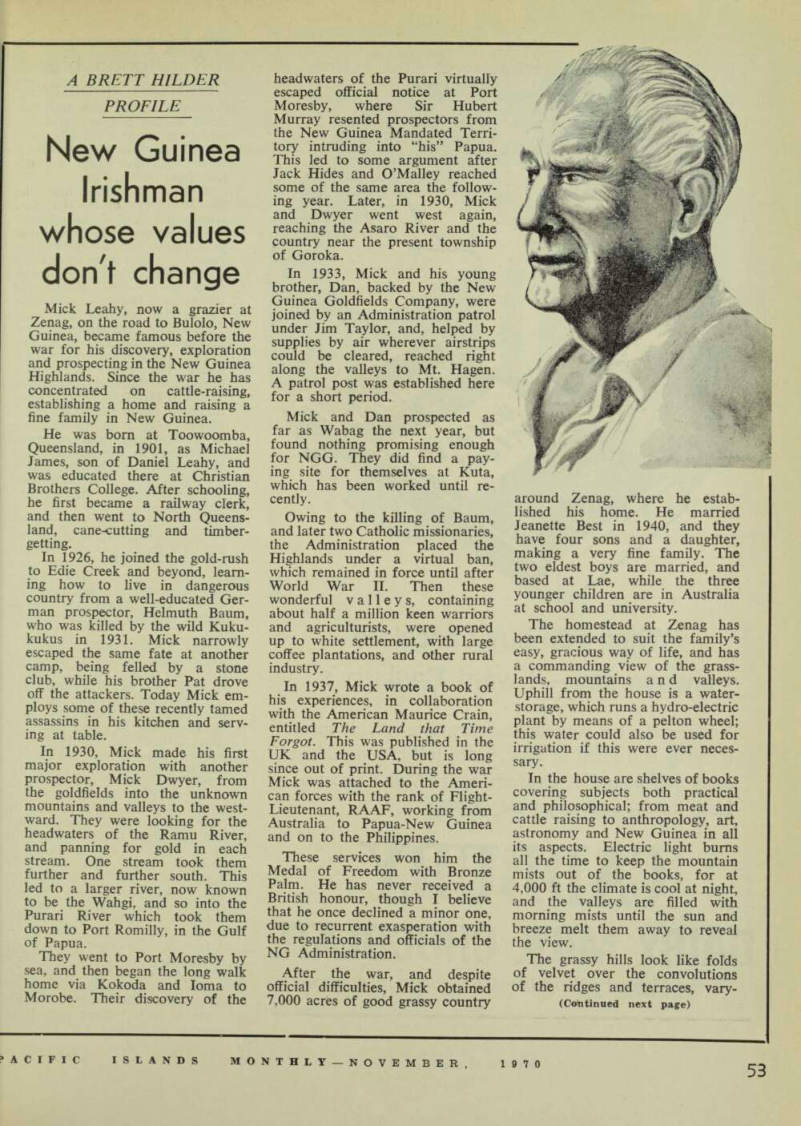
Mick Leahy, now a grazier at Zenag, on the road to Bulolo, New Guinea, became famous before the war for his discovery, exploration and prospecting in the New Guinea Highlands. Since the war he has concentrated on cattle-raising, establishing a home and raising a fine family in New Guinea.
He was born at Toowoomba, Queensland, in 1901, as Michael James, son of Daniel Leahy, and was educated there at Christian Brothers College. After schooling, he first became a railway clerk, and then went to North Queens land, cane-cutting and timber getting.
In 1926, he joined the gold-rush to Edie Creek and beyond, learn ing how to live in dangerous country from a well-educated Ger man prospector, Helmuth Baum, who was killed by the wild Kuku kukus in 1931. Mick narrowly escaped the same fate at another camp, being felled by a stone club, while his brother Pat drove off the attackers. Today Mick em ploys some of these recently tamed assassins in his kitchen and serv ing at table.
In 1930, Mick made his first major exploration with another prospector, Mick Dwyer, from the goldfields into the unknown mountains and valleys to the west ward. They were looking for the headwaters of the Ramu River, and panning for gold in each stream. One stream took them further and further south. This led to a larger river, now known to be the Wahgi, and so into the Purari River which took them down to Port Romilly, in the Gulf of Papua.
They went to Port Moresby by sea, and then began the long walk home via Kokoda and loma to Morobe. Their discovery of the
headwaters of the Purari virtually escaped official notice at Port Moresby, where Sir Hubert Murray resented prospectors from the New Guinea Mandated Terri tory intruding into “his” Papua.
This led to some argument after Jack Hides and O’Malley reached some of the same area the follow ing year. Later, in 1930, Mick and Dwyer went west again, reaching the Asaro River and the country near the present township of Goroka.
In 1933, Mick and his young brother, Dan, backed by the New Guinea Goldfields Company, were joined by an Administration patrol under Jim Taylor, and, helped by supplies by air wherever airstrips could be cleared, reached right along the valleys to Mt. Hagen.
A patrol post was established here for a short period.
Mick and Dan prospected as far as Wabag the next year, but found nothing promising enough for NGG. They did find a pay ing site for themselves at Kuta, which has been worked until re cently.
Owing to the killing of Baum, and later two Catholic missionaries, the Administration placed the Highlands under a virtual ban, which remained in force until after World War 11. Then these wonderful valleys, containing about half a million keen warriors and agriculturists, were opened up to white settlement, with large coffee plantations, and other rural industry.
In 1937, Mick wrote a book of his experiences, in collaboration with the American Maurice Crain, entitled The Land that Time Forgot. This was published in the UK and the USA, but is long since out of print. During the war Mick was attached to the Ameri can forces with the rank of Flight- Lieutenant, RAAF, working from Australia to Papua-New Guinea and on to the Philippines.
These services won him the Medal of Freedom with Bronze Palm. He has never received a British honour, though I believe that he once declined a minor one, due to recurrent exasperation with the regulations and officials of the NG Administration.
After the war, and despite official difficulties, Mick obtained 7,000 acres of good grassy country
around Zenag, where he estab lished his home. He married Jeanette Best in 1940, and they have four sons and a daughter, making a very fine family. The two eldest boys are married, and based at Lae, while the three younger children are in Australia at school and university.
The homestead at Zenag has been extended to suit the family’s easy, gracious way of life, and has a commanding view of the grass lands, mountains and valleys.
Uphill from the house is a water storage, which runs a hydro-electric plant by means of a pelton wheel; this water could also be used for irrigation if this were ever neces sary.
In the house are shelves of books covering subjects both practical and philosophical; from meat and cattle raising to anthropology, art, astronomy and New Guinea in all its aspects. Electric light bums all the time to keep the mountain mists out of the books, for at 4,000 ft the climate is cool at night, and the valleys are filled with morning mists until the sun and breeze melt them away to reveal the view.
The grassy hills look like folds of velvet over the convolutions of the ridges and terraces, vary
(Continued next page)
ing from golden yellow to emerald and olive green, with some slashes of brown or black where the grass has been fired. The higher mountains are wooded, providing distant blue peaks and ridges against the flying clouds and the sky.
Mick and his story have been written up on many occasions, and also shown on TV, but as he looks over h;s broad acres and his 200 head of cattle he must still gain a well-deserved satis faction from his long years of effort. At 69 he is very fit and well, a non-drinker, non-smoker, and an early riser.
His Irish blood still rises fast at every new restrictive regula tion. He would like to stay in New Guinea where he began work with untamed natives shadowing his movements with curiosity or hostility. Today he notes the haste with which self-government and independence are being rushed along, with little hope of cohesion, stability or economic security for the new state.
It would be tragic if men like Mick Leahy do not find a place in the future of New Guinea: his values are unchanging, like his solid virtues, and he is universally regarded with varying degrees of respect, admiration and affection.