Tahiti's Autonomists: "Ready
pp. 32-33 · Read in the full issue
Relations with French at rock-bottom
To Hoist Their Flag Again"
Prom a Tahiti correspondent Relations between the French Government and the leaders of the movement for internal self-government in French Polynesia are now in a worse state than at any time since the heyday of the Tahitian nationalist leader Pouvanaa a Oopa some 12 years ago.
It is a case of the irrepressible force meeting the immovable object.
For the past three and a half years—ever since Mr. Francis Sanford was elected to the French Parliament as deputy for French Polynesia— there has been an increasingly insistent demand for internal self-government in the territory. The demand has quickened as other territories in the Pacific have achieved self-government or independence.
The chief spokesmen for the auto nomists have been Mr. Sanford him self and the members of Te E’a Api and Pupu Here Aia, the two radical parties in French Polynesia’s Ter ritorial Assembly which have a majority of 18 of the 30 seats.
However, although the autonomists clearly have a mandate from the people for the views they express, the French Government has always loftily dismissed their claims as being unrepresentative of the true wishes of the Polynesians, or it has ignored them altogether.
This policy has forced the autono mists into an increasingly frustrated and extreme position, and one can only wonder whether the French are not deliberately trying to provoke them into some kind of “criminal” act so that they will be able to gaol or exile the more militant leaders — as they gaoled Pouvanaa a Oopa and some of his associates in 1959.
The last semblance of cordiality between the French Government and the autonomists evaporated in Sep tember during the visit to Tahiti of the French Minister for Overseas Territories, Mr. Henri Rey (P/M, Oct., p. 18). During that visit a number of incidents occurred which had repercussions afterwards; • Mr. Rey made a point of not confronting the members of the majority coalition in the Assembly. (He also refrained from meeting them when he passed through Tahiti again later in the month after visiting New
Caledonia and Wallis and Futuna). • Mr. Sanford returned all the medals awarded to him by the French Government. (A highly decorated Tahitian soldier later fol lowed suit). • The majority parties held a meeting in the Territorial Assembly building while the red and white flag of the once-independent kingdom of Tahiti was hoisted on a flagpole out side. • The Governor (Mr, Pierre Angeli) promulgated a decree forbidding the flying of any flag, other than the French flag, on public buildings or monuments. • A scuffle occurred at Faaa Airport on the morning of Mr.
Key’s departure during which the Chief of Police, after a brief con versation with the Chief of the Intelligence Service, wrested a Tahitian flag from the hands of an autonomist, broke the staff across his knee, threw it on the ground and stamped on it—and then made the remark, “Where is the W.C.?” (This provoked another autonomist to throw down a French flag and stamp on that).
Not surprisingly, all the fuss over the flags produced some heated and/ or frosty exchanges afterwards.
Mr. Sanford denounced the Governor’s flag decree as “a dic tatorial act,” and said that although he and his followers had lowered their Tahitian flags, they were “ready to raise them again”.
He added: “The government is now trying to push us to extremes, and one day we will be obliged to appeal to the United Nations to conduct an honest referendum in the territory [on the self-government issue]”.
Subsequently, the Commission Per manente —a working committee nominated by the Territorial As sembly unanimously adopted a
motion submitted by the radical As sembly leaders demanding the im mediate recall to France of the two service chiefs involved in the Tahitian flag incident at Faaa.
In the motion, the proposers said that no genuine Tahitian could re main insensitive to the contemptuous treatment of his old flag, because French Polynesia was Polynesian first and then French.
“The territory’s annexation by France has not caused it to lose its own character, nor the legitimate pride in a past which has the same worth as any other country’s,” the proposers of the motion added.
In a written reply to the Commis sion Permanente (which was released to the Press first), the Governor took issue over the use of the word “an nexation” as well as the adoption of the old Tahitian flag as an emblem of the autonomists.
French Polynesia, he said, was French by law and “through the will of its inhabitants,” and not because of a “pretended annexation”. As for the Tahitian flag, this ran the risk of losing its original character if it was used for political purposes.
The Governor’s letter gave the Commission Permanente another op portunity to make a few more tel ling points, for in their reply they said that: • Under the French Constitution, French Polynesians had the right to withdraw from the French Republic if they wished, so this proved that the territory was Polynesian first and French second. • The word “annexation” was, in fact, used by the French in their official documents when they “united”
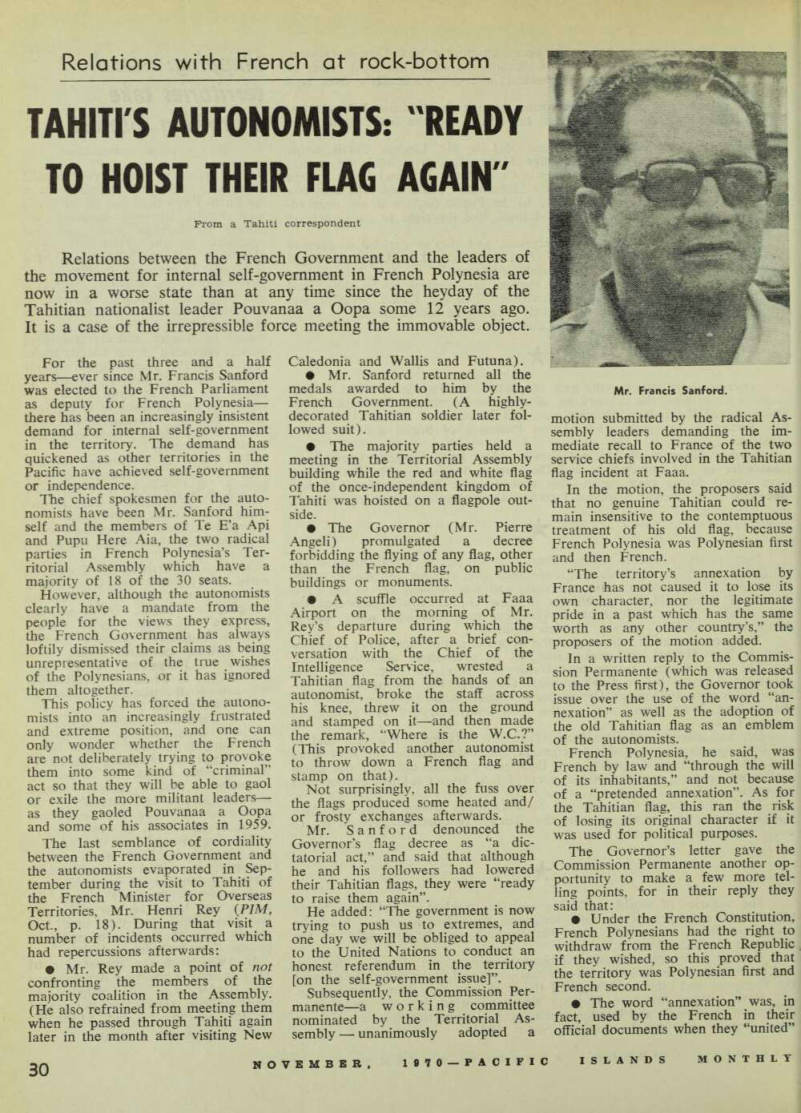
Mr. Francis Sanford.
Tahiti and its dependencies to the French Republic in 1880. • The mass of French flags which appeared in Papeete and its environs during the de Gaulle referendum in April, 1969, and during Mr. Key’s visit in September were far beyond the financial resources of the Tahitians. This, therefore, “indicated their origin” and seemed to prove that the Governor had no fears about the French flag losing its character by being used for political purposes.
A week or so after these exchanges took place, the Council of Govern ment (which consists of the Governor, the territory’s Secretary-General and representatives nominated by the Assembly) held a meeting to discuss, among other things, the motion iemanding the recall to France of he two service chiefs.
As soon as the meeting began, the Tovernor announced that he did not ntend to act on the motion—where ipon the nominated members swept ip their papers and walked out, caving the Governor and the Sec etary-General “tete en tete”, as one ’apeete newspaper put it.
Next day, however, the Council )f Government met again. And this ime there was another highly con entious motion on the agenda. This /as that a decree of 1932, which ;ives the Governor sweeping powers iver entry to and residence in the slands of French Polynesia, should •e repealed.
The Governor had acted under this ecree in September when he expelled dr. Marcel Lejeune, an outstanding awyer, from the territory, because, e said, there was a risk that Mr.
Lejeune’s presence could endanger public order during Mr. Key’s visit.
This expulsion, besides causing con siderable resentment among the auto nomists (who claimed that Mr.
Lejeune was not the slightest risk to public order), led them to fear that, under the 1932 decree, any one of them could be treated in much the same way if the Governor wanted to get rid of them because of their political views.
In a motion which Mr. Sanford and his political ally, Mr. John Teariki, submitted to the Commision Permanente seeking the repeal of the decree, they spelled out their fears.
They said, for example, that under the decree the Governor could prohibit access to Tahiti of any person not born on that island; and they recalled that it was under that decree Pouvanaa a Oopa was exiled first to Huahine and then to Mopelia during World War 11. They added that the decree was “anti-constitu tional” and contrary to the Declara tion of Human Rights and should therefore be abrogated.
The Sanford-Teariki motion pro duced another wordy exchange between the Governor and the Ter ritorial Assembly, with the Governor apparently stalling for time while waiting on instructions on what he should do next.
Meanwhile, Mr. Sanford had flown to France where he addressed an open letter to the Prime Minister, Mr. Chaban-Delmas, in which he said that Mr. Key’s recent visit to Tahiti had “demonstrated once more the government’s ignorance of our political, economic and social problems”.
After outlining these problems, Mr. Sanford complained that “an essential characteristic” of govern ment policy in French Polynesia was the use of all means of pressure— especially insidious means—to prevent the free expression of opinion and the free propagation of ideas that “run counter to colonial conformism and do not ensure the peoples’ sub mission to the decisions of Paris”.
Mr. Sanford added that in a vote of confidence in the French Parlia ment, he would vote against the Chaban-Delmas governmen t— although a Paris report says that he, in fact, abstained.
On October 22, French Polynesia’s Territorial Assembly budget session opened—but not with the customary words of welcome from the Assembly President to the Governor.
This time, the President muttered a few words about “if times were normal ...” and left it at that.
• See "How the Tahitians got their flag", p. 73.