an independent Fiji
pp. 27-30 · Read in the full issue
What we can expect from an independent Fiji
Coinciding with Fiji’s independence is the appearance of a small but important paperback, The Political Economy of Indepen dent Fiji. The author, Mr. E. K. Fisk, Professorial Fellow in Econo mics at the Australian National University, Canberra, has much to say about the future politico-economic problems of an independent Fiji and raises the frightening spectre of serious racial problems unless a positive effort is made by all races to relieve some of the tensions which are at present built into Fiji’s society.
The book is published by the ANU Press, at $ A 1.95.
Taken as a whole, says Fisk, Fiji is not, by world standards, a poor country. Its per capita domestic product is about the same as that of Spain in Europe, and is greater than that of virtually all the African and Asian countries.
While the economy faces many geographical problems such as isola tion, a limited land area, shortage of good agricultural land, etc., it also has a number of assets; specific ally a climate favourable to agricul ture, the absence of malaria, and a location on the main travel route between North America and Aus tralia. This location, coupled with pleasant scenery and a friendly people, provides the basis of the growing tourist industry.
Fiji’s population has grown rapidly from 157,000 in 1921 to 519,000 in
1969, and during that time the Indian population has replaced the Fijian people as the largest single racial group.
The country’s gross domestic product stood at SFI4O million in 1968, as compared with $36 million in 1950, while the average per capita figure was $277 in 1968, compared with $125 in 1950. Had the rate of population increase been less over the period, then the per capita figure would have been much greater in 1968.
Fisk gives the following review of the economy: As far as future economic develop ment is concerned, he foresees an expansion in the production of agri cultural products for the home market, so as to replace imports, while modest surpluses would be exported. Tourism he thinks will become increasingly important, al
though sugar, which has formed the basis for Fiji’s prosperity in the past, will continue to play an im portant role in the country’s future.
The timber industry, which makes use of non-cultivable agricultural land, has considerable development potential. From being at present an importer of timber, Fiji could in the future become an exporter, although this would require a much more efficient timber industry.
Mining, an industry with a long history in Fiji, may in the future include the development of copper, bauxite and offshore oil.
The manufacturing industry can expand to replace certain of the country’s imports, although the small size of the country’s market is a limiting factor in many cases.
Notable successes in recent years in this field include beef, pork, beer, cigarettes, rice, cement and paint.
The government is a major em ployer of labour in the economy and, Fisk asserts, the government “is
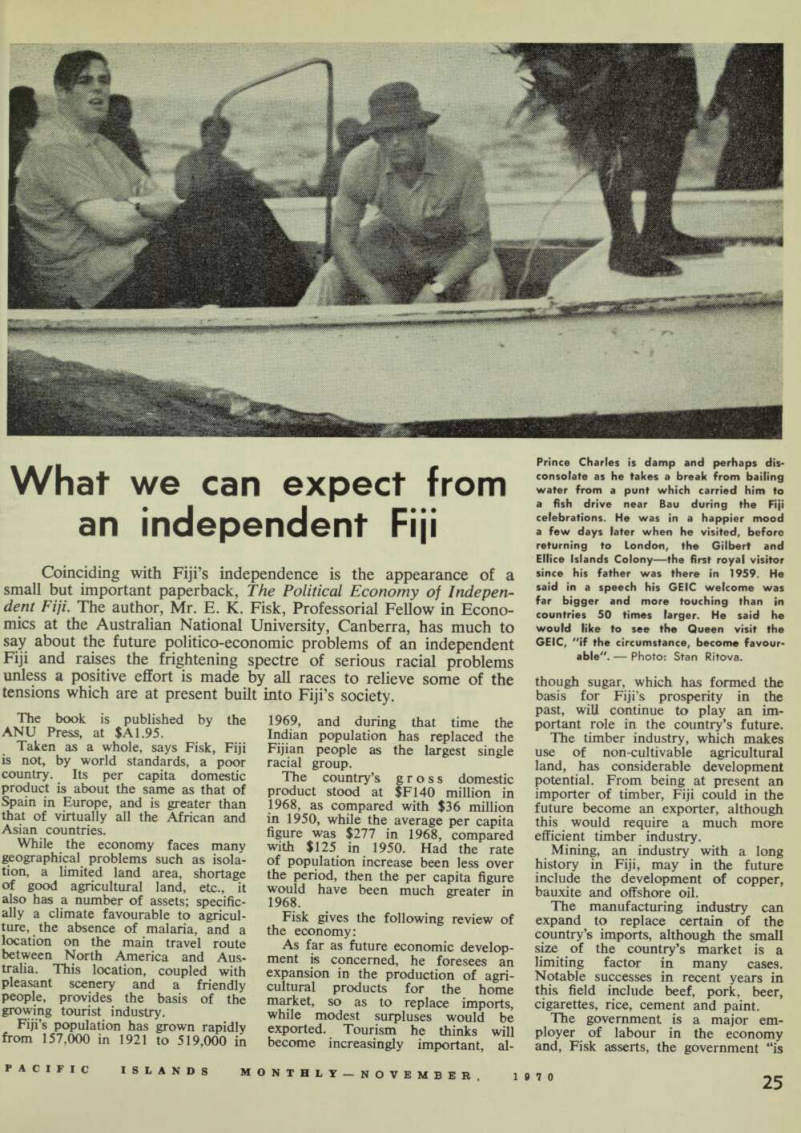
Prince Charles is damp and perhaps dis consolate as he takes a break from bailing water from a punt which carried him to a fish drive near Bau during the Fiji celebrations. He was in a happier mood a few days later when he visited, before returning to London, the Gilbert and Ellice Islands Colony—the first royal visitor since his father was there in 1959. He said in a speech his GEIC welcome was far bigger and more touching than in countries 50 times larger. He said he would like to see the Queen visit the GEIC, "if the circumstance, become favour able".-Photo: Stan Ritova.
efficient and honest—particularly so for a country in this stage of de velopment”. At present there is no central bank in Fiji, and so the main banking services are operated by in stitutions controlled from overseas.
In practice this system has worked well so far, although with indepen dence, he thinks a central bank would now appear to be necessary.
The scope for local investment is limited, there being no stock ex change at present. Investment has nevertheless been running at a high rate, totalling $3O million in 1967.
The country’s external public debt at $4.5 million in 1967 is relatively small and there is considerable scope for further overseas borrowing for development purposes.
The subsistence sector in Fiji con tinues to account for a large and important part of the country’s economic activity. The subsistence sector can be divided between inde pendent commercial farmers, who are mainly Indians growing cash crops and their own food, and the Fijian village population. This latter group farm their lands in the traditional manner, and their agri culture is in most areas highly pro ductive. This has given rise to the quite serious problem where a senior Fijian Government official can readily go back to his village, after an absence of many years, and can live a life where he lacks for little.
In this way, many able and well trained Fiijans are lost to the govern ment and to industry.
After this brief and yet thorough review of the Fijian economy, Fisk concludes that as a whole the economy appears to be in a reason ably healthy state. Economic plan ning is reasonably well developed,
the balance of payments position is good and there is a strong inflow of private capital. If well managed, the economy as a whole is set for a period of strong, orderly growth.
But then he issues sounds of warn ing.
“Unfortunately,” writes Fisk, “it is entirely misleading to look at the Fijian economy only as a whole unit.
For to do so hides problems which are themselves far more important than the single issue of national economic growth.
“The main problem facing Fiji is the very uneven distribution of in come between the three racial groups which make up the Fijian popula
tion. On top of this is the unequal distribution of political power, al though this does encourage inter racial party politics, rather than politics on purely racial lines.
Generally, the politico-economic in fluence of the European and Chinese community far exceeds their numerical value in the population.”
He says that basic to this whole problem is the fact that Fijians, Indians and the European and Chinese communities are quite dis tinct, not only racially and politic ally but, “they also have distinct historical backgrounds, different cultures, different motivations and social values. And these three groups are differently distributed over Fiji’s land area, have different economic activities and face different economic opportunities”.
Land ownership is one of the major issues. The Fijians own four fifths of the land, while the re mainder is either privately owned freehold land or is Crown land.
The non-Fijian land often includes the better agricultural land. The Indian community owns very little land, and mostly leases land from the Fijian community.
Looking at Fiji’s growth industries it is apparent to Fisk that Europeans and Indians occupy not only more of the jobs than their numbers warrant, but they also hold nearly all of the better jobs. There are also many medium and small-scale industries which are dominated by the Indian populace, while the Fijians, owning most of the land, form a reasonably affluent subsis
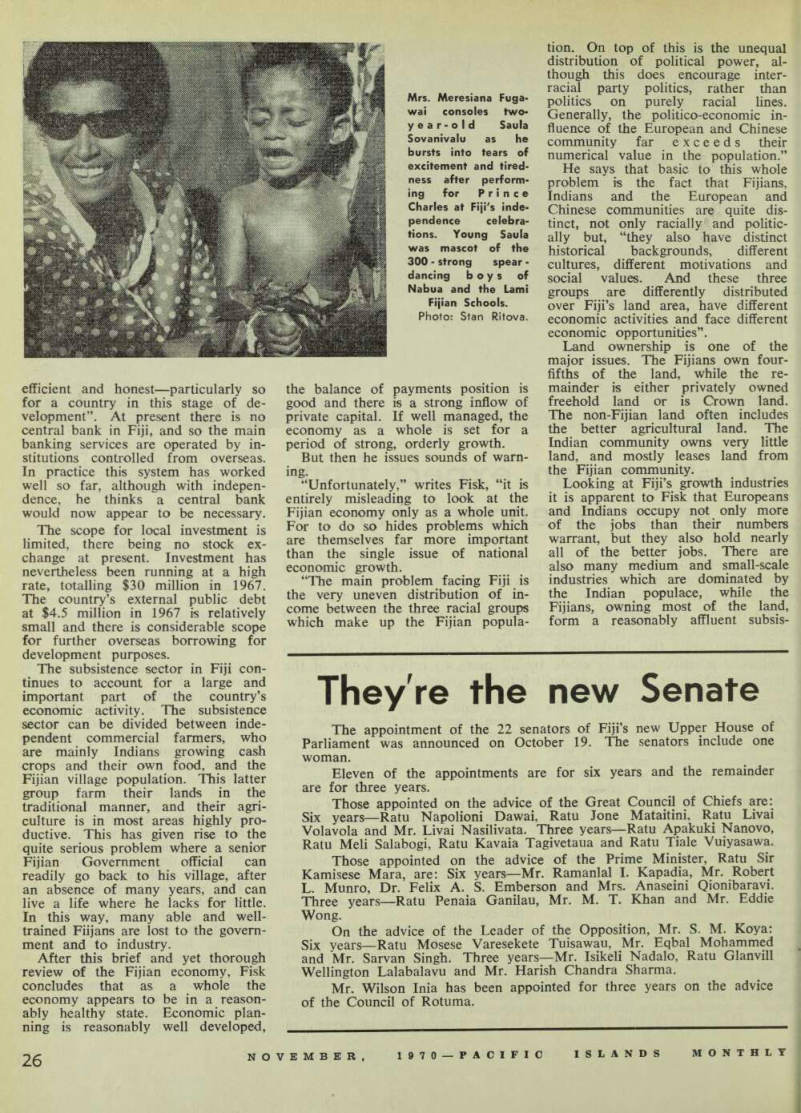
Mrs. Meresiana Fuga wai consoles two year-old Saula Sovanivalu as he bursts into tears of excitement and tired ness after perform ing for Prince Charles at Fiji's inde pendence celebra tions. Young Saula was mascot of the 300 - strong spear dancing boys of Nabua and the Lami Fijian Schools.
Photo: Stan Ritova.
tence sector. Obviously the economic roles of the different racial communi ties vary very considerably.
To date racial relations have been ►urprisingly good in Fiji. Yet when me looks at all these racial inequali ;ies which Fisk details, it becomes dear that such good relations cannot )e taken for granted in the future.
Summarising his arguments, the ►mail European and Chinese group las economic and political power n the country out of all proportion 0 its numbers. The Indians are lumerically in a majority, although >olitically they are not, and they nust in the future increasingly come ip against Europeans, Chinese and ujians in the search for jobs. The rijians’ dominant concern must be hat of seeing themselves to be a ninority in their own land; in seeing booming economy in which they »lay only a small part, and in seeing he end of a British rule, which if it las not favoured them, has at least qarded most of their interests.
Over the past decade Fiji has 'aid much attention to providing he political and administrative aachinery for the preparation and mplementation of economic develop ment plans. There is a Ministerial )evelopment Planning Committee nd a Central Planning Office, to ether with other groups of experts 1 the various ministries. Added to hese are teams of advisers from tritain, various UN agencies, and rom firms of international consul ants. Taken together, this all adds
up to a very effective planning machinery.
Yet, present planned development, with its emphasis upon “the promotion of growth in commercial agriculture, industry and tourism” is rapidly worsening the serious racial unbaiance in the country and is adding to the serious strains existing be^ e . n .thf various races.
This is bringing into jeopardy not only the economic growth the plan seeks to produce, but also a large part of the social, political and w n T 1C H Pr » BreSS Z°l ° Ver the last decades, says Fisk.
Where, Fisk asks, is all this pe™ 0 w P iITT g t !f admg , the . u- th if B °? s f^n!w ent ?°^ cy . wtu ch guide the pprvnrmvip 5r an u 1 i P [ operl J’ economic policy should lead towards the type of environment and society desired for the country. An economic policy directed solely to increasing the country’s national income could, Fisk argues, “make Fiji an intolerable place in which to live”
The key policies which Fisk believes should comprise Fiji’s economic policy are: (1) The maintenance of national independence; (2) the maintenance of racial harmony; (3) effective population control; (4) the abolition of the worst poverty.
Only after these policies have met with some success should the country seek that economic growth which aims solely at an increase in the average per capita income. “In fact
the main economic problem requir ing massive and urgent government intervention in Fiji is not the size of the country’s national income but its distribution, and this requires recognition at all levels,” he says, The rac i a j tensions among Fijians are seen to stem not so much from poverty, from which their lands cushion them, as from their loss of economic, and to a lesser extent of political, influence in their country, Among the Indian populace, the limited employment opportunities mean that Poverty and hunger are a very real threat, and so greater access to land seems necessary. The Euro- Peans and Chinese can only fear resentment against their political and economic pre-eminence in the country, and future tensions could affect their investments, profits and even lives “ M , . problems must be con sidled very seriously when economic F° ICy 1S ma J®» lf . necessary the tei 3 ns °? , whlch f( >reign enterprises and ca P lta l enter the country must be modified to some extent, to con tnb“te towards the solution of the P roble ms.
Fisk clearly points out that any f ea l on these problems will involve a considerable sacrifice of the jealously-guarded narrow interests of the different racial groups. But little hope remains for Fiji unless these sacrifices are made, and narrow in terests subordinated to the interests of the country as a whole, This is at once a sympathetic and
yet at times a frightening book.
With great care and attention to de tail, Fisk considers Fiji’s economy and points to the considerable pro gress which has been made in the country’s economic development.
With similar care, attention and de tachment he points to all of the weaknesses to be found in Fiji’s multi-racial society. It is, writes Fisk, “a situation of great potential danger”.
And yet Fisk does not limit him self to a diagnosis of the patient’s ills, for in the last chapter of the book he sets out a very realistic prescription for the first steps of a cure. To those interested in the long term well-being of Fiji this book is sobering and yet stimulating reading.
It should be made required reading for all those involved in planning the future Fiji.
Air Fares To Go Up!
Hopes that air fares across the South Pacific might be reduced, were dashed at the October lATA fares conference in Honolulu in October.
Fares will increase by 5 per cent, from February to points across the South Pacific and the 5 per cent, reduction on return flights will be scrapped. But as an inducement to group travel, lATA have introduced special fares which will save as much as $285 on a round-the-Pacific trip —if passengers visit virtually all the Pacific basin countries. The 5 per cent, fares increase does not apply to trans-Pacific through travellers.
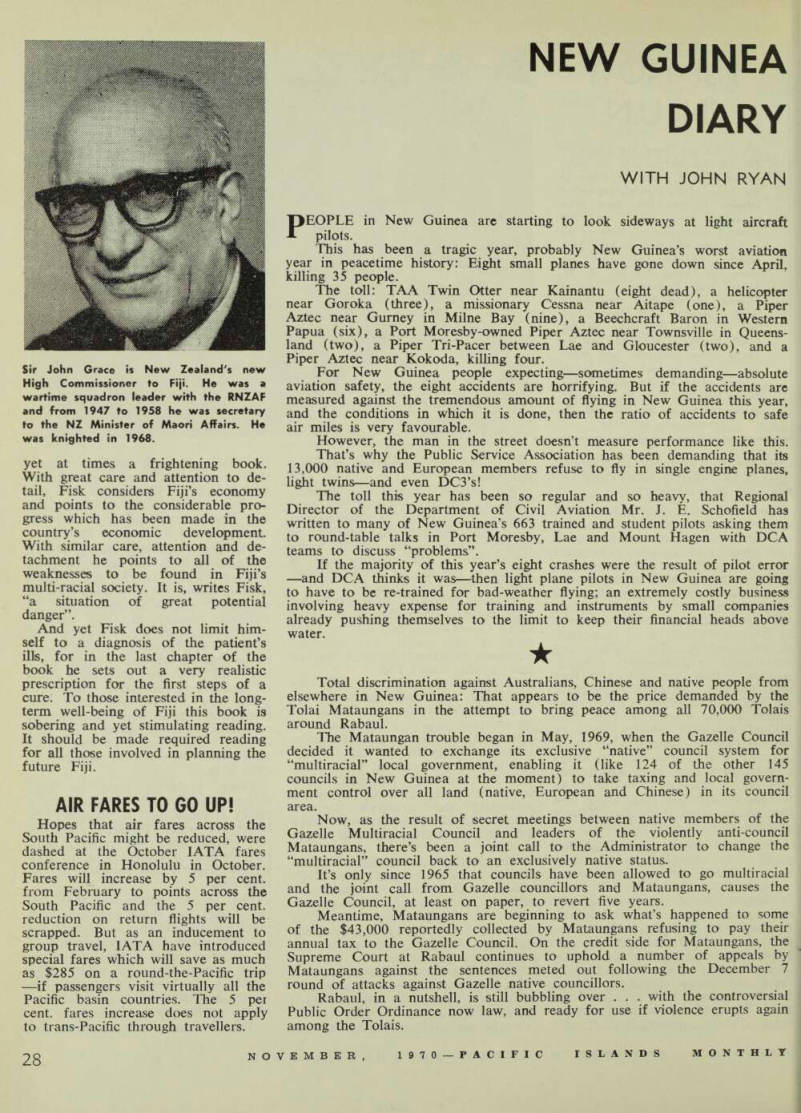
Sir John Grace is New Zealand's new High Commissioner to Fiji. He was a wartime squadron leader with the RNZAF and from 1947 to 1958 he was secretary to the NZ Minister of Maori Affairs. He was knighted in 1968.