Pacific Islands Monthly
pp. 23-25 · Read in the full issue
Fiji independence was a lump in the throat and a hope for the future
From SUE WENDT, in Suva The breath-taking spectacle of sulu-clad soldiers marching with precision and pride icross the greensward of Albert Park. . . . The bar-oom of cannon and the rattle of rifle-fire, puffs )f smoke fading into a clear sky. A rainbow bevy of Indian girls weaving a graceful dance around he flagpole, Fijian warriors leaping, lalis beating. ... A pale blue flag, showing a Union Jack with the 7 iji coat-of-arms in one corner, rising steadily. The incredible sight of three RANZF Orions appear ng from over the hill and swooping low at the precise moment that the flag of nationhood reaches he top of the pole.
Fiji’s independence celebrations: a aleidoscope of pageantry and colour, if split-second timing and awesome pectacle. It was a time for feasting nd dancing and singing, to an xtent never before seen in these ►lands. And it was time for a lump i the throat . . . and a heart farming hope for the future.
Even the organisers couldn’t have Dreseen the smoothness with which le four days of celebrations were onducted, event by event, and in very corner of the Fiji Group.
What might have been a major pset—Royal guest of honour, Prince harles’ arrival in Fiji some 3i hours iter than planned—became only a linor hitch. The reception by the lay or of Suva was dropped, but ;placed later in the programme with friendly gathering of councillors, layor and casually-dressed Prince at le Suva Town Hall.
A 21-gun salute marked the 21- ;ar-old Prince’s arrival at Nausori irport at 3 p.m. on October 9. At Ibert Park, Suva, representatives of ;arly 30 countries and a crowd of lousands awaited him under a rain javy sky. He was welcomed with laborate Fijian and Indian sremonies.
At five past six came the end of iji’s era as a British colony. The nion Flag was lowered, an emo- Dn-charged climax to the moving sremony of Beating Retreat. The mng heir to the British throne stood raight and tall, a lump, perhaps, his own throat.
Prince Charles watched the sremony from a masi-decorated ivilion erected in front of the
park’s permanent pavilion. With him were the Governor-General designate, Sir Robert Foster, with Lady Foster, the Prime Minister, Ratu Sir Kamisese Mara and Adi Lady Lala Mara and the Prime Ministers of New Zealand, Western Samoa, Tonga and the Cook Islands.
Also present were representatives of Australia and India.
In a speech of thanks for the ceremonies of welcome the Prince said that he had been told that it was a departure from tradition to have Indian ceremonies combined with Fijian ceremonies of welcome.
“This is a true indication of the future potential of this multi-racial society and I wish all its people success beyond measure,” he said, his clear voice ringing across the park to the crowds watching from the roof of the historic Grand Pacific Hotel.
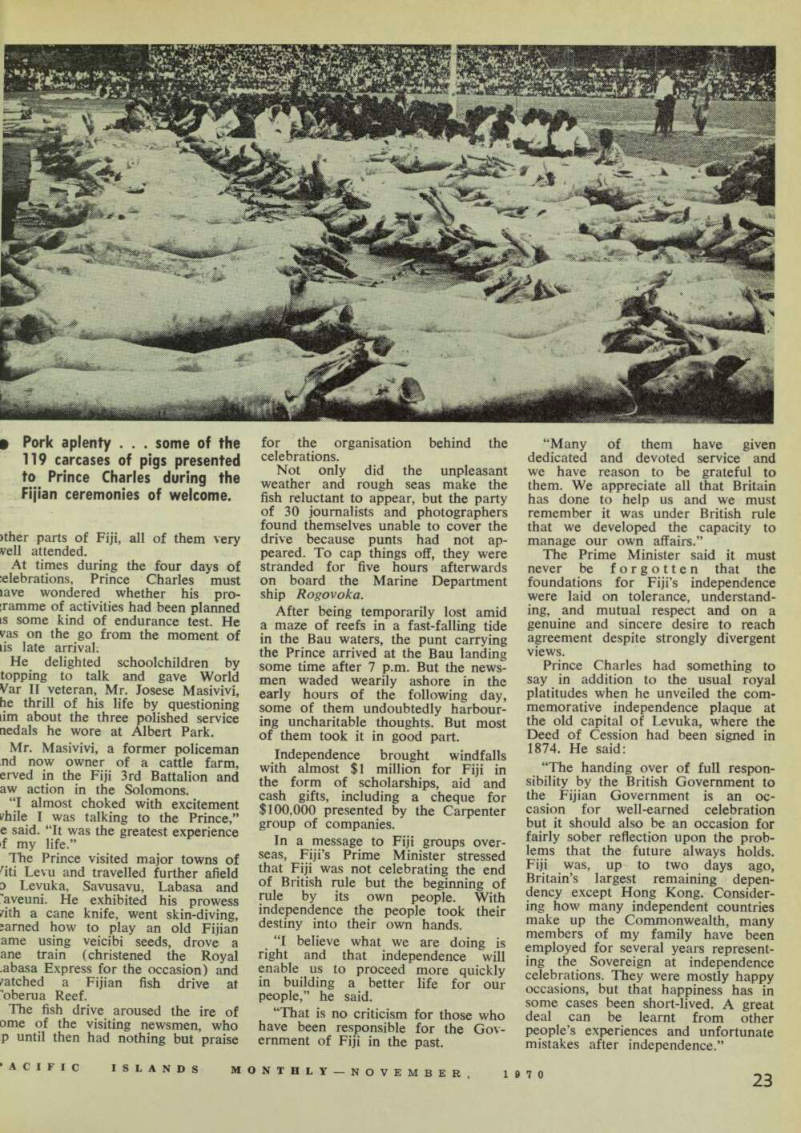
During the welcome ceremonies, the Prince received 14,000 dalo and yams, 119 pigs and 23 turtles, presented by the 14 provinces in Fiji.
At 10 a.m. on October 10 the blue Fiji flag was hoisted in a ceremony watched by more than
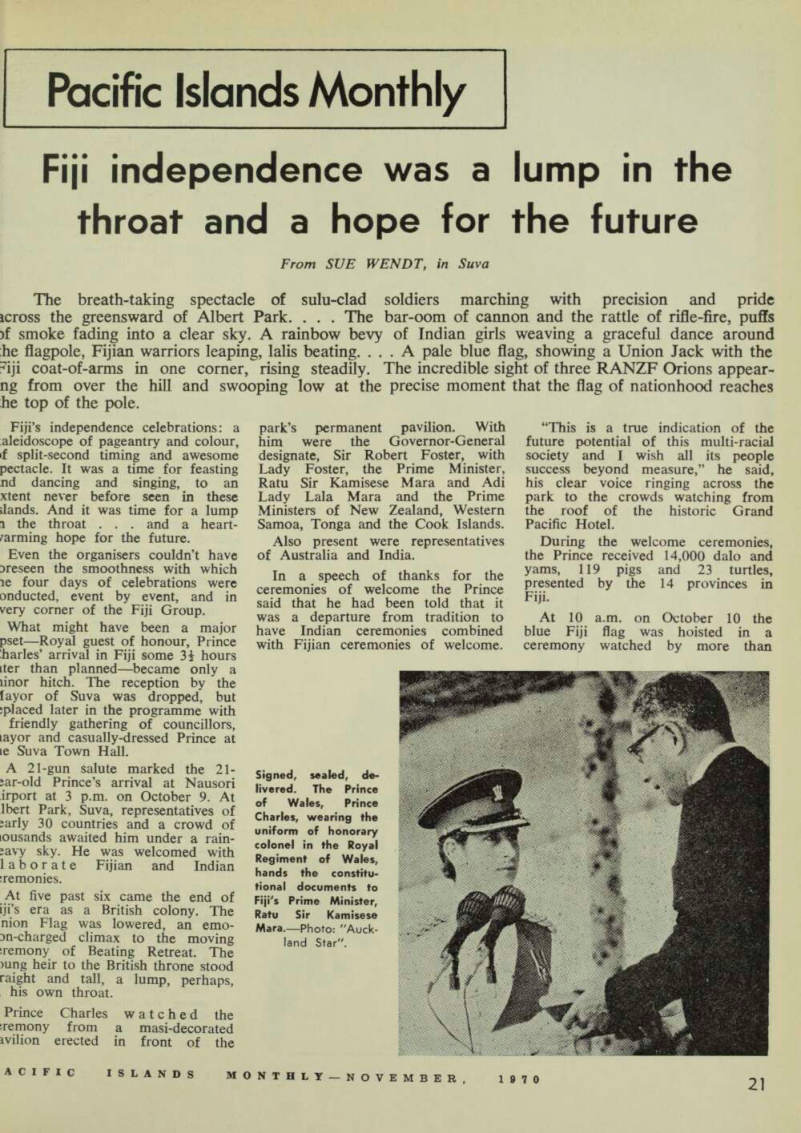
Signed, sealed, de livered. The Prince of Wales, Prince Charles, wearing the uniform of honorary colonel in the Royal Regiment of Wales, hands the constitu tional documents to Fiji's Prime Minister, Ratu Sir Kamisese Mara.—Photo: "Auck land Star".
20,000 people and filmed by tele vision crews from several countries.
Earlier the crowd had watched Fiji’s Prime Minister accept the new dominion’s constitutional documents from Prince Charles. Ratu Sir Kamisese, with simple dignity and in eloquent tribute to Fijian tradi tion, knelt in the “cobo” position to deliver a ceremonial speech of ac ceptance to the Prince. He spoke in Fijian.
Then he rose to give his prepared speech of acceptance of the con stitutional instruments—the Order in Council and Independence Act, printed on vellum and rolled scroll fashion.
It was after this that the folded piece of cloth symbolising a new era for Fiji was carried by Captain Namosi Komaisavai to the flagpole in front of the frond-draped Royal dais.
The captain, colourfully flanked by the scarlet tunics of Fiji Military Forces soldiers, placed the flag on six drums at the foot of the flagpole.
A bellowing order to “present arms” rang out. The Reverend Samisoni Vugakoto, chaplain to the FMF, delivered a blessing. Drums rolled . . . and the flag of independent Fiji rose fluttering in the breeze.
The appearance of the three Orion aircraft at that precise instant and the single booming salute from an FMF battery on the hillside made the moment almost unbearably emotional.
Flags rose simultaneously at pre arranged points throughout Fiji.
On Sunday October 11, all stands at Albert Park were filled for the ecumenical service of praise and dedication, a service in which all religions—Christian, Hindu, Muslim and Sikh—joined.
As observers remarked, there can have been few similar gatherings to mark the coming of national indepen dence or any other occasion.
Doctrinal differences were forgotten and language barriers seemed of no consequence. Muslim, Hindu, Christian and Sikh prayers were offered. The Prime Minister led the assembly in an act of personal dedication to God.
Similar ceremonies were held in
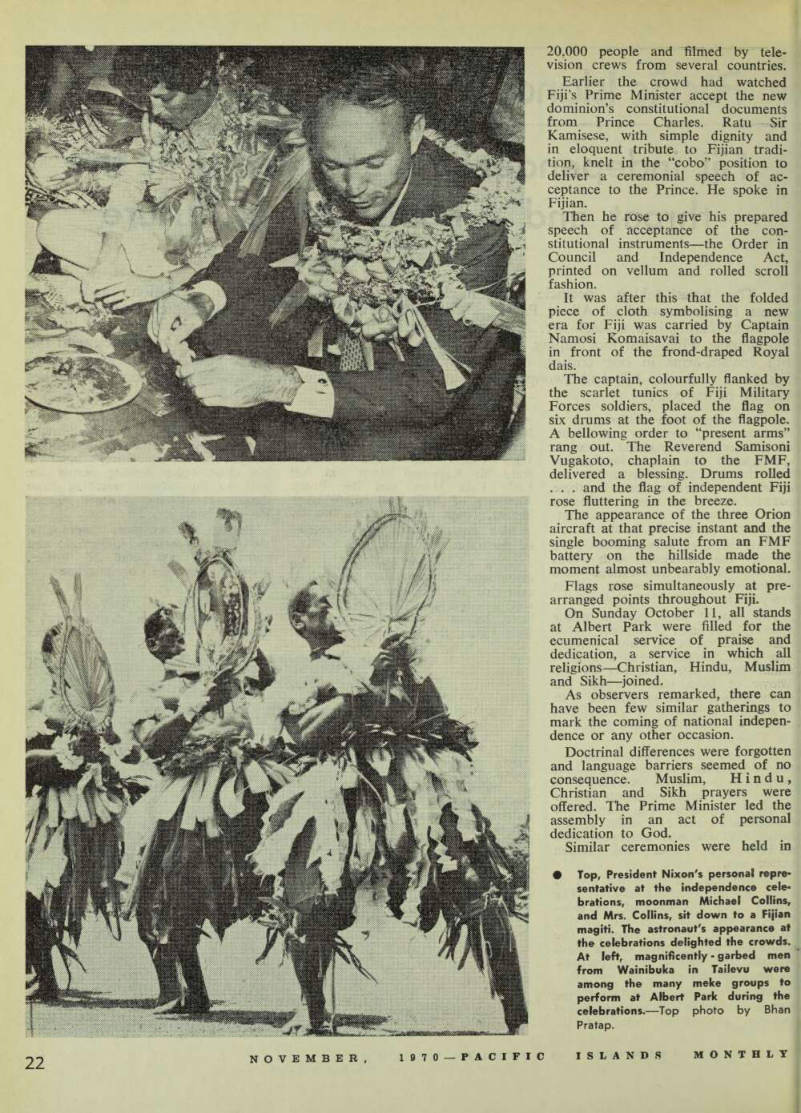
Top, President Nixon's personal repre sentative at the independence cele brations, moonman Michael Collins, and Mrs. Collins, sit down to a Fijian magiti. The astronaut's appearance at the celebrations delighted the crowds.
At left, magnificently-garbed men from Wainibuka in Tailevu were among the many meke groups to perform at Albert Park during the celebrations.—Top photo by Bhan Pratap.
)ther parts of Fiji, all of them very veil attended.
At times during the four days of celebrations, Prince Charles must lave wondered whether his pro gramme of activities had been planned is some kind of endurance test. He vas on the go from the moment of lis late arrival.
He delighted schoolchildren by topping to talk and gave World Var II veteran, Mr. Josese Masivivi, he thrill of his life by questioning lim about the three polished service nedals he wore at Albert Park.
Mr. Masivivi, a former policeman nd now owner of a cattle farm, erved in the Fiji 3rd Battalion and aw action in the Solomons.
“I almost choked with excitement /hile I was talking to the Prince,” e said. “It was the greatest experience if my life.”
The Prince visited major towns of Tti Levu and travelled further afield a Levuka, Savusavu, Labasa and 'aveuni. He exhibited his prowess dth a cane knife, went skin-diving, earned how to play an old Fijian ame using veicibi seeds, drove a ane train (christened the Royal .abasa Express for the occasion) and matched a Fijian fish drive at 'oberua Reef.
The fish drive aroused the ire of ome of the visiting newsmen, who p until then had nothing but praise
for the organisation behind the celebrations.
Not only did the unpleasant weather and rough seas make the fish reluctant to appear, but the party of 30 journalists and photographers found themselves unable to cover the drive because punts had not ap peared. To cap things off, they were stranded for five hours afterwards on board the Marine Department ship Rogovoka.
After being temporarily lost amid a maze of reefs in a fast-falling tide in the Bau waters, the punt carrying the Prince arrived at the Bau landing some time after 7 p.m. But the news men waded wearily ashore in the early hours of the following day, some of them undoubtedly harbour ing uncharitable thoughts. But most of them took it in good part.
Independence brought windfalls with almost $1 million for Fiji in the form of scholarships, aid and cash gifts, including a cheque for $lOO,OOO presented by the Carpenter group of companies.
In a message to Fiji groups over seas, Fiji’s Prime Minister stressed that Fiji was not celebrating the end of British rule but the beginning of rule by its own people. With independence the people took their destiny into their own hands.
“I believe what we are doing is right and that independence will enable us to proceed more quickly in building a better life for our people,” he said.
“That is no criticism for those who have been responsible for the Gov ernment of Fiji in the past.
“Many of them have given dedicated and devoted service and we have reason to be grateful to them. We appreciate all that Britain has done to help us and we must remember it was under British rule that we developed the capacity to manage our own affairs.”
The Prime Minister said it must never be forgotten that the foundations for Fiji’s independence were laid on tolerance, understand ing, and mutual respect and on a genuine and sincere desire to reach agreement despite strongly divergent views.
Prince Charles had something to say in addition to the usual royal platitudes when he unveiled the com memorative independence plaque at the old capital of Levuka, where the Deed of Cession had been signed in 1874. He said: “The handing over of full respon sibility by the British Government to the Fijian Government is an oc casion for well-earned celebration but it should also be an occasion for fairly sober reflection upon the prob lems that the future always holds.
Fiji was, up to two days ago, Britain’s largest remaining depen dency except Hong Kong. Consider ing how many independent countries make up the Commonwealth, many members of my family have been employed for several years represent ing the Sovereign at independence celebrations. They were mostly happy occasions, but that happiness has in some cases been short-lived. A great deal can be learnt from other people’s experiences and unfortunate mistakes after independence.”
Pork aplenty . . . some of the 119 carcases of pigs presented to Prince Charles during the Fijian ceremonies of welcome.