The Practical Planter
pp. 131-139 · Read in the full issue


Winning The War On New
Guinea's Cocoa Weevil
By Bill Ritchie, B.Agr.Sc.
When the sudden upsurge of a native weevil threatened to ruin cocoa plantings in Papua-New jruinea, something had to be done—and quickly.
Now, thanks to research, a spray ig programme is reclaiming cocoa rees from the ravages of this pest -but it’s not easy.
Cocoa is not a new crop to the slands which sweep across to the orth and north-east of Australia, ut the last 10 years or so have een substantial expansion of plant igs.
Major areas of expansion centre round Popondetta, Papua, and the lazelle Peninsula, not far from Labaul in New Britain.
Here you’ll find fairly large planta ions, averaging about 150 to 200 cres and run by Europeans, together dth the smaller native holdings anging about 10 to 15 acres.
When large areas of forest were leared for planting some 10 years go, good prices beckoned, and the iiture looked really rosy.
Now, when 10-year-old stands hould be producing at their peak, ocoa prices have fallen drastically, nd Pantorhytes weevil, coupled with range of other pests and diseases, as taken a large bite out of anticipa ;d production on large areas of the lantings.
Pantorhytes weevil is a native of liese islands, and is spreading as ar west as Indonesia. It is also in tie Solomons.
More than 50 species have been lentified, but three of them are ausing the major trouble—Panto hytes szentivanyi around Popondetta, *. batesi in the Markham Valley, and *. plutus on the Gazelle.
Host plants for the weevil are aany and varied, and prominent mong them is Pipturus, a shrub or mall tree which is one of the first egrowth plants where land is cleared.
Pantorhytes had long been recog ised as a pest of cocoa, but as new re as were developed to cocoa, it iccame more apparent, probably
emerging from the forest to take advantage of this new and concentrated food supply.
Then about 1967, it really began to make its presence felt, and built up to become the most pressing pest of cocoa, ruining up to 80 per cent, of the trees in some plantings, and posing a severe threat to plantings generally.
This flare-up demanded swift action, and a group of entomologists led by Mr. T. V. (Terry) Bourke, Principal Entomologist of the Department of Agriculture, Stock and Fisheries, at the entomological laboratories at the Popondetta Agricultural Training Institute, quickly intensified research on the pest and began screening insecticides to counter its threat.
To understand the damage caused by this pest needs an understanding of its life cycle.
The adult is a hard-shelled weevil about an inch long, almost spiderlike in its rapid scurrying movements.
Although it cannot fly, it is very mobile, and once a close canopy of leaves has formed in a plantation, can range the whole area without touching the ground, Young trees up to three or four years old are relatively unaffected, but in older trees the adult weevil feeds off the young bark of growing shoots, leaving scarred areas. These scars, or any other cracks and crevices in the bark, are ideal sites for depositing eggs which hatch in about two weeks into little larval grubs about an eighth of an inch long.
Here’s where the the real trouble begins.
These larvae burrow straight into the bark and sap wood, eating as they go, channelling as deep as 1 or 2 in.
Once inside, they are immune to orothodox spraying or dusting methods of treatment, even to the systemic insecticides tried, What’s more, they go on growing and developing for a minimum of
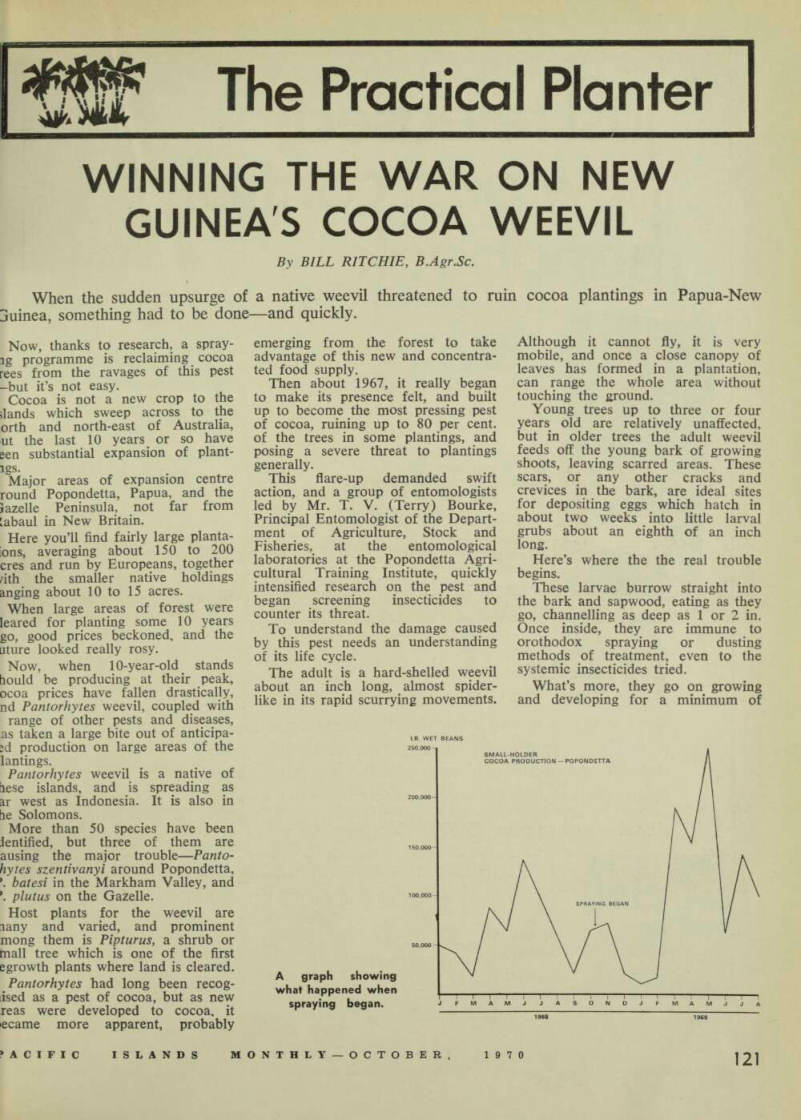
A graph showing what happened when spraying began.
ix or seven months before they merge again as adults. In some pecies it can be as long as a year.
This poses a real problem in pest ontrol. Protected in the trunk and ranches, the larvae are a steady eservoir of infective material. Even I all the adults were killed, new dults would keep emerging for at ;ast another six months—and up to year or more—to keep the infesta ion going.
In the meantime, they are channel ing through the trunk and branches, teadily weakening the tree—even ingbarking some of the branches— ntil branches collapse and the tree ies.
Infested trees go on producing ocoa pods right up to the end, ut once the infestation builds up 3 dangerous levels, it means—unless omething is done about the pest— bat the tree is doomed. It may ake two or three years to die, but be end is in sight.
Graham Baker, one of the Popon etta entomologists, has recorded 80 er cent, loss of trees in some blocks, nd in an observation area counted nly five surviving trees from an riginal planting of about 350.
According to Terry Bourke, there an be up to 350 larvae in one tree, nd a badly infested tree can be iterally riddled by six to seven years fter planting—before it is even aature and into full production.
Traditional methods of control, .'here infestations are only light, are and picking of adult weevils from be trees by work gangs, and tackling be larvae in the channels by fishing bem out with a piece of wire or minting the channel with insecticide.
Dichlorvos and fenthion have proved the most effective chemicals for this. Banding tree trunks with Osticon—a tacky paste containing the Bayer insecticide product, Dipterex, is used to prevent weevils from enter ing newly planted areas.
But these methods have failed hopelessly where weevils have built up to large numbers and are doing the real damage to the plantations.
Terry Bourke and his colleagues had to find a much more effective control system.
Biggest stumbling block was the long part of the life cycle spent out of reach of normal insecticide application, but the weak point of the pest was found in another part of the life cycle.
After a new adult female emerges from the channel in the tree, it is about seven to eight weeks before she can lay fertile eggs. This is the weakness which makes possible slow strangulation of the weevil popula tion.
If adults could be killed every six weeks, they would get no chance to lay eggs to carry on the infesta tion. New adults would keep hatch ing from the reservoir of larvae for many months, to be killed in their turn before they could lay fertile eggs. After about a year, the supply of larvae in the tree would be exhausted, with no fresh ones to re place them.
Unfortunately, it’s not as easy as that. You can’t kill all the females present at a spraying. Some get through to carry on the cycle.
But Terry Bourke and his group reasoned, if you could get a fair proportion of the adults at each
spraying, you would markedly reduce egg laying, cut down the number of larvae, and bring the pest down to a level where the trees could still produce effectively without fear of mass extinction, and the older methods of control could handle this level of pest.
They screened a wide range of insecticides and narrowed it down to a handful which proved effective against the weevil. From these they chose Bayer Dipterex.
They said it was the safest of them to use. Its toxicity to humans was only about half that of DDT. This safety factor is vital where unskilled labour is used.
It left no harmful or unwanted residues. It was fairly specific— active against the weevil, but not against natural predators of the weevil or other beneficial insects. It did not endanger birds, wild life, or domestic animals.
It was found that a monthly spraying with Dipterex SPBO, using about 2 lb active ingredient in 25-30 gallons of water per acre gave at least 50 per cent, kill of adults. This, it was considered, could tackle the problem.
Prompted by these results, the Administration introduced a control programme for the Popondetta region
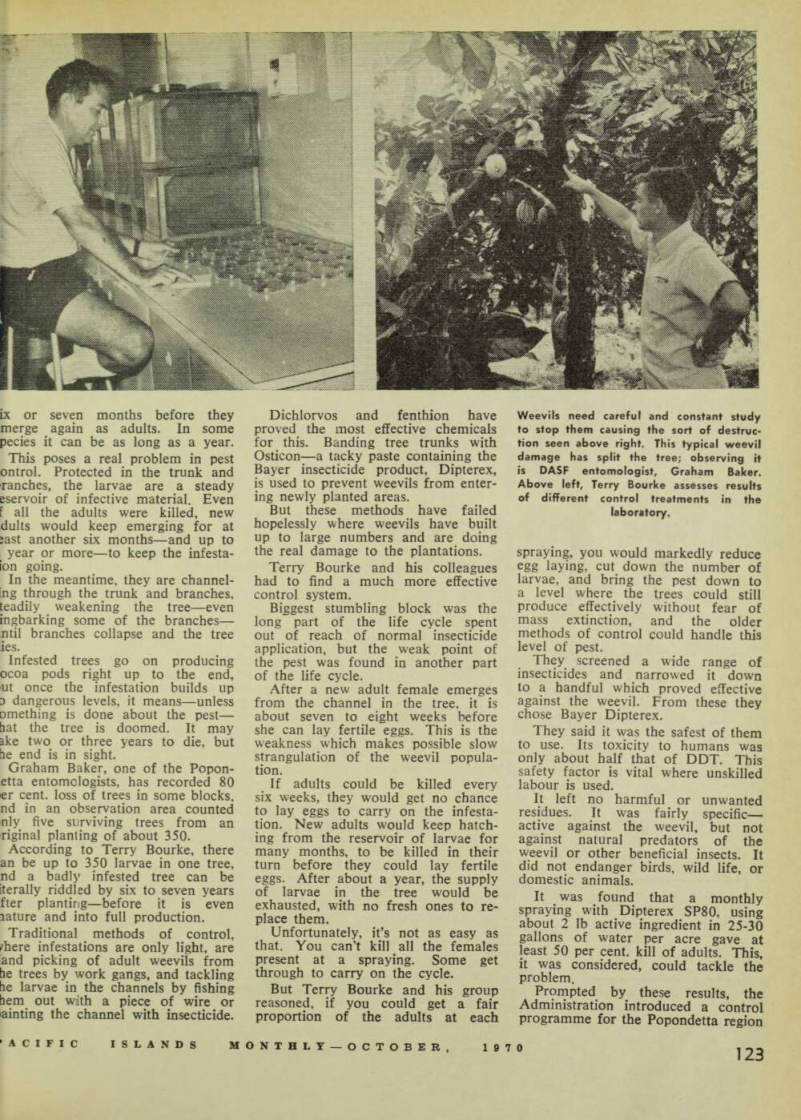
Weevils need careful and constant study to stop them causing the sort of destruc tion seen above right. This typical weevil damage has split the tree; observing it is DASF entomologist, Graham Baker.
Above left, Terry Bourke assesses results of different control treatments in the
laboratory.
Vo harmful effect
ate in 1968. Larger plantations were riven Dipterex and portable misting nachines free of cost. Small hold ogs—mainly owned and operated by *apuans—were treated by spraying earns from the BASF, administered >y John Swanston.
The programme was tor li nonthly sprayings, by which tune it vas considered weevil populations vould again be at reasonable levels, md spraying could then possibly be tretched to once every three months.
Before long, however, Terry Jourke and his group began using l lower volume spraying technique, nvolving low - volume - concentrate Dipterex in about three gallons of rater per acre. This gave a better -ill—about 80 per cent, of the adults it each spraying. .
This allowed the spraying schedule o be lengthened to spraying every ix weeks. It meant fewer spray ngs, faster spraying, and a marked owering of cost, so about three luarters of the way through the pro ;ramme, it was switched over to the lewer technique. „ In the meantime, Mr. u. r.
Dermott) O’Sullivan, entomologist >f the BASF at the Lowlands Agri cultural Experimental Station at Ceravat, on the Gazelle Peninsula, lad been working with a closely ■elated weevil Pantorhytes plutus, vhich had been making inroads m jarts of the 30,000 acres and more >f cocoa on the peninsula.
His results paralleled the Popon letta work, and Bermott recom nended a similar spraying tramme for infested areas, although lere the cocoa growers had to go t alone, without financial help from he Administration.
Now, more than a year after the ecommended control programmes >egan, there is no doubt that where he spraying was done effectively, and iccording to the programme, it has lealt a severe blow to the weevil md turned on the road to recovery arge areas of cocoa trees which vere otherwise doomed.
The performance of the small lolder blocks around Popondetta, vhich were sprayed by the Admini itration, is striking evidence. Badly nfested areas which were almost vritten off have responded to the reatment.
Production has taken a leap upwards (see graph on p. 121).
Ken Francis, whose “Bebelau” ilantation is at North Sangara, near Popondetta, planted 69,000 cocoa rees in 1960-61. In June, 1969, he had 37,000 of them left, and was
Road to recovery
into a massive replanting pro gramme.
“I’d been hand picking and treat ing larval channels, but in late 1967 the weevil went like an explosion,” he explains. “About 45 acres were almost a write-off.
“My production dropped from 60 tons to 40 tons a year, and was still falling. I’d have been out of business if I hadn’t done something.”
Now Ken has a year’s spraying behind him, but he missed a couple of sprayings, and is still not quite at the stage where he can handle the weevil with a spray every three months coupled with picking and channel treatment.
His production dropped another 10 tons after he started spraying, as trees already ravaged continued to die, but now there’s a real improve ment in the affected regions, and he expects 40-45 tons this When replanting is complete and in pro duction, he expects to be back on the 60 ton level.
He’s now so confident that he can handle the weevil that he plans further expansion of cocoa, inter planted with rubber.
John Richardson and his vivacious blonde wife Hilda have had their share of pest problems on their plantation “Tuna Puna”, on the Upper Warangoi of the Gazelle Peninsula, but it hasn’t stopped John from rigidly adhering to the spray ing programme.
He found his cocoa areas, hacked
Sangara planter Ken Francis now plans further cocoa plantings.
°roduction right up
rom the forest some 10 years ago, nfested in all stages from minor to write-off”, when in 1967 the weevil really went mad”, as he describes t. Hand picking and larval channel reatment wouldn’t stop it.
Now, after about a year’s spraying, te’s bent on eradication of the weevil.
Uready there’s a vast improvement a the treated areas, and he’s going a to treat trees in areas he had /ritten off and was replanting.
He hopes that now he can take tie pressure off and spray only about very three months, depending on iow things turn out.
Unfortunately, the same story an’t be told of all the infested ocoa in the Popondetta and Gazelle 'eninsula areas. In some cases re □lts have been somewhat disappoint ig to the growers.
Terry Bourke and his entomologi al colleagues are convinced that the lain problem is of getting thorough pplication of the spray. Looking trough some of the plantings, this 5 understandable.
Some are relatively flat, and clean nough to use tractor mounted listers. In others, the land is steep nd broken, with impediments like alien logs and stumps, and man lounted machines must be used.
Heavy falls of rain interrupt praying programmes, and it’s difficult 0 impress the importance of a borough cover on unskilled labour.
Then there’s a psychological factor. r ou must continue regular sprayings or many months before you see ppreciable effects, and this could /ell have a discouraging effect on ny control programme.
But where the insecticide has been pplied thoroughly and according to ecommendations, the results are here to see.
Dermott O’Sullivan will show you reas on the Gazelle Peninsula where intreated trees show a 50 per cent, lortality, alongside treated trees with •nly 16 per cent, dead-trees which iad probably gone too far before reatment.
Meanwhile, Terry Bourke and his roup at Popondetta continue their esearch to develop even more effec ive control programmes. They know 1 lot about the weevil, but they /ant to know more. They have a pray which is effective against it, but hey are looking for simpler and nore effective methods of application.
Answers are now being sought in egions where similar problems have >een met and countered —such as the ar-removed steep orchards of the Adelaide Hills of Australia.