Pacific Shipping
pp. 105-109 · Read in the full issue

Mili Under Fire
In Micronesia
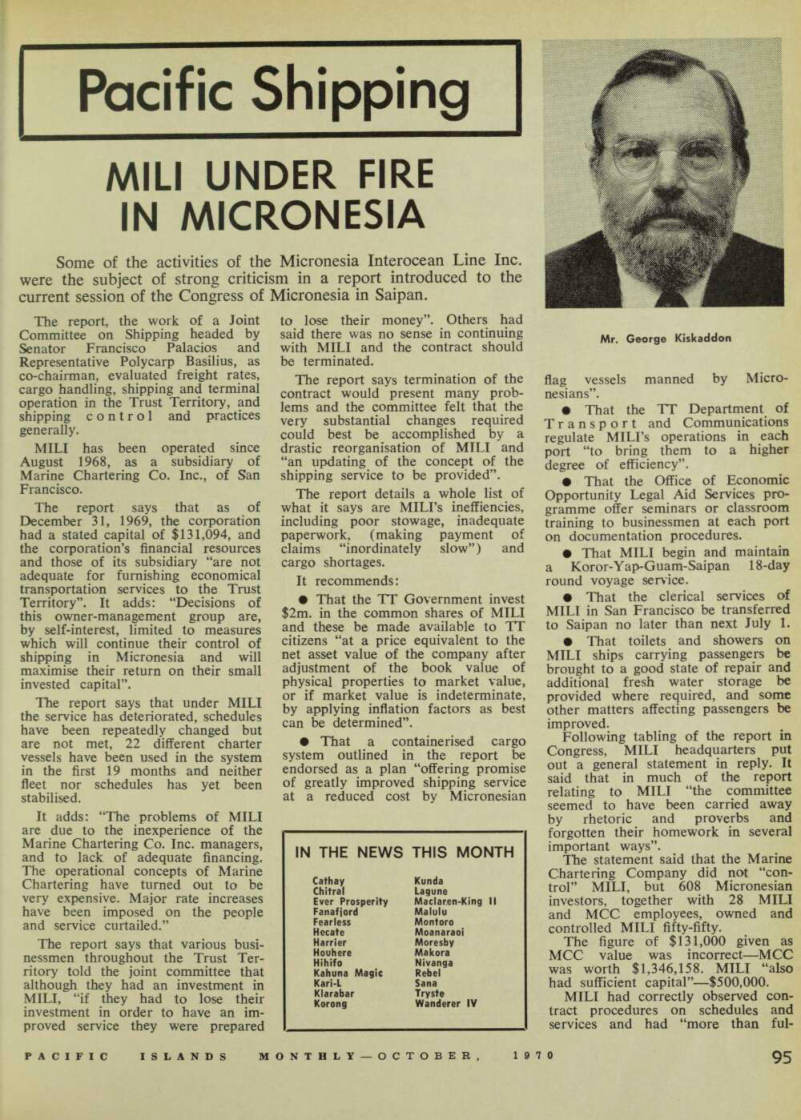
Some of the activities of the Micronesia Interocean Line Inc. were the subject of strong criticism in a report introduced to the current session of the Congress of Micronesia in Saipan.
The report, the work of a Joint Committee on Shipping headed by Senator Francisco Palacios and Representative Polycarp Basilius, as co-chairman, evaluated freight rates, cargo handling, shipping and terminal operation in the Trust Territory, and shipping control and practices generally.
MILI has been operated since August 1968, as a subsidiary of Marine Chartering Co. Inc., of San Francisco.
The report says that as of December 31, 1969, the corporation had a stated capital of $131,094, and the corporation’s financial resources and those of its subsidiary “are not adequate for furnishing economical transportation services to the Trust Territory”. It adds; “Decisions of this owner-management group are, by self-interest, limited to measures which will continue their control of shipping in Micronesia and will maximise their return on their small invested capital”.
The report says that under MILI the service has deteriorated, schedules have been repeatedly changed but are not met, 22 different charter vessels have been used in the system in the first 19 months and neither fleet nor schedules has yet been stabilised.
It adds: “The problems of MILI are due to the inexperience of the Marine Chartering Co. Inc. managers, and to lack of adequate financing.
The operational concepts of Marine Chartering have turned out to be very expensive. Major rate increases have been imposed on the people and service curtailed.”
The report says that various busi nessmen throughout the Trust Ter ritory told the joint committee that although they had an investment in MILI, “if they had to lose their investment in order to have an im proved service they were prepared
to lose their money”. Others had said there was no sense in continuing with MILI and the contract should be terminated.
The report says termination of the contract would present many prob lems and the committee felt that the very substantial changes required could best be accomplished by a drastic reorganisation of MILI and “an updating of the concept of the shipping service to be provided”.
The report details a whole list of what it says are MILI’s ineffiencies, including poor stowage, inadequate paperwork, (making payment of claims “inordinately slow”) and cargo shortages.
It recommends: • That the TT Government invest s2m. in the common shares of MILI and these be made available to TT citizens “at a price equivalent to the net asset value of the company after adjustment of the book value of physical properties to market value, or if market value is indeterminate, by applying inflation factors as best can be determined”. • That a containerised cargo system outlined in the report be endorsed as a plan “offering promise of greatly improved shipping service at a reduced cost by Micronesian
flag vessels manned by Micro nesians”. • That the TT Department of Transport and Communications regulate MILI’s operations in each port “to bring them to a higher degree of efficiency”. • That the Office of Economic Opportunity Legal Aid Services pro gramme offer seminars or classroom training to businessmen at each port on documentation procedures. • That MILI begin and maintain a Koror-Yap-Guam-Saipan 18-day round voyage service. • That the clerical services of MILI in San Francisco be transferred to Saipan no later than next July 1. • That toilets and showers on MILI ships carrying passengers be brought to a good state of repair and additional fresh water storage be provided where required, and some other matters affecting passengers be improved.
Following tabling of the report in Congress, MILI headquarters put out a general statement in reply. It said that in much of the report relating to MILI “the committee seemed to have been carried away by rhetoric and proverbs and forgotten their homework in several important ways”.
The statement said that the Marine Chartering Company did not “con trol” MILI, but 608 Micronesian investors, together with 28 MILI and MCC employees, owned and controlled MILI fifty-fifty.
The figure of $131,000 given as MCC value was incorrect—MCC was worth $1,346,158, MILI “also had sufficient capital”—ssoo,ooo.
MILI had correctly observed con tract procedures on schedules and services and had “more than ful
Mr. George Kiskaddon
filled” its promises of employment and training of Micronesians.
It had not delayed containerisation —it had over 700 containers now and would increase them until a potential of 40 per cent, was reached.
The statement, signed by George Kiskaddon, added there was bound to be opposition to the recommenda tions of the report, and that “oui guess is that the issue will escalate to include all sorts of arguments not present at this stage, such as public versus private ownership of utilities, of foreign v. local control, etc.”,
Strike Still Holds
"Montoro" In Sydney
Burns Philp vessel Montoro has been laid up in Sydney since the end of July by a seamen’s strike.
And Tulagi is to make her last run in October.
When BP’s sold the Moresby it was agreed to convert Montoro to suit an Australian crew while seeking another ship. Negotiations on the manner in which Montoro was to be converted, were still under way in mid-September between the Seamen’s Union and Burns Philp. See p. 38 for details of Montoro and Tulagi.
Joint Marine Safety
Board For Samoas
A Marine Safety Board is to be jointly set up by the governments of Western and American Samoa.
The first meeting will be held soon in Apia to discuss purposes and objectives of the joint board and establish a standard set of regulations for the inspection and operation of inter-island and freight vessels.
Initial members of the board will be: American Samoa—Capt. R.
Payes, harbourmaster, and James Sword, marine railway manager; Western Samoa P. Plowman, harbourmaster, L. McQuitty, Direc tor of Works, and Capt. H. Moors Jr.
Members of the marine industry will be called by the board as necessary.
NEW E & A LINE SHIP FOR
Australia-Japan Service
The Eastern and Australian Steam ship Company will add the passenger vessel Chitral to the Australia-Japan route in November. At present with the Cathay on the service, sailings are every seven weeks. From November there will be monthly departures from Melbourne, Sydney and Brisbane to Manila, Hong Kong, Keelung, Kobe, Nagoya, Yokohama, and return via Rabaul and Brisbane.
The 14,000 ton Chitral, will be transferred to E & A Line, a member of the P& O Group, from P& O
Lines Ltd. Her sister ship Cathay was similarly introduced to the run in 1969.
The Chitral is a one-class liner built in France in 1956. She operated between the continent and the Belgian Congo as the Jadotville for the Cie Maritime Beige until 1961 when she was purchased by P& O Lines and renamed.
Chitral will depart Hong Kong on October 26 for Brisbane, Sydney and Melbourne, departing there for her first round voyage on November 18.
Norfolk Port Improvements?
That hardy perennial, the possibility of a harbour, came before the Norfolk Island Council in Sep tember. Most councillors thought that there were more immediate and urgent matters for the council to consider. After consideration it was decided to follow up a hydrographical and geological survey of Ball Bay as suggested by Mr. Taylor, the SPC expert who recently examined Norfolk’s potential for a port.
As the cost of a two stage hydro graphical survey alone is thought to be about $13,000, plus Administra tion costs, it seems that Kingston and Cascade jetties will be in use for some time.
More Local Masters
In The Geic
Betio-based master, Tom Murdoch, returned home in August after several months study and examina tions in Sydney. He becomes one of the Gilberts’ senior mariners.
Of the influential Murdoch clan of Tarawa and Kuria, he gained his first mate’s ticket, foreign-going, in Sydney. His employers, the Whole sale Society, gave him two months leave on his return and in October, he will resume work, probably as first mate on the 800-ton Moanaraoi.
This vessel operates to Majuro, (Marshalls), Sydney, Santo and Vila (New Hebrides), Suva (Fiji) and also makes infrequent copra calls throughout the GEIC.
Meantime, Tom is enjoying a well earned break with his attractive wife, Euginie (of another Gilbertese- European family, Reiher), and their three children, Steven, Tania and Helen.
The other senior masters of the GEIC include Willie Schutz, an ebullient German-Gilbertese, also of Betio, who has a master’s ticket, foreign-going, and is attached to the Marine Department. He pilots most of the overseas vessels into Tarawa lagoon.
Captain Lomi Niumala, originally of Nanumea, Ellice, and now living
on Betio, has a first mate’s ticket, foreign-going, and is currently first mate of the Moanaraoi.
In September, he will go to Southampton’s School of Navigation, U.K. to study for his master’s ticket, foreign-going.
Captain Teitia Redfern, originally of Onotoa and also a part-European (a descendent of a well-known English trader of Onotoa in the late 1800’s), has his master’s ticket, GEIC, and is currently skipper of the inter-island Nivanga.
Tekabu Karibaua, of North Tabiteuea, with a second mate’s ticket, foreign-going, is first mate on the Nivanga.
At 46, Captain Schutz is the senior local mariner. Captains Murdoch, 35, and Niumala 33, are next in order of seniority.
They're Looking Into That
Mystery Plaque
Following PI M’s request for in formation on a steam engine plaque recently recovered from an old wreck in New Caledonian waters ( PIM, July, p. 107), Bertram F. Randolf of the Conference of California Historical Societies has been sniffing out some facts, and kindly promises us some more.
The Noumea plaque was inscribed “Fulton Engineering & Shipbuilding Works No. 181, San Francisco. Cal., 1901”.
Preliminary research by Mr.
Randolf has shown that the Fulton shipyard was no longer operating under that name in San Francisco after 1919 and was originally founded on September 8, 1855. The San Francisco Maritime Museum also has a Fulton plaque, numbered 180 and carrying the date of 1902.
Shipping Briefs
• KLARABAR, 116 ft Swedish schooner, which put into Pago Pago recently to repair sails, was built in 1860 and is owned by two Swedes, Capt. Ove Linner and Sven lanum.
Klarabar has sailed from Gothen burg, Sweden, to the West Indies, Panama, Mexico, San Francisco and Honolulu. She planned to stay in Pago until about mid-September. • The Liberian ore carrier Ever Prosperity which ran onto a coral reef near Noumea was officially abandoned on July 30. The vessel had ridden 500 yards across the coral reef and rescue operations would have cost some $700,000. She is now open to salvage offers. The Ever Prosperity is the second ship of
this name to have foundered on the New Caledonian coast, the first was off La Foa in 1965. • Most mysterious. An un-named businessman of Apia and Pago Pago is reported to have purchased a 130 ft steel-hulled vessel in America for inter-island trade. Although the price and details of the ship are also being kept secret, it is understood that she is at least 200 tons gross. As the present vessels operating between Apia and Pago are several times smaller than this, inter-island trade may be getting a much-needed shot in the arm. • The Anglican Church in Papua-
New Guinea has sold the Maclaren- King II to Steamships Trading Co.
After 22 years in church service the 40 ton vessel had become too ex pensive to run and it was felt that one vessel could adequately serve the coastal stations. The Maclaren-King II was named after the pioneer Anglican missionaries Albert Maclaren and Copland King. • The MILI-owned and operated sea tug, Hecate, lost its main mast in September while loading at Majuro. “Wood fatigue” was given as the cause of the break. Hecate will now go into dry dock in Fiji in early October—three weeks earlier than planned.