Disaster, 20
pp. 100-102 · Read in the full issue
Years Later
From JOHN RYAN al Popondetta The jungle now hides the scars of New Guinea's greatest peacetime tragedy . . . the 1951 Mount Lamington eruption that killed 4,000 people. It occurred 20 years ago next January.
But among the jungle roots and wet earth are hundreds, possibly 2,000 or 3,000 of the dead. On that disastrous Sunday morning in January, 1951, Lamington virtually blasted the Higaturu government station off the face of the earth.
In the confusion and chaos of that day and the gruesome weeks of cleaning up that fol lowed, most of the bodies were given quick burials. A few miles away at Popondetta, grieving families of the 35 Europeans killed, erected headstones in a special cemetery.
Now, the horror of Mount Lamington is being re-lived —because village people going back into the area have stumbled across skeletons. A schoolteacher and helpers located one body in the ruins of the Higaturu Hospital that some think may be that of the European doctor.
District Commissioner for Northern Papua, David Marsh, told me that the Higaturu foot hills beneath Lamington "are virtually covered
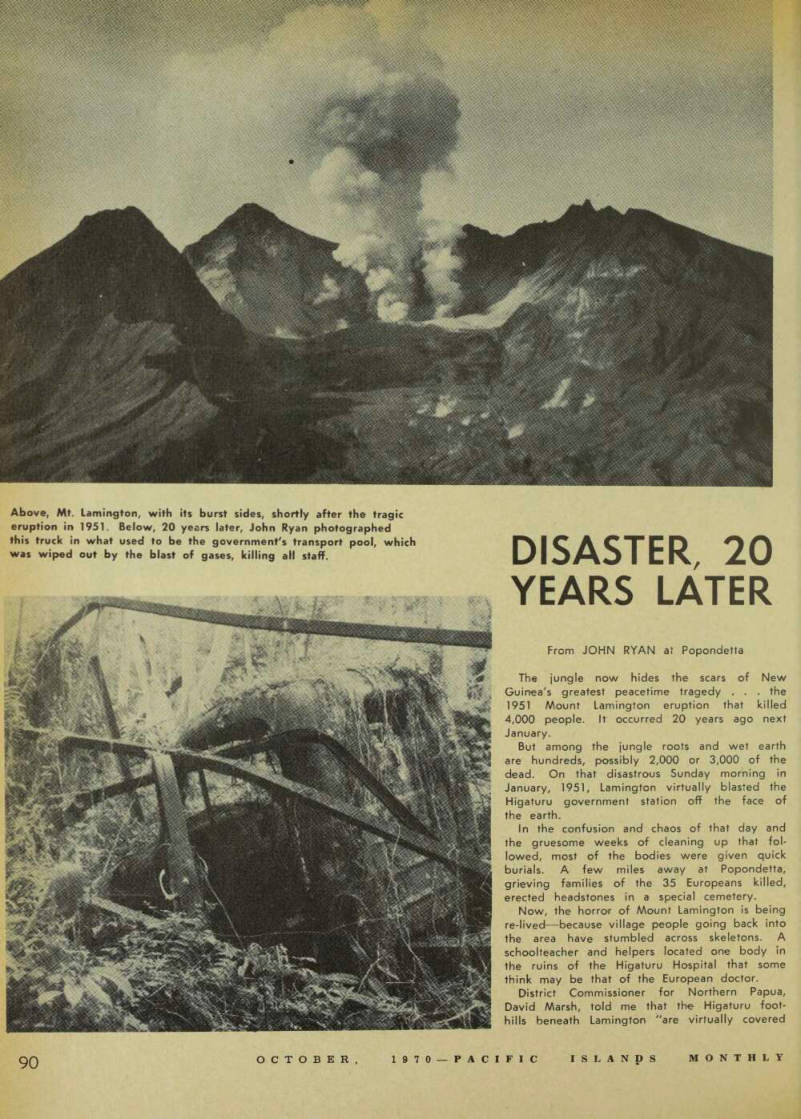
Above, Mt. Lamington, with its burst sides, shortly after the tragic eruption in 1951. Below, 20 years later, John Ryan photographed this truck in what used to be the government's transport pool, which was wiped out by the blast of gases, killing all staff.
with bodies —there was nothing much they could do straight after the explosion. It was a shambles".
Head of the Department of Public Health, Dr. R. F. R. Scragg, said many of the bodies were probably not buried properly because the volcano area had been declared (straight after the eruption) a dangerous place in which to live. Village people had stayed out of the area for many years. Now, some were going back.
District Commissioner Marsh: "The discovery of these remains means we'll probably have to do something about it fairly quickly—maybe collect everything we can find, and put them in a mass grave.
"I'm thinking of a large, special memorial.
I'm not sure, but I doubt if many remains were buried in 1951 at Popondetta—the bodies just couldn't be identified."
The Higaturu Local Government Council and the Anglican Mission have been asked to help.
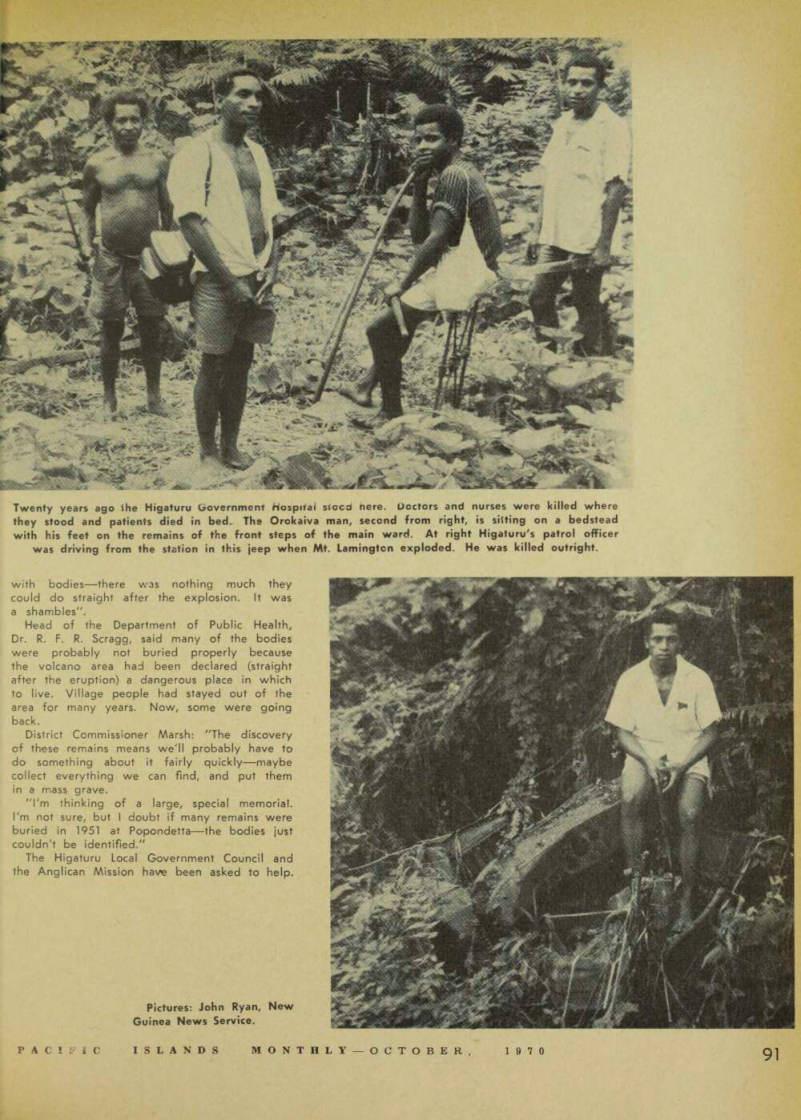
Twenty years ago the Higaturu Government Hospital stood here. Doctors and nurses were killed where they stood and patients died in bed. The Orokaiva man, second from right, is sitting on a bedstead with his feet on the remains of the front steps of the main ward. At right Higaturu's patrol officer was driving from the station in this jeep when Mt. Lamington exploded. He was killed outright.
Pictures: John Ryan, New Guinea News Service.
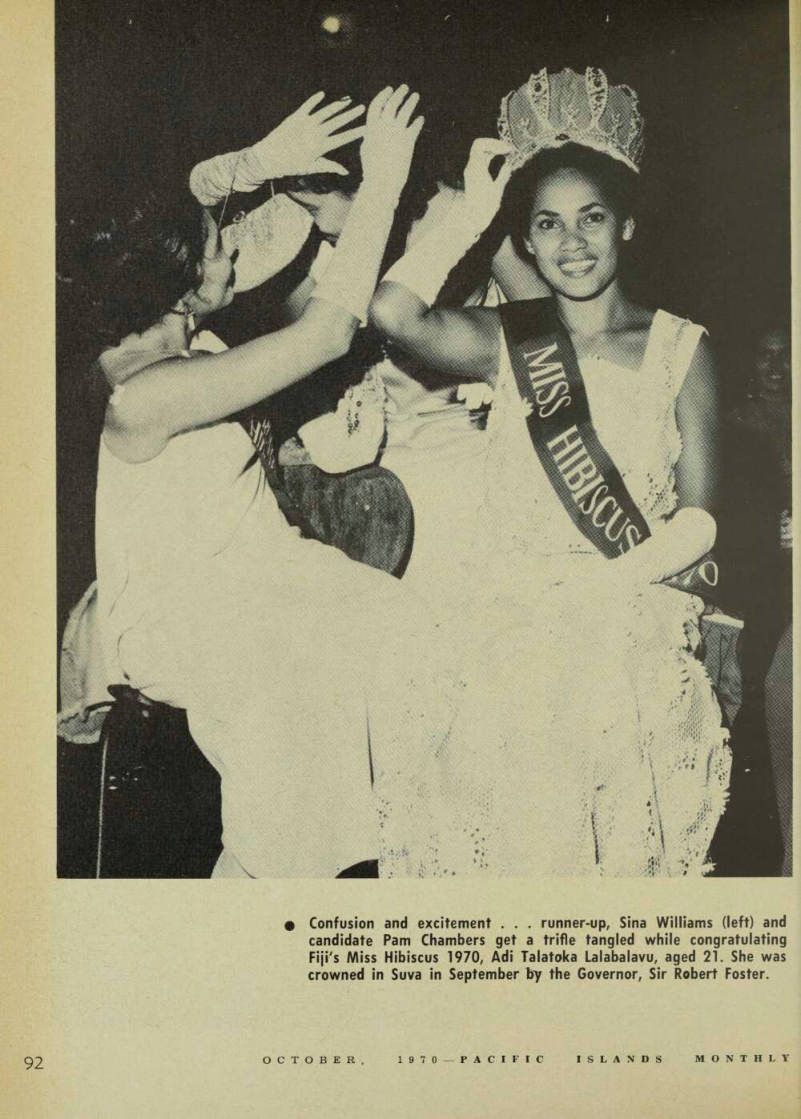
Confusion and excitement . . . runner-up, Sina Williams (left) and candidate Pam Chambers get a trifle tangled while congratulating Fiji's Miss Hibiscus 1970, Adi Talatoka Lalabalavu, aged 21. She was crowned in Suva in September by the Governor, Sir Robert Foster.