blank spaces
pp. 91-93 · Read in the full issue

Filling in New Guinea's blank spaces
Although the island of New Guinea has been known to Europeans since the early part of the 16th century when the Spaniards and Portuguese found their way to the spice-rich East Indies, it was not until the early part of 1965 that a party of young Australians succeeded in crossing one of the last blank areas in that “last unknown”.
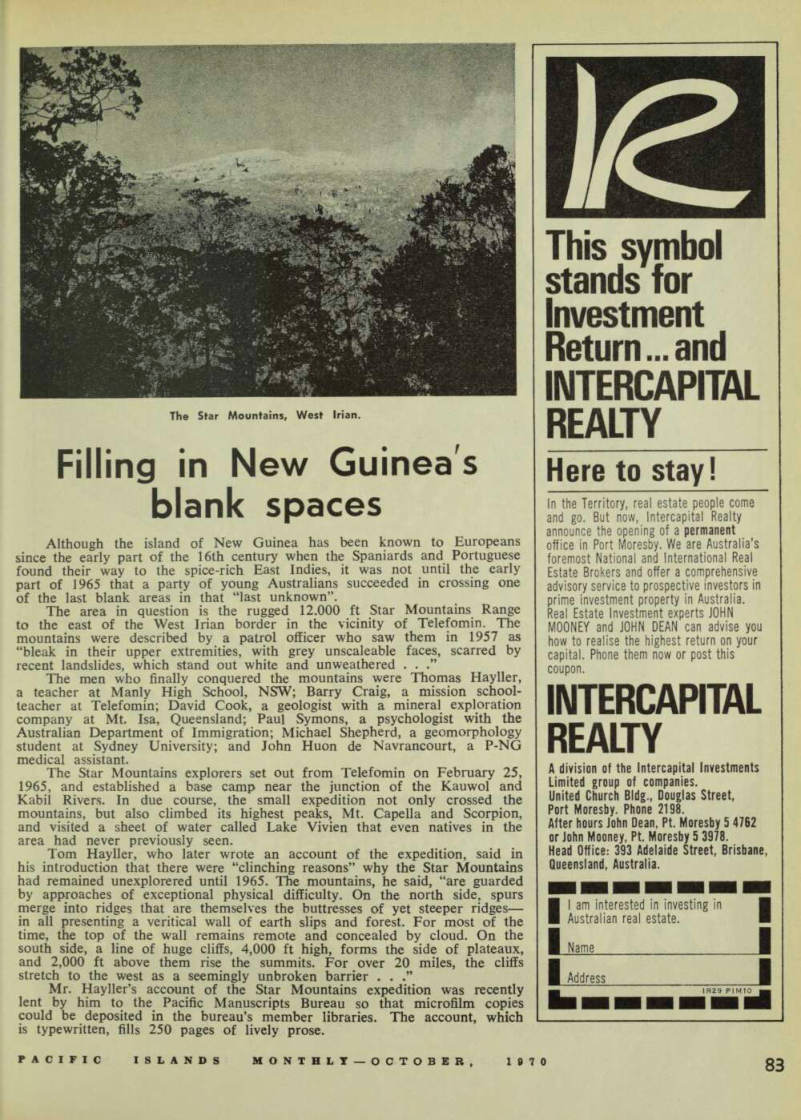
The area in question is the rugged 12,000 ft Star Mountains Range to the east of the West Irian border in the vicinity of Telefomin. The mountains were described by a patrol officer who saw them in 1957 as “bleak in their upper extremities, with grey unscaleable faces, scarred by recent landslides, which stand out white and unweathered . .
The men who finally conquered the mountains were Thomas Hayller, a teacher at Manly High School, NSW; Barry Craig, a mission school teacher at Telefomin; David Cook, a geologist with a mineral exploration company at Mt. Isa, Queensland; Paul Symons, a psychologist with the Australian Department of Immigration; Michael Shepherd, a geomorphology student at Sydney University; and John Huon de Navrancourt, a P-NG medical assistant.
The Star Mountains explorers set out from Telefomin on February 25, 1965, and established a base camp near the junction of the Kauwol and Kabil Rivers. In due course, the small expedition not only crossed the mountains, but also climbed its highest peaks, Mt. Capella and Scorpion, and visited a sheet of water called Lake Vivien that even natives in the area had never previously seen.
Tom Hayller, who later wrote an account of the expedition, said in his introduction that there were “clinching reasons” why the Star Mountains had remained unexplorered until 1965. The mountains, he said, “are guarded by approaches of exceptional physical difficulty. On the north side, spurs merge into ridges that are themselves the buttresses of yet steeper ridges— in all presenting a veritical wall of earth slips and forest. For most of the time, the top of the wall remains remote and concealed by cloud. On the south side, a line of huge cliffs, 4,000 ft high, forms the side of plateaux, and 2,000 ft above them rise the summits. For over 20 miles, the cliffs stretch to the west as a seemingly unbroken barrier . .
Mr. Hayller’s account of the Star Mountains expedition was recently lent by him to the Pacific Manuscripts Bureau so that microfilm copies could be deposited in the bureau’s member libraries. The account, which is typewritten, fills 250 pages of lively prose.
The Star Mountains, West Irian.
The sixth session of the South Pacific Commission was meeting in Noumea in October, 1950, —but it discussed only a narrow range of subjects compared with those being discussed at the meeting of the commission currently sitting in Suva 20 years later. The story of that meeting was one of many reports in that issue of PIM of 20 years ago. Here are others:
Sir Hugh Ragg announced his retirement from Fiji Legislative Council after 24 years of member ship.
Nauru residents were considering erection of a memorial to a previous Administrator, Col. F. R. Chalmers, who with others, was murdered on the island by the Japanese. And on Tarawa, a permament memorial had just been erected to 22 civilians, most of them New Zealanders, who were massacred by the Japanese on that island.
Retiring Commissioner for India in Fiji, Mr. S. A. Waiz, created a major sensation in a farewell speech in Suva by sharply criticising Indian political leaders in Fiji for main taining factional divisions “as a means to their own glorification”.
He said younger Indians were pro foundly dissatisfied with present Indian leadership and there was a strong chance of a revolt against it.
He also attacked Indians in Fiji for having failed to take their “full share in the defence of their adopted homeland” during the Pacific war.
“It is not good, and it ought not to happen again,” he said.
A Teal Solent flying-boat on October 5 inaugurated a Wellington to Sydney return service.
A company was being formed to produce beer in Port Moresby for territory distribution. The brewery eventually got going (and a second brewery is now being established in the territory).
Western Samoa was having a crime wave and there were demands for the police and courts to take more severe measures. There had been a number of murders and a correspondent reported that the crime outbreak “has caused a panic amongst women and children in Apia”.
Also in Western Samoa, planters were happy that cocoa had reached a record price of $335 fob Apia.
Port Moresby’s new weekly news paper, the "South Pacific Post”, was
pleading with the New Guinea Administration to acquire on behalf of Australia the remaining scrap metal and war disposals materials still being sold in New Guinea. PIM, in support, pointed out that the Australian Government was having to repurchase at great cost goods that had been taken away as war disposal purchases because there was now need for all kinds of material in the territory.
Papua and New Guinea was advertising for two Deputy Admin istrators at salaries between £2,000 and £2,500. (These two appoint ments were later known as Assistant Administrators, and in August, 20 years later, both positions were abolished and a single new appoint ment made of a Deputy Admin istrator).